Pablo

Pablo was born in Hollywood and raised in Los Angeles, the youngest of three. Football took him from Westchester High to L.A. Harbor College, then on athletic scholarships to the University of Hawaii and Utah State, before he earned a sociology degree from California Lutheran University. He spent more than 25 years in IT across insurance, healthcare, and county government. Pablos HelpDesk is where he writes about the habits and beliefs that actually hold up — backed by research.

Why I Deleted My Twitter Account with 7,000 Followers
Why I Deleted My Twitter Account (with 7,000 followers)

Hi everyone! About two months ago (April 2018), I deleted my Twitter account @celestinechua. I thought I should write a post explaining this as some of you have been asking me about it.

My Issues with Social Media

First off you guys know my stance with regards to social media. While social media used to be a great place for authentic conversations, it has become a very “noisy” commercial ground now. When I use social media as a content publisher, I feel like I’m just one drop in a very large ocean, where my comments have no impact whatsoever. There are just way too many — think hundreds of millions of — content creators on social media these days, with many using bots, digital assistants, and agencies to tweak every aspect of their social media messaging, so that they can get the best engagement and ROI for their posts.

This is vastly different than years ago, say in 2011, when I was having many authentic interactions with readers on Facebook and social media has not become the monster that it is now.

These days though, my notifications on Facebook and Twitter are either spam, some commercialized plug, or some pointless alert. It has become very tiring to log into my social media accounts each day with a bright red alert showing XX notifications, only to sieve through and see that they are pointless updates. I have talked about these issues in these posts: Why I Deleted My Facebook Page, Challenges that I’m Facing Today, and The Fear of Missing Out (I’ve since reinstated my Facebook page after deleting it in 2016, but I no longer actively maintain it).

Detroit Become Human: Hands in the Junkyard Scene

This is how I feel when I log onto social media and my inbox every day for the past few years (Image: Detroit Become Human; theRadBrad)

My Issues with Twitter

In the same vein, Twitter has become a frustrating experience for me in the past few years.

To begin with, most readers of PE do not follow me there. Many readers on PE don’t use Twitter, while those who do don’t connect with me using that channel. I think Twitter has a specific demographic and most PE readers are just not active Twitter users. Users who want to get my updates sign up for my mailing list (which is the official channel to get my updates btw — I post stuff that I don’t post here, including new courses and special messages). For anyone wants to send me a message, the contact form is the way to go.

Next, when I looked at my Twitter followers — about 7,000 of them — I realized that (a) this number has not been growing for the past two years, and (b) 99.9% of them are inactive or “dead.” “Dead” in that the users no longer use their accounts, or are following so many people that users like me who believe in tweeting less, not more, can no longer be heard anymore. Out of these 7,000, maybe only three people actively read and reply to my tweets (hi Charles, Ted, and Rick!). It became clear that my Twitter follower count has become a vacant number. While I was meticulously maintaining my Twitter account daily for the past few years and thinking that I was reaching 7,000 followers with every tweet, I was really shouting into a black hole.

Following this, I then looked at my Twitter messages. Over the years, I began to receive a high proportion of empty alerts, such as notifications of some company bot tweeting out my articles and tagging me, usually done to increase exposure of their account/business. Messages from content creators trying to network, expressing manufactured interest in what I wrote — but the reality is they are just trying to network to spread the word about their service. Nothing wrong with what they are doing, but when I check Twitter, I’m looking for authentic conversations with people who really read PE, not networking requests and solicitation. These are things that I’ve dealt with immensely for the past ten years, and I feel like I’m at a stage of my life (mid-30s) where I just want to move on and focus on creating content and live my life, not battle the same things that I spent my 20s dealing with.

Note that this issue is specific to me rather than most Twitter users. Running a large website has made me the target of an enormous amount of spam and solicitation requests. When I looked at my issues with Facebook, blog comments, contact form, and now Twitter, it’s the same thing — an enormous amount of spam, noise, and empty comments because of my blog’s visibility. While I used to get a ratio of 100% authentic messages to 0% noise in my messages, now it’s more like 0.01% authentic messages to 99.9% noise.

Frustration vs. Inspiration

After thinking about this, I realized the fundamental problem is that the social media and internet landscape has changed enormously since I started my website. Conversations online used to be authentic because people were using the internet in an authentic way then. These days, the internet has become massively commercialized, while abusers have a huge amount of power due to the democratization of technology and automation tools.

The answer, then, is to use social media in a way that enables me. I asked myself: If this platform is making me feel so frustrated when using it, should I continue using it then? The answer was clearly, a “no.”

To be honest, I felt a little surprised by my answer. Because having a Twitter account feels so basic, so essential today, something that every business owner must have. Every time you sign up for a new service, you will invariably be asked for your Twitter handle (and Facebook page ID). Not having a Twitter account is unheard of. It feels blasphemous. It feels like you are some backward, outdated business owner who is not in touch with his/her audience.

But is it true though? Because even when I was managing a Twitter account with “7,000 followers,” I didn’t feel like I was reaching anyone. Every time I tweeted something, I felt like I was throwing a coin into an abyss. I didn’t feel this way in the early years of Twitter — it’s only so in the recent years as social media morphed into some giant, monster entity. These days, I feel like everyone is shouting at the top of their lungs and commercial businesses have unlimited resources to micro-optimize every aspect of their presence, and social media is no longer the right place for me to connect with my audience: everyday people without a voice, people whom I want to speak out to and help.

In short, Facebook and Twitter were good ways for me to connect with my audience from the late 2000s to early 2010s, but not anymore as they have morphed into totally different beasts that favor quick engagement and short-form conversation. I have become tired of navigating these platforms’ ever-changing layouts and guidelines for outreach (particularly for businesses), and spending an exceeding amount of energy to maintain my accounts with very little return. The net conclusion of having a business account with these giants these days is that there are too many creators (many profit-focused over value-driven) with elaborate teams and assistants hacking the algorithms and getting their content seen by focusing on what the social media giants want (rather than what truly helps the user).

What I’m interested in is creating long-form, deep content on important life topics, and these are just not well-suited for their algorithms and landscape today.

“Death by a Thousand Cuts”

In retrospect, I should have closed my Twitter account much earlier. I feel like this is a case of “death by a thousand cuts,” something which I feel is very common in today’s social media world. When something is unpleasant, if the unpleasantness is on a very small level, you will usually tolerate it. What social media giants have done today is that they are delivering many little cuts slowly, over a long period of time. Tweaking the platform little by little, changing the rules every other day, altering the algorithm in a way that builds stickiness for them (but creates user fatigue), inserting little ads everywhere, and just making changes that maximize profit rather than create value.

Since these cuts are delivered little by little, most people don’t observe this. They continue to use the platform every day, addicted to it (an addiction that is carefully engineered by growth hacker teams). At the same time, the users start to experience other changes in their life: decreased productivity, mental fatigue, a general feeling of emptiness, but they have no idea that these are linked to their use of such platforms. So they stay on, getting sucked deeper and deeper.

I find this issue with Netflix as well (even though they have an active product which is video subscriptions) — I tried using it for the past month as part of a free trial from another service, and I find that it employs highly negative, dark design patterns meant to suck the user deeply into the platform. Not surprising since this is what many modern-day giants are doing.

When it comes to digital platforms today, figure out your needs and use them in a way that supports your needs, rather than the other way round where you change your life to fit their ever-changing rules and guidelines. I share more in 6 Tips to Deal with Digital Burnout.

Endnote

At the end of the day, I’ve spent the past few years trying to make sense of my relationship with social media and online tools. I don’t want to jinx this but I think I’m starting to reach a good place regarding this.

I have my Facebook page but I don’t actively maintain it anymore because of the reasons stated here. I no longer have Twitter and I’m happy to have gotten rid of it. As a Facebook personal account user, I use it in a way that supports my needs. I have my growing newsletter list where I can connect authentically with you guys, where I get authentic replies to what I send out (thank you to all of you who have been participating in my surveys and sending kind messages through the contact form!). There are still negative bad eggs every here and there, but I’ve come up with tools and ways to manage and minimize them to a near-zero instance.

In the meantime, I’ve been busy working on my next course (on how to discover your life purpose), based on your feedback to my email survey sent out a few months ago. I’ll be sharing updates via my email list when it’s ready, so stay tuned!

Check out:

The post Why I Deleted My Twitter Account with 7,000 Followers appeared first on Personal Excellence.
Read More

The Shiny Object Syndrome: How to Stay Focused and Stop Getting Distracted

The Shiny Object Syndrome: Stay Focused and Stop Getting Distracted

Have you heard of the Shiny Object Syndrome? It is the tendency for someone to chase something new — be it a new business idea, tool, or goal — rather than stay focused on what they’re doing.

It is similar to a child who is attracted to anything that’s shiny and new. I have a nephew who is 18 months old, and he is constantly attracted to anything that moves or emits sound. As a child approaches a new object that he’s never seen, he’s intrigued at first, but quickly loses interest as the item loses its appeal. He’s then attracted to the next new shiny thing, only to lose interest and seek the next new shiny object!

You know that you have experienced the shiny object syndrome if you belong to the following:

  • You have a list of business ideas but nothing gets executed.
  • You constantly start new goals but never see them through to the end.
  • You jump from one internet course to another, drawn by the wild claims of each course.
  • You frequently jump from one goal to the next rather than sticking with what you’re doing to the end.
  • You keep registering new domain names, even launching new websites, but you never work on building those sites.
  • You have a collection of plugins and tools, but you don’t actually use them.

The Issue with the Shiny Object Syndrome

At the heart of it, the issue with the shiny object syndrome is distraction. Being constantly drawn to new ideas and tools, and abandoning important tasks in the process.

When you’re constantly distracted, a few issues happen:

  1. You never get things done. That’s because you’re always on to something new, rather than completing your current plans.
  2. You spend too much time on new ideas and fancy tools, of which 95% are noise, rather than building the fundamentals.
  3. You become a jack of all trades, master of none. That’s because you don’t spend enough time to become good at something. There is a difference between a Beginner vs. Intermediate vs. Veteran vs. Expert, and you spend too much time being a Beginner since you’re switching focus and learning things from scratch all the time. This is different from the talent stack, which means being good enough in a variety of skills, hence giving you an edge over others.
  4. Because you never get good enough at something, you never reap the market leader rewards. The market leader effect is the phenomenon where the winner takes all. Most people will only ever know the top leaders in each industry, and hence market leaders often enjoy a huge lead in market share over everyone else. When you’re constantly chasing new things, you spend too much time learning the basics of each tool, each skill, rather than building on your skills. This causes you to miss out on market leader gains.
Market Sales Chart (Market Leader Effect)

When you are the best in your field, you enjoy significant gains — whether monetary gains, brand name recognition, or opportunities. This is the market leader effect. (Image: Personal Excellence)

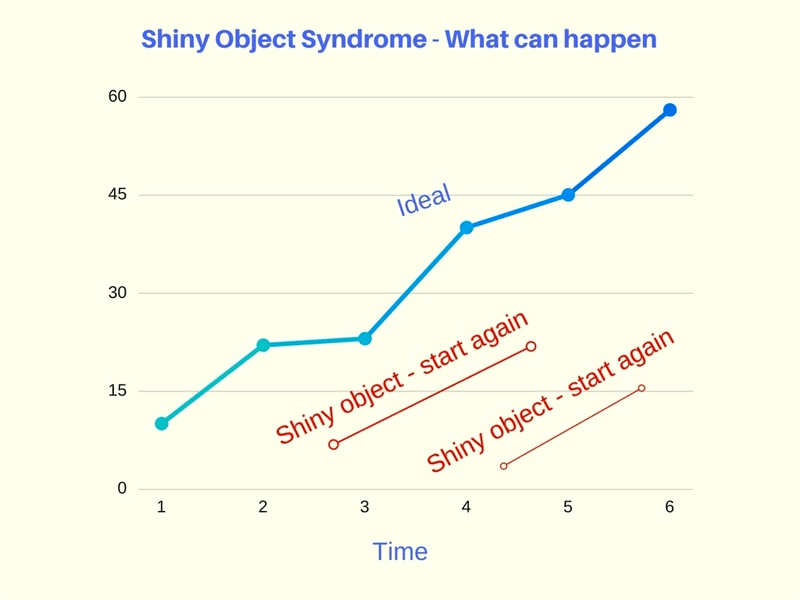
The Shiny Object Syndrome

But when you are constantly attracted to shiny objects, you never have the chance to become great at something. You’re always climbing the learning curve for each new thing you chase. (Image: Jan Sullivan)

How to Avoid the Shiny Object Syndrome: 7 Tips

So how can you stay focused and avoid the shiny object syndrome?

  1. Understand that new does not mean better. To be clear, addressing the shiny object syndrome is not about ignoring every new thing. In today’s world, it is important to keep in touch with the latest trends and updates. However, when all you do is follow every new tool and idea, you waste your time chasing trends rather than getting things done. Understand that new doesn’t mean better. Just because a company just launched something new doesn’t automatically mean that it’s better.
  2. Learn to see past the hype. There are constantly new, shiny objects in the online world. New startups, new products, new services. On social media, seeing raving reviews creates a mob mentality where you feel the need to jump in and follow what others are doing.

    But see past the hype. While people may brag about how great a product/service is, what’s good for others may not be good for you. Even though a company can promise the world on what their product can do, many startups, ideas come with birthing pains and issues. Rather than jump headfirst into something, question how it fits in with your priorities.

  3. Assess its fit with your work (and life). Before jumping into a new idea or tool, assess its fit with your work and life. Don’t follow what others are doing just because it’s the hottest thing now — it’s not sustainable. Ask yourself,
    1. Is this what I really need?
    2. Will it add value to my work and life?
    3. What are the pros vs. the cons of doing this?

    Only do something if it’s what you need and it adds genuine value to your work and life. Just because others are doing something doesn’t mean you have to.

  4. Improve your signal-to-noise ratio. The best way to manage distraction is not through discipline, but by managing the sources of distraction. When you are part of groups and newsletters that keep recommending new products, new offerings, it disrupts your focus and train of thought. You have to deal with the mental load of looking up each recommendation, assessing if it’s good for you, and making a decision about it. This is known as cognitive load, something that I mentioned in my How to Say No podcast.

    Instead of sieving out noise which takes up precious mental energy, remove low-quality information sources. Evaluate your social media news feeds, Facebook group memberships, email subscriptions, and RSS feed subscriptions. What is your noise-to-signal ratio for each channel? Noise refers to information that’s irrelevant to you, while signal refers to information that’s useful and relevant. A high noise-to-signal ratio means the channel has a high proportion of unhelpful, irrelevant suggestions (noise) vs. helpful suggestions (signal). Unsubscribe from groups and newsletters with a high noise-to-signal ratio. Get your information from sources with a high signal-to-noise ratio instead.

  5. Understand the concept of switching costs. Even though there are new tools released all the time, I only look into a new tool when (a) it has something that my current tools can’t provide, and/or (b) there are very strong reviews from multiple sources. Otherwise, I simply take a cursory glance at what’s available and return to my work priorities.

    One reason is that when you shop even though you don’t need anything, you’re invariably going to end up buying something. The second reason is switching costs, which are invisible costs incurred as a result of switching to something new. Switching costs can be monetary. They can be the time taken to learn a brand new system. They can also be the mental cost of changing your focus. When you keep switching to new ideas, new projects, and new tools, you are just incurring switching costs all day long and getting nothing done. Always factor such costs in when you are enticed by a new idea or tool.

  6. Adopt a “wait and see” approach. When you’re unsure, it helps to adopt a “wait and see” approach. With rapid technological changes today, many tools tend to become obsolete after a couple of years. For example, many WordPress plugins are no longer supported or have died out. Products that claim to be the best often get replaced by better products one to two years later.

    My personal approach when I feel 50/50 about something is to wait and see. If it’s a new tool, I take the chance to look at the company’s background, preview the tool, and assess if I really need it. For new online tools, there are often integration issues and unknown bugs, and it can be costly to be an early adopter if you already have a live business with customers. Unless this is something that I need to use now and I have no other alternative, I find that “waiting and seeing” a much more prudent approach.

  7. Differentiate between shiny objects and real opportunities. Last but not least, learn to differentiate between shiny objects and real opportunities. Shiny objects are things that look good and exciting, but are really distractions at the end of the day. There are many new products these days that look promising but don’t add value to your work and life. By the time you are done with it, you realize you have no need for that tool — after which you get distracted by another shiny object.

    Keep a watch out for real opportunities — and be ruthless in saying no to shiny objects. Real opportunities make a real impact in your work. For example, tools that dramatically improve your workflow. Tools that help you grow your business. Tools that help you better engage with customers. Tools that help you deliver better products and services.

Have you been distracted by shiny objects? It’s time to get your focus back on. Get clear on your big rock priorities, invest your 10,000 hours, and pursue ideas that make a real change. Let’s get a move on and work on our real priorities! 🙂

Read:

The post The Shiny Object Syndrome: How to Stay Focused and Stop Getting Distracted appeared first on Personal Excellence.
Read More

The True Meaning of Wisdom

By Deepak Chopra, MD

For centuries a quality has existed that is referred to as wisdom. A phrase like “wiser heads prevailed” implies that wisdom can save us from stupid or foolish actions. Elders were once considered wise, and so were philosophers. But once you bring up these references, wisdom feels antiquated and irrelevant. Who are the wiser heads in our day? Aside from a revered figure like the Dalai Lama, it’s hard to name one, and he is really a spiritual figurehead more than the classic wise man.

Whatever wisdom might be, the average person doesn’t think about it very much, if at all, and when you consider the problems that feel the most disturbing—climate change, terrorism, racism, poverty, and international tensions, for example—nobody is clamoring to call on wisdom to solve them.

But maybe only wisdom can. Let me explain what I mean.

Every problem, not just the big global ones but problems in everyday life, get solved by using a mental model. This model explains what has gone wrong, which is the first step in making things right again. Consider a common problem like feeling depressed. In our time we apply a medical model and send the depressed person to get help from a doctor, who will prescribe an antidepressant, or to a psychologist, who will apply some kind of therapy.

In the past, other models would have offered a very different explanation of why someone is depressed. Instead of calling depression a mental disorder or a psychological malady, which leads to trying to understand the person’s brain, depression would have been considered a lack of personal discipline or a moral failing. A depressed person in another model would be considered possessed by evil spirits or punished by God for some hidden sin. It’s strange to think that depression might be treated using everything from bleeding to exorcism, but such is the power of mental models.

Models fool people into believing that they are true. In modern society, the general belief that depression is an illness like catching a cold or contracting cancer feels so certain that few would disagree. But in fact, the disease model is not always workable in depression. The action of popular antidepressants on the brain isn’t certain and may be totally misunderstood. You cannot reliably predict who will get depressed, and quite often depression comes and goes on its own for no reason anyone can explain.

If your model doesn’t predict things correctly, leads to haphazard solutions, and depends on unproven assumptions (in this case, the assumption that depression is a brain problem), it’s not a model that matches reality. In modern life, we rely on a model of reality that has three components or levels.

The first level is data, which we collect and assemble into facts. Facts are supposed to match reality, but thanks to the human gift of rationality we now have so-called “alternative” facts, that are really just stubborn opinions that refuse to be rational.

The second level is information. Information consists of the conclusion that the data reveals. If your blood test comes back with an abnormal blood sugar reading (fact), your doctor might inform you that you are diabetic (conclusion). But in many cases of other disorders doctors and other experts frequently disagree. The same information can often lead to opposite conclusions.

The third level is knowledge, which consists of understanding. You are a knowledgeable doctor if you went to medical school and acquired the knowledge of diseases and how to treat them. Knowledge is the summit of the scientific or rational model. Data gives us the facts; facts assemble into correct information; information, when absorbed as knowledge, allows any problem to be solved, any question to be answered.

And yet knowledge also breaks down; in fact, it breaks down all the time. A good example is diets. There is enough information out there about the failure of diets to show that they don’t work, but the fact that only around 2% of dieters can lose five pounds and keep it off for five years doesn’t inhibit the massive lucrative diet industry. We know all kinds of things where our understanding is futile: carbon emissions warm the planet, women are equal to men, wars have no upside. Gender inequality, global warming, and violent conflicts run amok, not for lack of understanding—after all, the data, facts, information, and knowledge about these problems are irrefutable—but because the current model has failed.

What do people do when their cherished model of reality breaks down? They cling to it even harder and continue to do the same old things that have never worked. Science, the ultimate icon of the rational model, clings to the totally unproven notion that the brain creates the mind, for example, and if you say that this model has lots of problems, a brain scientist will ignore your objections. He clings to his model because it seems good enough, despite its inconsistencies, and his job depends upon it.

Enter wisdom. Wisdom has grown scarce for the simple reason that it follows no model. Socrates made the point, and it got him into a great deal of trouble, that wisdom cannot be taught. You can teach data collection, the amassing of facts, and many branches of knowledge, but wisdom stands apart. True wisdom leads to such things as insight, intuition, depth of experience, self-awareness, and humility before mysteries that will never be fully comprehended.

Because wisdom contradicts the certainty that models try to give us, it has had a hard time in society, as the death of Socrates shows. Society defends its favored and cherished models (which can be mythical, religious, animistic, scientific, and so on) with ferocity; certainty is not to be flouted. Wisdom calls for a totally different way of looking at reality. I will argue in the next post for taking the road back to wisdom. It is the only way to fulfill the infinite potential that human beings possess, and on a global scale, it is the only way we will reach desperately needed solutions.

(To be cont.)

Deepak Chopra MD, FACP, founder of The Chopra Foundation and co-founder of The Chopra Center for Wellbeing, is a world-renowned pioneer in integrative medicine and personal transformation, and is Board Certified in Internal Medicine, Endocrinology and Metabolism.  He is a Fellow of the American College of Physicians and a member of the American Association of Clinical Endocrinologists. Chopra is the author of more than 85 books translated into over 43 languages, including numerous New York Times bestsellers. His latest books are The Healing Self co-authored with Rudy Tanzi, Ph.D. and Quantum Healing (Revised and Updated): Exploring the Frontiers of Mind/Body Medicine. Choprahost a new podcast Infinite Potential available on iTunes or Spotify  www.deepakchopra.com

Read More

Positive psychology—with Martin Seligman

During the 1960s the field of psychology focussed on the science of how past trauma creates present symptoms, and how to reduce people’s misery. Professor Martin Seligman wanted to change that focus. He’s become known as the Father of Positive Psychology, and he’s had a profound influence worldwide. In Part 1 of our 2 programs with Martin Seligman, hear him address an exclusive audience in Australia on happiness and human flourishing.

Read More

8 Habits That Can Really Change Your Daily Life

You’re reading 8 Habits That Can Really Change Your Daily Life, originally posted on Pick the Brain | Motivation and Self Improvement. If you’re enjoying this, please visit our site for more inspirational articles.

habits that can really change your daily life

Your mind decides your altitude. Jack Canfield, an American author, and entrepreneur has said – Successful individuals do not simply drowse off to the highest. Obtaining there needs targeted action, personal discipline and plenty of energy daily to create things happen. And he could not be a lot of correct.

So, do not let ancient habits hold you back. Begin setting up these easy yet necessary habits for a more joyful and increasingly beneficial life:

1. Say Thanks

Having a constant gratefulness habit has several verified health advantages like high relationships, more noteworthy mental and physical health and higher self-respect.

So whenever you see something that you admire having in your life, keep a silent yourself or perhaps a not speechless when suitable – thanks. Be it a short conversation with an unknown person, a sapid meal, a reliable vehicle, a useful fellow worker, no matter it’s for you – say thanks.

2. Continue to keep a daily journal

Like contemplation, you do not have to be compelled to log multiple journal pages each day to be generative. However, obtaining your unchanged thoughts out on the page habitually notwithstanding for only a couple of minutes or one-page value continues to be extremely helpful.

Journaling clarifies your mind for the day, keeps your brain in innovative mode, enables you to mark out purposes for the day, assists you achieve them and an additional also, it is relaxing.

3. Take exercise regularly

Notwithstanding all the physical advantages of daily exercise, moving your body has numerous psychological and emotional advantages also. Improved confidence, a lot of energy, enhanced brain power, diminished pressure, and better sleep are only some of the mental advantages of having a daily exercise schedule.

If you’ve got access to a gymnasium and utilize it, it’s great. If it is not, don’t be worried. Only ten to a half-hour of moving, yoga, walking or reinforcing with light weights will give all of the equivalent benefits of figuring out at a gymnasium.

4. Hear uplifting music or play a musical instrument

The nature of what you consume without a doubt influences your energy and mindset. Media filled with negativity may adversely influence your temperament and health, yet higher vibration media can make active and do well you.

Attempt starting your day by abstinence from social media and TV. Rather, put on some great music to go with your morning schedule or commute. If you do not get the music you like already, find out positive music or motivational video from online.

On the other hand, you can play any kind of musical instrument. If you have, it’s OK. If you don’t have, you can buy a guitar, ukulele, piano or any other musical instrumen that you like best and play at any time of the day for only 15-30 minutes.

With motivating music or playing a musical instrument in the background, you will find your regular tasks are very enjoyable.

5. Work on Morning Meditation

A meditation practice does not require to be a half-hour in length to be helpful. In fact, 5 minutes of sitting quietly along with your eyes stopped whereas concentrating on your breath, worship, or mantra can diminish pressure and nervousness, decline blood glucose, enhance brain, and promote positive thoughts.

6. Read books

Reading books could be a good way to achieve knowledge and awaken creativity. Plunge reading also promotes focus and contains a calming impact the same as meditation. In addition, reading before sleep will assist you to sleep higher. Non-fiction books, specifically, are a wonderful tool to widen horizon, improve new thoughts, look for inspiration. In addition, they also provide an actionable recommendation on a way to exceed all types of difficult circumstances through true-life examples.

7. Encircle yourself with positive people

Jim Rohn, the American author, and entrepreneur said – “A person is the average of the 5 people he spends the most time with”. This can be exactly why you ought to deliberately think about whom you are expending time with. Let go of friendships that pull you down rather than lifting you up. And expend time with people who understand how to support and share the delight. As happiness is infectious, it is one of the simplest ways to make positivity in your life.

8. Keep positive

It’s anything but difficult to think about how remaining positive can enable to create your life better. Well, consider about it this way – once you are positive, you manage frustrations better and are consequently more possible to conduct pressure in a very healthy manner. This alone is sufficient argument to find out a way to keep positive particularly while everything feels to be falling down.

Remaining positive additionally suppresses your dread of making an attempt out new things. An individual with a positive mood will be more valiant about applying for that activity and since we all know, confidence is essential throughout these interviews.

Positive thinking results in more sound living as people are increasingly worried about what’s beneficial for them and what is not. So, positivity is a more helpful quality than you might imagine.

Some simple habits have the highest influence, therefore don’t be worried about creating life-changing choices overnight. Change is continuous and it occurs through frequent motions that we tend to habits.

You’ve read 8 Habits That Can Really Change Your Daily Life, originally posted on Pick the Brain | Motivation and Self Improvement. If you’ve enjoyed this, please visit our site for more inspirational articles.

Read More

The Ways in Which Shyness Affects You, Based on Your Personality Type

The Ways in Which Shyness Affects You, Based on Your Personality Type Shyness is something which introverts and extroverts can both experience, and isn’t simply tied to those who keep to themselves or are drained by too much interaction. There are plenty of shy extroverts, or outgoing introverts, and so these qualities are not mutually […]

The post The Ways in Which Shyness Affects You, Based on Your Personality Type appeared first on Personality Growth.

Read More

How to Identify Your Creative Block and Succeed

There is untapped creativity inside you that will enrich your life if you learn to identify and remove the creative blocks in your way. Identify Your Creative Block and Thrive! By Lien Potgieter      Untapped creativity is detrimental to your life, relationships, business, and career. If you believe that you are not creative or that there is no need for creativity, you could even become obsolete. According to the World Economic Forum, the Future of Jobs report creativity will be third on the list of the top ten critical skills by 2020. In the short space of just five years, creativity has moved up seven places from ten to number three. You can increase your creative intelligence (CQ) despite the outdated notion that people are either right- or left-brain dominant. New research shows that we need to use both sides of the brain to be successful. Unconventional paths often lead to brilliant solutions. Color, which you find all around you, could act as a catalyst to identify what exactly is causing you to feel, think or believe that you can’t connect the dots. Many problems can be solved, and challenges overcome with the help of these vibrational energies.   How can color help? By becoming aware of the colors in your environment, you can pinpoint your creative block. It is a simple yet powerful method. Your color attractions and rejections demonstrate where you are stuck: Physically, emotionally, mentally, or spiritually. Only when we know what the heart of the matter is can you take action, unblock your creativity, and live a life of success and happiness.   Tell-tale signs of a creative block and how to overcome it How do you know where the block is? Here are a few signs to look out for. Body: If your block has a…

Continue Reading

Read More

Let go of burdens

During meditation, we should not develop a mind which accumulates and holds on to things, but instead we develop a mind which is willing to let go of things, to let go of burdens. Outside of meditation we have to carry the burden of our many duties, like so many heavy suitcases, but within the period of meditation so much baggage is unnecessary. So, in meditation see how much baggage you can unload. Think of these things as burdens, heavy weights pressing upon you. I like to begin at the very simple stage of giving up the baggage of past and future.

Abandoning the past means not even thinking about your work, your family, your commitments, your responsibilities, your history, the good or bad times you had as a child…, you abandon all past experiences by showing no interest in them at all. As for the future, the anticipations, fears, plans, and expectations let all of that go too. This future is known to the wise as uncertain, unknown and so unpredictable. It is often complete stupidity to anticipate the future, and always a great waste of your time to think of the future in meditation.

When you have abandoned all past and all future, it is as if you have come alive. You are here, you are mindful. This is the first stage of the meditation, just this mindfulness sustained only in the present.

Ajahn Brahm, Sustained Attention on the Present Moment

Read More