7 Ways to Deal with Insecurity and Uncertainty In A Relationship

This purpose of this article is to show couples how to deal with uncertainties and insecurities in their romantic relationship. This piece considers research studies that talk about how insecurities can trigger problems in an otherwise healthy relationship. Further cited research shows couples how to build trust and the important role that oxytocin plays in increasing trust between partners. Communication, comparisons to past relationships, and changing one’s perspective are also touched on in this article. How To Deal With Uncertainty And Insecurity In A Relationship By Sylvia Smith     Relationship uncertainty is an unpleasant feeling to have when trying to pursue something serious with a partner. If an individual is feeling uncertain or insecure about their partner, it could mean they don’t fully trust their spouse. It may also be a sign that they are feeling anxious about where the relationship is going. Or it could mean nothing at all. Insecurity can spring from past relationships or from seemingly nowhere at all. Even if a person believes they’ve found the person they want to spend the rest of their life with, insecurities can trigger doubt and create problems in a once healthy relationship Entering a new relationship should be an exciting, happy time in a person’s life. But for those who have had bad romantic experiences in the past, starting over can be a stressful experience.   How Uncertainty Ruins Healthy Relationships When an individual is experiencing uncertainty or insecurity in their relationship it can quickly create disharmony between partners. To begin with, not knowing where the relationship is going creates a lack of accountability between spouses. Can they trust that their partner is being faithful? If one were to lose their job, could they rely on their spouse to help carry the load? Without knowing how each partner feels about…

Continue Reading

Read More

Following Another’s Vision of Success

Question:

I am 31 years old. Married. My father has been an extremely successful person in his life, professionally and personally. I have a younger brother who to is heading in my father footsteps in his life and career which makes us all very happy and proud. My wife is an extremely talented, intelligent and hardworking woman who has her dreams and aims and which she is extremely capable of achieving. Among all this happy scenario, I am stuck in a life which seems to be going nowhere. Career wise I am going nowhere in spite of putting in my best efforts and success seems to be indifferent to me. I cant leave this job for certain reasons which are beyond my control for at least another 10 years. And by then I think it will all be too late for anything. What seems to be easy and ordinary for other people just doesn’t happen to me. all along in my conscious memory my life has been a string of failed attempts, so near yet never there episodes. I have repeatedly tried to put my failures aside
and work harder but still it has been for nothing. I am a believer but of late have started feeling that even God has turned a blind eye to my situation. I really feel desperate for some miracle to pull me out of this gloom but I don’t know whether that will ever happen. I feel my life is just running out without any purpose. I have tried taking solace in good books to find my answers but to no avail. I hate to be in this kind of melancholy but don’t know what to do. I feel that I am wasting my wife’s life too because of my situation. I am not sure if anyone will have any answers. What do you think? Is there hope?

Read More

Build Self Confidence

This blog has many tips on how to build self confidence. I wrote a post 20 ways to build self confidence some time back. I now find there is even a video based on an article I discussed in that post!

[youtube https://www.youtube.com/watch?v=ZLAogkva-Ok?rel=0]

My main criticism remains – walking faster and sitting in the front row are rather weird suggestions and hardly likely to have the desired effect.  If you lack self confidence you will feel very self conscious sitting in the front and feel worse.  There is no guarantee you will eventually get over that and feel more confident.

Feeling the fear and doing it anyway – as in Susan Jeffers book title – doesn’t work for everyone.  If you go along this route its about coming to terms that we have learnt to feel fear and associate it with that activity.  And, unless you are short sighted or hard of hearing, what actually do you achieve by sitting in the front?

Gratitude builds self confidence

Ironically the video misses the best tip in the original article – having gratitude:-

When you focus too much on what you want, the mind creates reasons why you can’t have it. This leads you to dwell on your weaknesses. The best way to avoid this is consciously focusing on gratitude. Set aside time each day to mentally list everything you have to be grateful for. Recall your past successes, unique skills, loving relationships, and positive momentum.

build self confidence, gratitude for family

gratitude for having family

This is something I do everyday in a form of journalling.  The first step I take is to reflect upon what I have to be grateful for. This can vary from family and friends to aspects of the environment around me – the sea, forest, the crazy weather we have (can’t remember who said it, but “never judge the day by the weather…”).

This list doesn’t have to be big things, and it certainly doesn’t have to be unique.  You’ll end it constantly repeating things like your good health and the men, women and children in your life.  But don’t forget the little stuff or more obscure  – being able to hear the birds sing, being able to walk/see/taste/smell,  living in a country where I can voice my opinion/vote, watching a comedy show on TV last night.

Even the things we moan about,  such as expensive car bills, can be turned into gratitude – at least you can afford a car. Reminds me of a favourite quote:-

I cried because I had no shoes until I met a man who had no feet.


Read More

7 Practical Tips For Boosting Your Self-Esteem

I’m forever coming across short articles or blog posts with seemingly useful tips.  But can such brief tidbits of information really do any good. For instance, with this article will any of the tips really “boost” you self esteem?

7 Practical Tips For Boosting Your Self-Esteem

by Ricky P O’ Shea

Having healthy self-esteem is the building blocks for happy, vibrant living. It means you have confidence in yourself and your abilities whereas as having low self-esteem can mean you lack confidence in yourself and never reach your true potential.

The good news is that if your self-esteem could do with a boost then there are small changes that can make a big difference. It all starts with reprogramming your beliefs and weeding out the negative inner-dialogue. To help you get started, consider the following tips for boosting your self-esteem.

Selective ignorance

The feedback and solicitations from others can greatly impact your own state of being. Choose to source your information wisely, limiting negative media in place of more positive media such as seminars or educational activities. Surround yourself with others who are positive and bring out the best in you and avoid allowing the negativity of others to affect your own judgement.

Comfort Zone

If we don’t push ourselves outside of our comfort zones then we have nothing to build on. You’d be surprised what you can achieve if you put your mind to it so take the plunge once in a while and take on new challenges. In doing so you’ll naturally grow in confidence and give your self-esteem a much-needed boost.

Negative Inner-Dialogue

Our inner-dialogue greatly influences our reality! If your inner-dialogue and thought patterns are generally negative then your self-esteem is bound to be lower. Weed out any negative thought patterns such as “I can’t” or “I’m not good enough” and replace them with positive ones instead.

Positive Affirmations

Affirmations are extremely effective for overcoming limiting beliefs. By repeatedly stating something to yourself you can slowly empower yourself with positive thoughts and beliefs. You can find many resources for affirmations online but the real key is to make them present tense, positive and stating an outcome you desire.

Stop Comparing

Media and society in general has a knack at making us feel we need to fit in. However, this simply isn’t true! We are each unique and each have our own set of strengths and weaknesses. Avoid feeling inadequate by comparing your weaknesses against others and focus instead on developing your strengths.

Accept Compliments

It’s easy to assume someone is lying or has ulterior motives when you’re passed a compliment but more often than not it’s genuine. Learn to accept compliments gracefully in order to strengthen your confidence. It will also help you to discover what you’re good at so you can further develop your strengths.

Reward Yourself

We often neglect to acknowledge our achievements and pass them off as something not worth gloating about. But, your achievements, no matter how trivial they seem, should be rewarded. It’s important to remind yourself that you’re a valued person and that you deserve to be rewarded and acknowledged for your achievements.

Wrapping It Up

In this article we’ve covered a few simple but effective ways to boost your self-esteem. Most important of all is reprogramming your beliefs and inner-dialogue. If you weed out the self-limiting thought patterns and replace with positive statements your self-esteem will naturally grow.

Facing a particularly traumatic phase in your life?

If so,then try these 3 painless strategies for overcoming low self-esteem during trying times.

http://path-to-happiness.com/confidence/self-esteem/how-to-overcome-low-self-esteem/

Article Source: EzineArticles.com

Simple huh! Unfortunately “reprogramming your beliefs and inner-dialogue” isn’t that simple. Learning to accept compliments and rewarding yourself are good habits to get into and over the long term will help. I’m a great believer in stepping outside your comfort zone, but this is more of a benefit for self confidence rather than self esteem. I’m not sure how realist this “surrounding yourself” with positive people is, and there is eveidence that positive affirmations can be counter productive.

Read More

Formal vs. Informal Power: Two Paths to Social Success

Social success has a lot to do with attaining and maintaining a position of power within a group, from which you can exert a large amount of influence. But not all power is created equal. When talking about this topic, I find it useful to make on crucial distinction: the one between formal and informal power.

Formal and Informal Power: Definitions

Formal power comes from the official position one holds within an organization or social structure. It is properly recognized by some type of written contract or official agreement, and regulated by a strict set of rules that everyone in the organization or social structure knows and must obey.

Formal forms of power exist in politics, business, religion, but also in social structures like a sports team or a student’s club. The manager of a company has formal power. So does the captain of a football team. This type of power changes as one’s official position within a structure changes, which is why many people compulsively seek to better their position.

Informal power comes, not from an official position, but from the respect and appreciation one has earned from the members of a group. This respect and appreciation allow the individual to influence his or her peers in a way that others within the group cannot.

Informal power comes from a person’s internal qualities. An employee may gain informal power in his department by being known as very competent and skilled in what he does. A person may gain informal power by having integrity and being trustworthy. And another person may gain informal power by being likable and charismatic.

The Power of Informal Power

Making the distinction between the two kinds of power is essential. Because many people simply aren’t aware of the existence or influence of informal power, and they blindly compete with others for the limited amount of positions that provide formal power. They wanna be managers, and leaders, and bosses, and CEOs. However, informal power is not only real, but it can often be much more valuable than formal power.

Here’s an example I’ve seen transpire many times while coaching clients within companies and corporations.

There is a manager of a department of a company, and he has formal power in that department, stipulated by his job description. In the same department, there is also a guy who is a simple employee, but who is known to be very skilled at his job. Everyone goes to him for advice, and he is eager to help. He is friendly and likable, he encourages others, and he knows everyone by name, while the manager doesn’t bother with such ‘details’ and acts more like a dictator than a manager.

In such a situation, the manager has formal power, but this employee has a lot of informal power. So much informal power, in fact, that it may be worth more than the formal power of the manager. For instance, this employee may have such good relationships with his colleagues, that if he leaves to another company, half of them would follow him. And his manager knows this. Such influence is no small thing, and a smart manager would make sure that such an employee is treated well, because otherwise he might do some real damage.

It’s just one type of situation, but informal power can trump formal power in many ways, in all kind of organizations and social structures.

Leveraging the Two Types of Power

So, while formal power is good and not something to ignore, after this analysis I hope it is clear that many times, informal power is even more desirable.

Ideally, you wanna have both forms of power within a structure. Also, achieving informal power first is often a great way to then acquire formal power as well. But even if you can’t acquire formal power due to heavy competition and political games, you may be better off by acquiring informal power anyway.

How do you attain informal power? It takes three key ingredients, to which I’ve already alluded above:

1) Competence. There is no doubt that people respect competence, especially in a field relevant to them. Members of a debate club respect good debaters; members of a sales team respect good salespeople. So getting good at what you do within an organization or social structure is a great way to earn respect, and thus informal power.

2) Character. Great leadership books and courses regularly talk about the value of character. But its role is much more important in acquiring informal power than formal one, because, like competence, in triggers respect, as well as trust. Being honest, having integrity, being fair, having confidence, being resolute, this kind of character traits will get you far within any group.

3) Social Skills. Your social skills play perhaps the most important role. You wanna be able to engage people in interesting conversations, be witty and funny, and make them enjoy your presence. If they like you, they are much more eager to follow your lead. You also wanna be able to speak in a way that persuades, inspires and motivates people, which directly gives you more informal power over them.

Fortunately, you can cultivate these 3 traits and use them to gain informal power incrementally. Each day you can put in some work, and each day you can see your informal influence rise.

For top practical resources to help you develop your character and social skills, first I recommend you check out this video presentation I created, in which I’ll share with you some top-notch techniques for boosting your social confidence and social skills, based on my 8+years of experience as a confidence and communication coach.

Also, join my free social success newsletter, to get regular advice from me on improving your social competence, career and social life. I’m certain you’ll learn a lot from it.

Read More

Trusting Inner Guidance

Question:

How can I get happy if I can’t trust my Inner Guidance?

I’m like a hostage needing to fall in love with it’s captor if I’m going to survive, while all the while praying to be rescued. I’m overboard emotionally and physically: depression; tiredness; exacerbated hypothyroidism from chronically getting “What I don’t want” and only recently learning the “why” of that.

I’m waking up from a life lived backwards. Clairvoyant, clairaudient, I’ve blindly followed the advice of my Inner Guidance for as long as I can remember. And the past 3 years, I’ve come to realize – wake up to – the fact that my Inner Guidance’s advising hasn’t been so loving. In fact, the “unhappy” I have in my life is because of having followed the advice of my Inner Guidance.

A few weeks ago, when I metaphorically inherited Unhappy and Bitter’s house, I realized I HATE my Inner Guidance. I realize we’re not playing on the same team and that I’ve been foolish to trust it, believe it. And it confirmed that that is so. It went on to say it doesn’t respect me … that it would have been braver for me to have died in childhood than have survived through becoming a people pleaser. Harsh!

Is Spirit this harsh to all clairvoyant/clairaudient’s wishing conscious contact? Do you know why I have such a mean, unloving Inner Guidance?

At the end of my rope (almost too literally) I want peace. I pray for peace. What I get is Inner Guidance’s acknowledgement of my making the wrong mental choices, or complex emotions to untangle myself from, or lies or false futuristic prophecies to ignore the fear of.

My people pleaser-ness in desperation, has tried to make peace with Inner Guidance, but honestly, what kind of peace can be had where there’s no trust? So accepting I no longer trust my Inner Guidance has been a hard acceptance to come to. And of course, Inner Guidance, hearing my everything, just dishes up more fear for me to find myself clear of. I dig myself out of Unhappy and Bitter, and IG drudges more. And it’s happening more and more. I feel emotionally controlled, dumped on, by Inner Guidance. The weeping, grief, and crying jags go on for days, and take me back to childhood and my shock and unfathomability at what appears to be my intrinsic inappropriateness.

I don’t know how much longer I can endure this kind of “spiritual” treatment. My grip on reality is waning in my confusion and cluelessness about what is happening to me and why. Inner Guidance says I’m doing the Great Work. Even gave me a bouquet of red and gold tulips in a meditation a few weeks ago. But I can’t tell the truth from the lies any longer.

In a recent meditation. Inner Guidance sent me a dolphin. I pet the heart-sick dolphin which spoke in an old old language I didn’t understand. And when I said I don’t understand you it said in PERFECT English, “Don’t worry. Be Happy.”

Abraham-Hicks say it takes a happy road to make a happy end. I want more than words can say to take this loosing hand of a life (having inherited Unhappy and Bitter’s house) and make it win. I see now how the deck has been so stacked against me from the very beginning by Spirit having used my Inner Guidance to create mayhem in my life against my trying to be “good.”

Each day, I get up determined to “BE happy” but succumb to the futility of that when I feel Inner Guidance laughing at me. I try to hold onto appreciating the present moment like your book THE WAY OF THE WIZARD says. As it turns out, the present moment is the only place I feel safe these days. But it takes a force of Will for me to stay there. Given I’m so tired, I’m hit and miss. And there’s Inner Guidance’s quick acknowledgement that I’m creating “MORE of what I don’ want.”

God is love. I’m love and I do the best to be the love that I am. If I could do better I would. As I live at the edge of the world in the Japanese countryside, in isolation and rejection, fearing what my Inner Guidance is going to do next to me, has become more than I can bear. I pray for help.

I probably haven’t learned the lesson that my Inner Guidance thought it was teaching. I’ve learned that although I don’t have the GREAT power and ALL KNOWINGNESS It does, in the least, I’m kind and allow others to be as they are, even when it’s to my detriment.

Know that I know you’re a very busy man and that I’m grateful and appreciative of whatever feedback/encouragement/advice you have to offer.

Read More

Three Ways Your Emotions Can Warp Your Decisions

Whether it’s sending a passive-aggressive email to a coworker, or not speaking up when you have a great idea, or even saying something rude when you should have said nothing at all, we’ve all made decisions we regret—and then tortured ourselves by thinking, “What if I’d made a different choice?” That’s where mindfulness comes in.

When we practice tuning in to the chatter of our minds and sweeping sensations of our bodies, and we learn seperate those triggers from the deep well of knowledge that is our innate awareness. By practicing mindfulness we slowly give ourselves permission to choose how we respond in the world. It’s pretty powerful stuff.

In this Big Think video, former Canadian intelligence officer Shane Parrish, creator of the website and learning community Farnam Street, shares three tips for making more mindful decisions:

[youtube https://www.youtube.com/watch?v=YW-LoBqmfIo?feature=oembed&w=500&h=281]

1) Don’t make a decision when you’re excited or frazzled

Many of us are guilty of making decisions in the heat of the moment—during a fight with our partner, in the middle of a stressful work meeting, or even when you’re over-excited. But Parrish says making decisions when we’re heated increases our chances of making the wrong choice.

“Our emotions spike, and that’s a signal to us that something’s wrong, or something is important to us,” he says. That’s a signal to pause. “We’ll do these things in the moment because we’re emotional, and then we sort of regret it.”

The next time you find yourself faced with a big decision while you’re caught up in the emotions of if all (whether that be intense joy and excitement, or anger and frustration), Parrish recommends placing some space between yourself and whatever it is that has you excited by going for a walk, or giving yourself the night to sleep on it. Doing so helps defuse high emotions, so you can calmly consider how you really feel.

“What I often do is I mentally decide, ‘Here’s my decision, now I’m going to sleep on it,’” Parrish says. “And then I’ll wake up in the morning and be like, how do I feel about that decision? Because I’ll trick myself into having made it. And if I have regrets, that’s a sign that I might want to think about that problem a lot more.”

2) Be aware of confirmation bias

Sometimes, we tell ourselves we are making a rational decision by taking the time to consider all options—but really, we only look at the information that confirms what we already believe.

Sometimes, we tell ourselves we are making a rational decision by taking the time to consider all options—but really, we only look at the information that confirms what we already believe.

“Our ego doesn’t often let this [other] information in, it doesn’t process it,” Parrish says.

To ensure we’re getting the full picture, Parrish recommends keeping a journal for a few days and making a note each time we discover something that opposes our own belief. Seeing all of the information in writing can help us make a more informed and well-rounded decision.

“Every time that something disconfirms with something that we think or we believe, that’s an opportunity to learn,” Parrish says. “Maybe they’re right, maybe they’re not. But to dismiss it out of hand without evaluating it is not doing ourselves justice towards outcomes.”

Pulitzer prize nominee, and bestselling author of Emotional Intelligence and Healing Emotions, Daniel Goleman recommends you check in on these five emotional intelligence competencies that help a leaders take the broad view and uncover their biases.

3) Be confident, not cocky  

You know that feeling of invincibility you get right before you do something you know you’re good at, only to find yourself in a cold sweat and not quite as prepared as you thought you were? That’s overconfidence. And while it may be harmless enough on a Friday night out with friends, it can cause serious damage when it influences decisions about your relationships or career.

“We take outsized risks. We believe that we have information that other people don’t have, which causes us to be overconfident, to do things that we otherwise wouldn’t do,” Parrish explains.

Pausing to recall a time you failed is one way to humble yourself. Another is to simply run your idea by another person, and ask them for their honest opinion.

“And once you start honing in on that, that’s an opportunity for learning,” Parrish says.

Of course, you don’t want to feel insecure and uncertain about everything you decide. But pausing to make sure you have all of the information before you jump head-first into a big decision, allowing time for your essential knowledge to bubble up, can help you be even more confident you’ve made the right choice.

The post Three Ways Your Emotions Can Warp Your Decisions appeared first on Mindful.

Read More

The Shiny Object Syndrome: How to Stay Focused and Stop Getting Distracted

The Shiny Object Syndrome: Stay Focused and Stop Getting Distracted

Have you heard of the Shiny Object Syndrome? It is the tendency for someone to chase something new — be it a new business idea, tool, or goal — rather than stay focused on what they’re doing.

It is similar to a child who is attracted to anything that’s shiny and new. I have a nephew who is 18 months old, and he is constantly attracted to anything that moves or emits sound. As a child approaches a new object that he’s never seen, he’s intrigued at first, but quickly loses interest as the item loses its appeal. He’s then attracted to the next new shiny thing, only to lose interest and seek the next new shiny object!

You know that you have experienced the shiny object syndrome if you belong to the following:

  • You have a list of business ideas but nothing gets executed.
  • You constantly start new goals but never see them through to the end.
  • You jump from one internet course to another, drawn by the wild claims of each course.
  • You frequently jump from one goal to the next rather than sticking with what you’re doing to the end.
  • You keep registering new domain names, even launching new websites, but you never work on building those sites.
  • You have a collection of plugins and tools, but you don’t actually use them.

The Issue with the Shiny Object Syndrome

At the heart of it, the issue with the shiny object syndrome is distraction. Being constantly drawn to new ideas and tools, and abandoning important tasks in the process.

When you’re constantly distracted, a few issues happen:

  1. You never get things done. That’s because you’re always on to something new, rather than completing your current plans.
  2. You spend too much time on new ideas and fancy tools, of which 95% are noise, rather than building the fundamentals.
  3. You become a jack of all trades, master of none. That’s because you don’t spend enough time to become good at something. There is a difference between a Beginner vs. Intermediate vs. Veteran vs. Expert, and you spend too much time being a Beginner since you’re switching focus and learning things from scratch all the time. This is different from the talent stack, which means being good enough in a variety of skills, hence giving you an edge over others.
  4. Because you never get good enough at something, you never reap the market leader rewards. The market leader effect is the phenomenon where the winner takes all. Most people will only ever know the top leaders in each industry, and hence market leaders often enjoy a huge lead in market share over everyone else. When you’re constantly chasing new things, you spend too much time learning the basics of each tool, each skill, rather than building on your skills. This causes you to miss out on market leader gains.
Market Sales Chart (Market Leader Effect)

When you are the best in your field, you enjoy significant gains — whether monetary gains, brand name recognition, or opportunities. This is the market leader effect. (Image: Personal Excellence)

The Shiny Object Syndrome

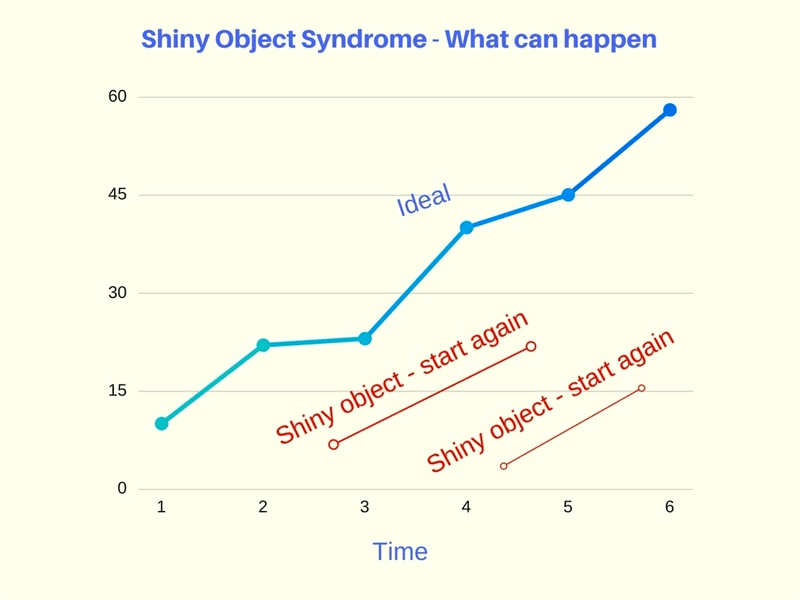
But when you are constantly attracted to shiny objects, you never have the chance to become great at something. You’re always climbing the learning curve for each new thing you chase. (Image: Jan Sullivan)

How to Avoid the Shiny Object Syndrome: 7 Tips

So how can you stay focused and avoid the shiny object syndrome?

  1. Understand that new does not mean better. To be clear, addressing the shiny object syndrome is not about ignoring every new thing. In today’s world, it is important to keep in touch with the latest trends and updates. However, when all you do is follow every new tool and idea, you waste your time chasing trends rather than getting things done. Understand that new doesn’t mean better. Just because a company just launched something new doesn’t automatically mean that it’s better.
  2. Learn to see past the hype. There are constantly new, shiny objects in the online world. New startups, new products, new services. On social media, seeing raving reviews creates a mob mentality where you feel the need to jump in and follow what others are doing.

    But see past the hype. While people may brag about how great a product/service is, what’s good for others may not be good for you. Even though a company can promise the world on what their product can do, many startups, ideas come with birthing pains and issues. Rather than jump headfirst into something, question how it fits in with your priorities.

  3. Assess its fit with your work (and life). Before jumping into a new idea or tool, assess its fit with your work and life. Don’t follow what others are doing just because it’s the hottest thing now — it’s not sustainable. Ask yourself,
    1. Is this what I really need?
    2. Will it add value to my work and life?
    3. What are the pros vs. the cons of doing this?

    Only do something if it’s what you need and it adds genuine value to your work and life. Just because others are doing something doesn’t mean you have to.

  4. Improve your signal-to-noise ratio. The best way to manage distraction is not through discipline, but by managing the sources of distraction. When you are part of groups and newsletters that keep recommending new products, new offerings, it disrupts your focus and train of thought. You have to deal with the mental load of looking up each recommendation, assessing if it’s good for you, and making a decision about it. This is known as cognitive load, something that I mentioned in my How to Say No podcast.

    Instead of sieving out noise which takes up precious mental energy, remove low-quality information sources. Evaluate your social media news feeds, Facebook group memberships, email subscriptions, and RSS feed subscriptions. What is your noise-to-signal ratio for each channel? Noise refers to information that’s irrelevant to you, while signal refers to information that’s useful and relevant. A high noise-to-signal ratio means the channel has a high proportion of unhelpful, irrelevant suggestions (noise) vs. helpful suggestions (signal). Unsubscribe from groups and newsletters with a high noise-to-signal ratio. Get your information from sources with a high signal-to-noise ratio instead.

  5. Understand the concept of switching costs. Even though there are new tools released all the time, I only look into a new tool when (a) it has something that my current tools can’t provide, and/or (b) there are very strong reviews from multiple sources. Otherwise, I simply take a cursory glance at what’s available and return to my work priorities.

    One reason is that when you shop even though you don’t need anything, you’re invariably going to end up buying something. The second reason is switching costs, which are invisible costs incurred as a result of switching to something new. Switching costs can be monetary. They can be the time taken to learn a brand new system. They can also be the mental cost of changing your focus. When you keep switching to new ideas, new projects, and new tools, you are just incurring switching costs all day long and getting nothing done. Always factor such costs in when you are enticed by a new idea or tool.

  6. Adopt a “wait and see” approach. When you’re unsure, it helps to adopt a “wait and see” approach. With rapid technological changes today, many tools tend to become obsolete after a couple of years. For example, many WordPress plugins are no longer supported or have died out. Products that claim to be the best often get replaced by better products one to two years later.

    My personal approach when I feel 50/50 about something is to wait and see. If it’s a new tool, I take the chance to look at the company’s background, preview the tool, and assess if I really need it. For new online tools, there are often integration issues and unknown bugs, and it can be costly to be an early adopter if you already have a live business with customers. Unless this is something that I need to use now and I have no other alternative, I find that “waiting and seeing” a much more prudent approach.

  7. Differentiate between shiny objects and real opportunities. Last but not least, learn to differentiate between shiny objects and real opportunities. Shiny objects are things that look good and exciting, but are really distractions at the end of the day. There are many new products these days that look promising but don’t add value to your work and life. By the time you are done with it, you realize you have no need for that tool — after which you get distracted by another shiny object.

    Keep a watch out for real opportunities — and be ruthless in saying no to shiny objects. Real opportunities make a real impact in your work. For example, tools that dramatically improve your workflow. Tools that help you grow your business. Tools that help you better engage with customers. Tools that help you deliver better products and services.

Have you been distracted by shiny objects? It’s time to get your focus back on. Get clear on your big rock priorities, invest your 10,000 hours, and pursue ideas that make a real change. Let’s get a move on and work on our real priorities! 🙂

Read:

The post The Shiny Object Syndrome: How to Stay Focused and Stop Getting Distracted appeared first on Personal Excellence.

Read More