It’s that time of year. We’re shopping for the grandkids. We’re shopping for our spouse. Maybe we’re even shopping for ourselves.
And a lot of us are doing it online, from a phone or a computer.
The crooks know it. So this time of year, two scams show up a lot:
A fake store with a great deal on something you want.
A fake “missed delivery” text about a package.
One dangles a prize. The other says there’s a problem. Both want the same thing: our money and our card number.
And the losses are real. In 2025, people 60 and older told the FBI they lost more than $127 million to “non-payment and non-delivery” crimes. That’s the FBI’s group for things like paying for something that never shows up. (FBI IC3 2025 report)
That’s our money. Let’s keep it.
Part of my “Know the Trick” series. This one: says there’s a problem or a prize.
The trick: a prize or a problem
The FTC lists four signs of a scam. One of them: scammers say there’s a problem or a prize. (FTC)
Holiday scams use both.
The prize is a deal that’s hard to pass up. Brand-name stuff at a crazy low price.
The problem is a package that “couldn’t be delivered.” Pay a small fee, or click a link, to fix it.
Either way, we stop and act before we think. That’s the whole trick.
Scam #1: The fake online store
How it works
You’re scrolling social media. An ad pops up. It’s a brand-name product you’ve been eyeing, at a price way lower than anywhere else.
The FTC says scammers pretend to be real companies and run social media ads just like this. You click the ad, and it takes you to a scam website. Then one of three things happens. They take your money and send a fake. They send something that looks nothing like the ad. Or they send nothing at all. (FTC)
Signs it’s a fake store
The price is too good. The FTC says that if expensive brand-name items are offered at bargain prices, they “could be counterfeit or stolen.” (FTC)
You found it through an ad, not on your own. Fake stores often reach us through social media ads. (FTC)
They want you to pay in a strange way. If a seller insists on a gift card, wire transfer, payment app, or cryptocurrency, the FTC says it’s “probably a scam.” (FTC)
Nobody else has heard of them, or what you find is bad. More on how to check below.
And one myth to clear up. You’ve probably heard to look for “https” or the little lock at the top of the page. That’s still good to see. But the FTC says it “doesn’t mean it’s a legitimate site.” (FTC) Crooks can get a lock too.
How to check a store before you buy
Search it. Type the store’s name or web address plus words like “review,” “complaint,” or “scam.” See what other people say. (FTC)
Don’t trust star ratings alone. The FTC warns that some reviews and ratings are fake. (FTC)
Go to the store yourself. If you see a deal in an ad from a store you know, type that store’s web address in yourself, or open its app. Don’t tap the ad.
How to pay
Pay with a credit card when you can. The FTC says paying by credit card “best protects you and your money in case of a scam.” (FTC)
Here’s why. If you get charged twice, pay for something that never comes, or get the wrong thing, you can dispute the charge with your card company. Contact them right away. The FTC says to send a letter within 60 days of the first bill that shows the mistake. (FTC)
The FBI also says to use a credit card instead of a debit card, and to check your statements often. (FBI)
Keep your receipt and order number. They can help you get your money back if something goes wrong. (FTC)
Scam #2: The “missed delivery” text
How it works
Your phone buzzes. It’s a text that looks like it’s from the Post Office, FedEx, or DHL.
It says your package is out for delivery. Or there’s a problem. Unpaid postage. A missed delivery. Tap the link to fix it. (FTC)
The link takes you to a look-alike of a real website. It asks for your information. If you pay, the crook gets the money, plus your card number, your name, your address, and anything else you type in. (FTC)
The fee is small. That’s on purpose. The FTC says many people paid a small “redelivery fee” that was really a way to steal their card numbers or Social Security numbers. (FTC)
This isn’t rare. Fake package delivery problems were the number one most-reported text scam of 2024. (FTC)
And this time of year, a lot of us really are waiting on packages. So the text doesn’t feel strange. Hum!
Two facts that make this one easy
The Postal Service doesn’t charge a fee to redeliver. “USPS does not charge a fee for redelivery.” (USPS)
The Postal Service won’t text you out of the blue. The U.S. Postal Inspection Service says USPS will not send texts or emails “without a customer first requesting the service.” And even if you did sign up for tracking texts, they will NOT contain a link. (USPIS)
So a text from “USPS” with a link in it? That’s not them.
What to do instead
Don’t tap the link. If you get a message about an unexpected package that tells you to click a link, the FTC says: “don’t click.” (FTC)
Check your order where you placed it. Go to the store’s website or app, or your account there, and look at the shipping status. (FTC)
Or contact the shipper yourself. Use a phone number or website you know is real. Not the one in the text. (FTC)
Report it. Use the “Report Junk” option in your phone’s messages, or forward the text to 7726. (FTC) For fake Post Office texts, you can also email a screenshot to spam@uspis.gov. Include the sender’s number and the date, and don’t click the link. (USPIS)
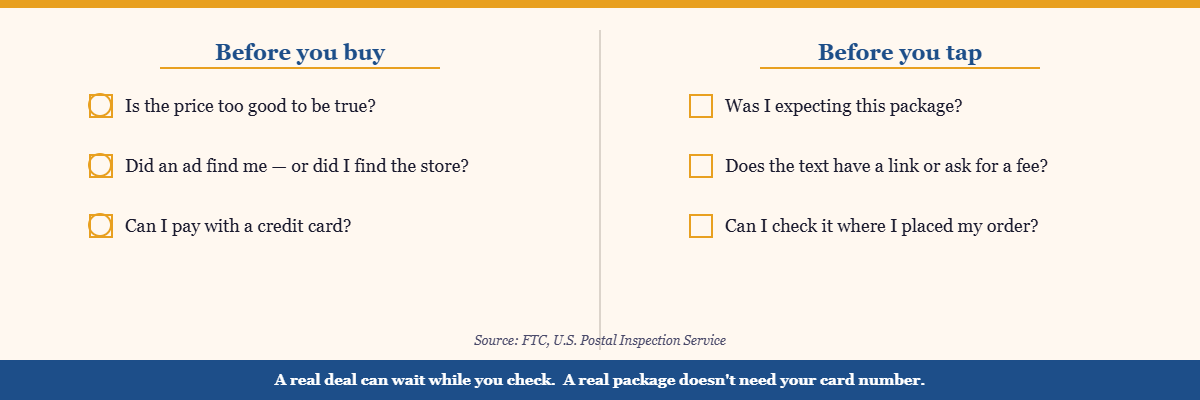
Did I find this store myself, or did an ad find me?
Can I pay with a credit card?
Before you tap, ask:
Was I expecting this?
Does it have a link, or ask for a fee?
Can I check it where I placed my order?
But let me state:
A real deal can wait while you check. A real package doesn’t need your card number.
Have a safe and happy holiday season.
Thanks,
Pablo
This article is for general information only. It isn’t legal or financial advice. If you’ve lost money, contact your bank or card company and report it at ReportFraud.ftc.gov right away.
Free · 2 pages · Print it
Get The Scam-Proof Checklist
10 plain-English rules that stop most scams cold, plus what to do if one already got through. Keep it by the phone. I’ll also send you new posts when they come out.
No spam. We never sell or share your email. Unsubscribe any time with one click. Privacy
A call, letter, or text says you won a car or cash. You just have to pay a small fee first. Here’s how to tell a prize scam from a real prize, and what to do.
A while back I wanted a quote on an extended warranty for my car. I clicked an ad and filled out a short quote form. Simple, right? Not quite. The next page said they couldn’t match me to a quote. Then it offered me something else: a free scan to see if my personal information…
Your phone buzzes. It’s a text. It says you owe money on a toll. Or there’s a problem with your package. Or the DMV says you have an overdue ticket. Or it’s just a friendly “hi, how are you?” from a number you don’t know. Some of these are real. A lot of them are…