AI Voice-Cloning Scams: Protect Your Family With a Code Word
Picture this. Your phone rings late one evening, and it’s your grandson on the other end, crying.
He says he’s been in a car accident, or he’s in jail, or he’s stuck somewhere and needs money right now. He begs you not to tell his parents. Then someone else gets on the line, a “lawyer” or a “police officer,” and tells you how to send the money.
It sounds exactly like him: his voice, his way of talking, maybe even the nickname he always calls you.
But it isn’t him.
How they copy a voice
This used to be called the “grandparent scam,” and the crooks would just guess and hope you’d fill in the name yourself. Now they have a powerful new tool.
With today’s artificial intelligence, a scammer only needs a short recording of someone’s voice to copy it. The FTC says a short audio clip is enough. Where do they get it? From the videos people post on Facebook, Instagram, TikTok, and YouTube: a birthday video, a voicemail greeting, or a quick clip from a family trip.
The FBI warned about this in December 2024. Criminals are using AI to make short audio clips of a loved one’s voice and pretend that person is in a crisis, all to get you to send money.
So here’s the hard truth. A familiar voice on the phone doesn’t prove anything anymore.
The one fix that works: a family code word
The FBI’s advice is simple, and I like it because it costs nothing. Pick a secret word or phrase with your family. If anyone ever calls in a panic asking for money, you ask for the code word.
A real family member will know it right away. A scammer won’t, no matter how convincing the voice sounds.
How to pick a good one:
- Make it something you’ll all remember. The name of a first family dog, a favorite fishing spot, or a silly family saying.
- Don’t use anything that’s online. Skip birthdays, street names, pet names you’ve posted about, or anything someone could find on social media.
- Don’t text it or post it. Share it in person or in a phone call you started yourself. If you write it down, keep it in a drawer, not on the fridge.
- Make sure everyone knows it. Your kids, your grandkids, and your spouse. Especially the grandkids, since they’re the voices scammers love to copy.
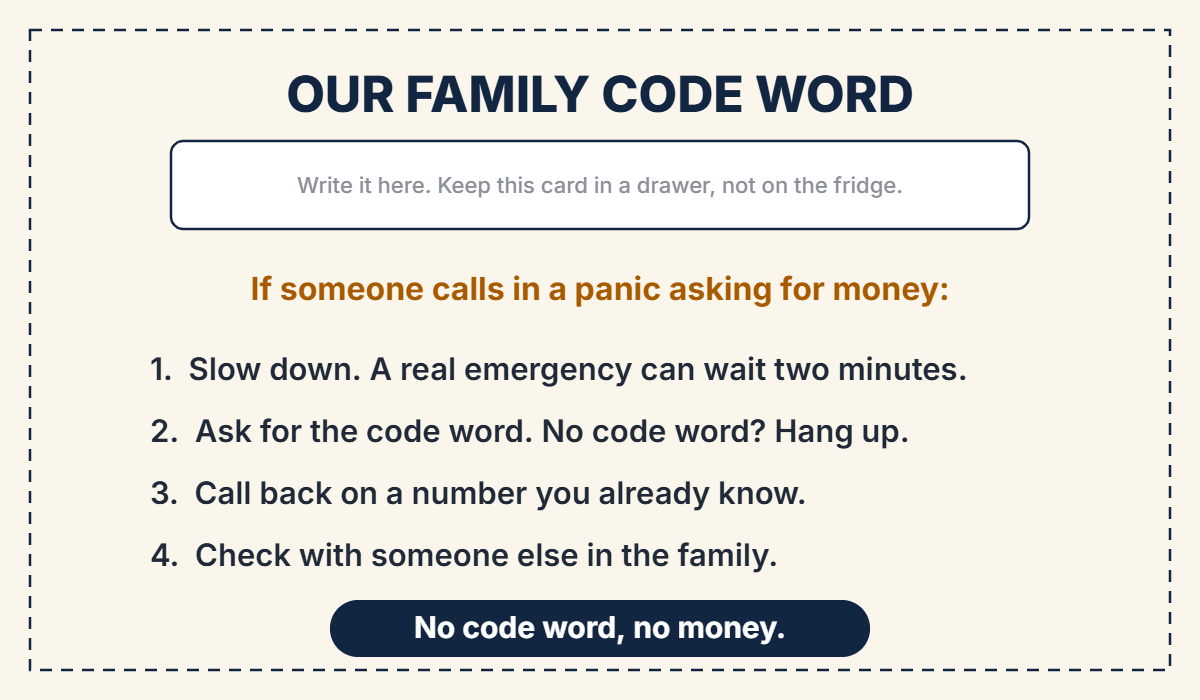
Then put it to work by making one simple rule in your family: no code word, no money. There are no exceptions, no matter how upset the caller sounds.
If you get one of these calls
These calls are built to rush you. The panic is the whole point. Here’s what to do instead:
- Slow down. Take a breath. The scammer needs you scared and in a hurry. A real emergency can wait two minutes while you check.
- Ask for the code word. If they can’t give it, or they dodge the question, hang up.
- Hang up and call back on a number you already know. Call your grandson on his own cell phone, the number you’ve always used. Don’t use any number the caller gives you. The FTC says to call the person directly and check the story.
- Check with someone else in the family. If you can’t reach him, call his parents, a brother or sister, or a friend. Yes, even if he begged you not to. That “don’t tell Mom and Dad” line is part of the script.
- Never pay this way. Wire transfers, gift cards, cryptocurrency, or cash picked up by a “courier.” The FTC calls these red flags because that money is very hard to get back. A real lawyer or police officer will never ask you to pay with gift cards.
Trust your gut
If something feels off about the call, it probably is.
The caller says they can’t talk long, they don’t want you to call anyone else, and they need the money within the next hour. Every one of those is a warning sign, all by itself.
And remember, caller ID can be faked too. Even if the screen shows a name or number you recognize, it could still be a scammer.
Scammers use the same rush-and-panic trick with fake computer warnings. Here’s what to do about those: Tech Support Pop-Up on Your Screen? Do This, Not That.
If you already sent money
You are not the first person this has happened to, and you won’t be the last, because these people practice this every single day. What matters now is acting fast:
- Call your bank, credit card company, or the gift card company right away. Tell them it was a scam and ask them to stop or reverse the payment. The sooner you call, the better your chances.
- Report it at ReportFraud.ftc.gov and at the FBI’s ic3.gov.
- Tell your family. Not to embarrass anybody, but because scammers sometimes call back, and now everyone knows to watch for it.
The bottom line
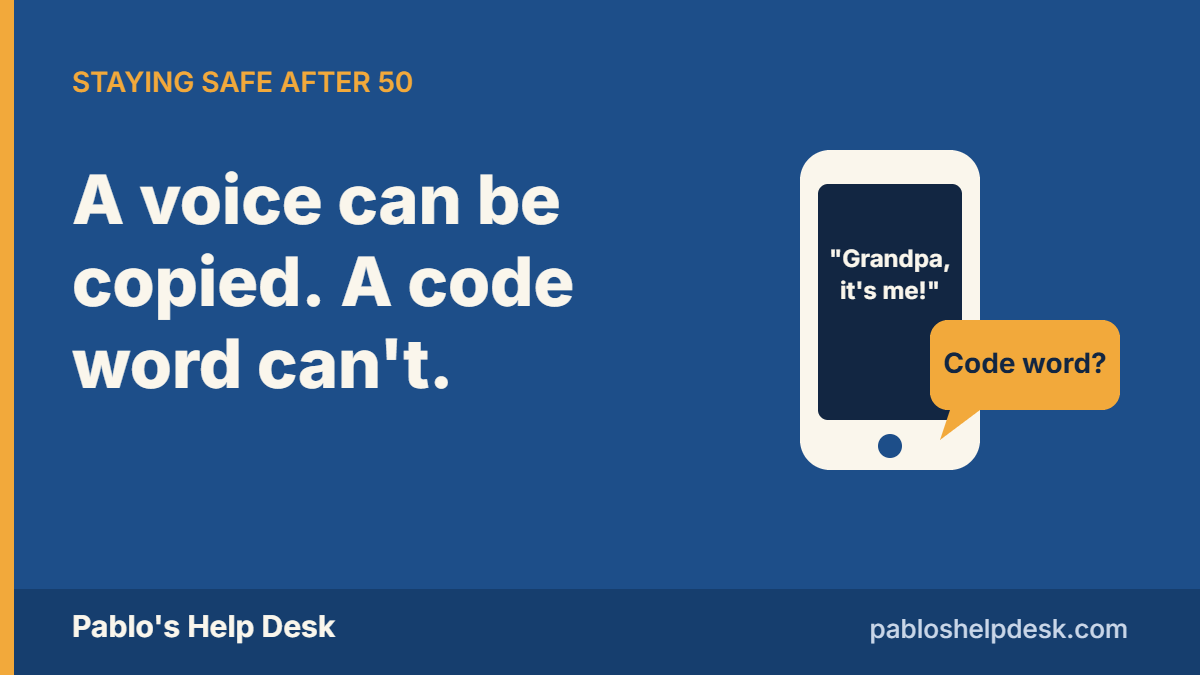
A voice can be copied. A code word can’t.
Pick yours this week. Bring it up at the next family dinner, or call the kids tonight. It’s a two-minute conversation that could save your family a lot of money and a lot of heartache.
No code word, no money.
Thanks,
Pablo
Sources: FBI IC3, “Criminals Use Generative Artificial Intelligence to Facilitate Financial Fraud” (Dec. 3, 2024); FTC, “Scammers use AI to enhance their family emergency schemes”; FCC, “Caller ID Spoofing”.
This article is for general information. It isn’t legal or financial advice. If you’ve lost money, contact your bank and the agencies listed above right away.
Free · 2 pages · Print it
Get The Scam-Proof Checklist
10 plain-English rules that stop most scams cold, plus what to do if one already got through. Keep it by the phone. I’ll also send you new posts when they come out.
No spam. We never sell or share your email. Unsubscribe any time with one click. Privacy