How to Tell If a Text Is a Scam (Real Examples)
Your phone buzzes. It’s a text.
It says you owe money on a toll. Or there’s a problem with your package. Or the DMV says you have an overdue ticket. Or it’s just a friendly “hi, how are you?” from a number you don’t know.
Some of these are real. A lot of them are not.
And the crooks are getting paid. The FTC says people reported losing $470 million in 2024 to scams that started with a text message. That’s five times more than in 2020. (FTC)
That’s our money. Let’s keep it.
Here are the real scam texts going around, what they look like, and how to tell if a text is a scam before you tap anything.
Part of my “Know the Trick” series. This one: small-amount bait.
The real examples
These come straight from warnings put out by the FTC and the FBI.
1. “You owe a toll”
This one is everywhere. The text says you have unpaid tolls and need to pay right away. It shows a dollar amount and a link. (FTC)
The FBI shared the wording from one of these texts: “We’ve noticed an outstanding toll amount of $12.51 on your record.” It said you’d avoid a $50 late fee if you paid through the link. The link went to a fake toll website. The FBI got more than 2,000 complaints about these texts in about six weeks. (FBI IC3)
Notice the small amount. $12.51 doesn’t feel like a big deal. That’s the point. They don’t want your $12.51. They want the card number you type in to pay it.
2. “The DMV says you have an overdue ticket”
This text claims to be from your state’s DMV. It says you have an overdue traffic ticket. Then it piles on the threats: a “DMV violation database,” a suspended license and registration, an extra 35% service fee, even damage to your credit. (FTC)
A newer version comes with a QR code, a state seal, a fake case number, and a fake court date. It tells you to scan the code and pay “to avoid court.” (FTC)
It’s meant to scare the manure out of us. Don’t scan it. Don’t reply.
3. “There’s a problem with your package”
The most reported text scam of 2024 was the fake package delivery text. (FTC)
These texts say a package is out for delivery, or there’s a problem like unpaid postage. They use names like USPS, FedEx, or DHL. They want you to click a link to “fix” it. (FTC) Some links go to a fake Post Office page that asks for a “re-delivery fee.” (FTC)
If you ordered something, check on it where you ordered it. Not through the text.
4. “Hi, how are you?” (the “wrong number” text)
This one looks harmless. A stranger texts “hi, how are you?” Other versions people have reported to the FTC: “Long time no see. Is everything all right?” and “I’m at the airport. Where are you?” (FTC)
If you answer, they apologize for the “wrong number.” Then they keep chatting. They’re friendly. They build trust. Later comes the pitch, usually a cryptocurrency “investment” or a secret way to make big money. It’s a scam, and the money is gone. (FTC) The FTC says these chats often take on a romantic tone before the money talk starts. (FTC)
Most of us were raised to be polite. If someone says hello, we say hello back. But the FTC says it plainly: it’s not rude to ignore these. Even a short reply tells them your number works, and that can bring you more scam calls and texts.
5. “Can you do me a quick favor?”
A text that seems to come from your boss, or someone in charge, asking for an “urgent favor.” The favor turns out to be buying gift cards and sending the numbers off the back. Sometimes they call them “Google certificates.” (FTC)
If you’re retired like me, you might think you’re safe from this one. Not so fast. I serve on a volunteer committee myself. Lots of us still volunteer, serve on a board, or help out at church or a club. The same trick works there. Scammers have even posed as real pastors, priests, rabbis, and imams, texting members to send money in gift cards. (Georgia Attorney General)
But let me state: only scammers ask you to pay with a gift card. (FTC)
6. A text from your own phone number
Yes, really. Scammers can fake the number a text comes from, so it looks like you sent it to yourself. One version thanks you for paying your bill and offers you a gift if you tap a link. (FTC)
You didn’t send it. Don’t tap it.
7. “Fraud alert” texts
These pretend to be from your bank or a big store’s fraud department about a charge you didn’t make. They want you to reply or call a number. Then they try to drain your account. (FTC)
How to tell if a text is a scam
Look at all seven of those. They have a lot in common. Here’s what the FTC says to watch for: (FTC)
- You weren’t expecting it. It came out of the blue.
- It asks for personal or money information. Passwords, account numbers, your Social Security number, a card number.
- It’s rushing you. Pay now. Avoid court. Avoid a late fee. Act today.
- It wants you to tap a link to “learn more” or “fix” something. The link can go to a fake site that looks real.
- It sounds too good to be true. Free prizes, gift cards, easy money.
- It wants payment in a strange way. Gift cards, crypto, or a link in a text.
And one more: don’t trust a text just because it uses a name you know. Your bank. The Post Office. Amazon. Your state toll agency. Scammers use those names because we trust them. (FTC)
Scam or real? How to check
So what if it might be real? Maybe you did drive on a toll road last week.
Here’s the fix, and it works every time. Check it yourself, a different way.
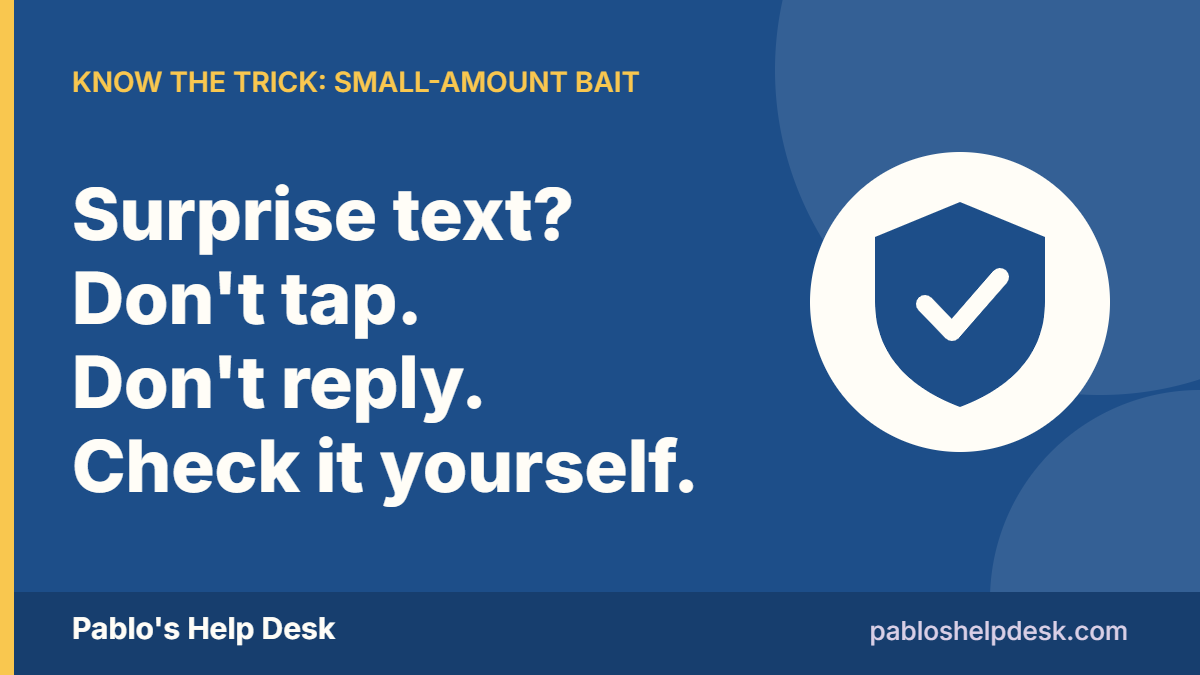
- Don’t tap the link. Don’t reply. Don’t scan the QR code.
- Go around the text. Call the company, the toll agency, the DMV, or the court using a phone number or website you already know is real. Not the one in the text. (FTC)
- For packages, check your order on the store’s website or app where you bought it. (FTC)
- For a “boss” or friend, call them at the number you already have. (FTC)
If it’s real, they’ll tell you. If it’s not, you just saved yourself a big headache.
Got a scam text? Report it, then delete it
It only takes a few seconds, and it helps everybody:
- Use the “Report Junk” option in your phone’s messaging app, or forward the text to 7726 (that spells SPAM). This helps your phone company block more texts like it. (FTC)
- Report it to the FTC at ReportFraud.ftc.gov.
- For toll texts, the FBI also asks you to report them at ic3.gov, with the phone number the text came from and the website it listed. (FBI IC3)
- Then delete it.
Oh, and by the by, your phone can help. Many phones can filter texts from unknown senders, and your phone company may have free blocking tools too. (FTC)
Uh-oh. I already tapped it.
Don’t beat yourself up. These texts are built by people who do this all day long. What matters now is what you do next. Here’s what the FTC says:
- If you typed in personal or money information, go to IdentityTheft.gov. It gives you the exact steps based on what you gave out. (FTC)
- If you entered a card or bank number, call your bank or card company right away, using the number on the back of your card. The FBI says to secure your accounts and dispute charges you don’t recognize. (FBI IC3)
- If you paid with a gift card, report it fast. The FTC says the sooner you report it, the better your chance of getting money back. (FTC)
- Turn on two-step login (multi-factor authentication) for your important accounts. It makes it harder for scammers to get in, even if they have your password. (FTC)
- Report it at ReportFraud.ftc.gov.
Want to talk it through with a real person? Call the free AARP Fraud Watch Network Helpline at 877-908-3360, Monday to Friday, 8 a.m. to 8 p.m. Eastern. (AARP)
Got a scam phone call too? A family member’s voice asking for money? Read my post on AI voice-cloning scams and the family code word. And if a scary warning ever pops up on your computer screen, here’s what to do about a tech support pop-up.
The bottom line
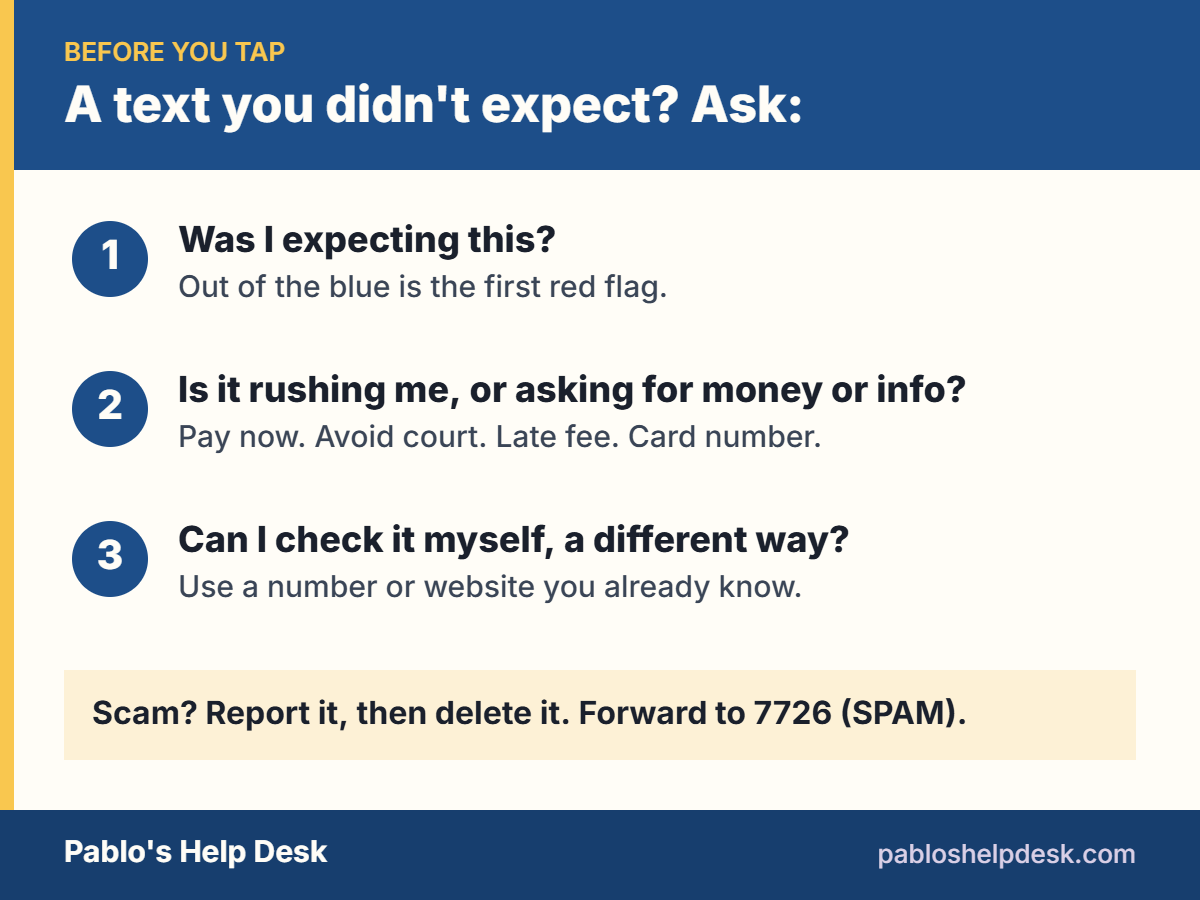
Before you tap, ask yourself three questions:
- Was I expecting this?
- Is it rushing me, or asking for money or information?
- Can I check it myself, a different way?
If the answer is no, yes, and yes: don’t tap, don’t reply, check it yourself.
A real company can wait five minutes while you check. A scammer can’t.
Thanks,
Pablo
This article is for general information only. It isn’t legal or financial advice. If you’ve lost money, contact your bank or card company and report it at ReportFraud.ftc.gov right away.
Free · 2 pages · Print it
Get The Scam-Proof Checklist
10 plain-English rules that stop most scams cold, plus what to do if one already got through. Keep it by the phone. I’ll also send you new posts when they come out.
No spam. We never sell or share your email. Unsubscribe any time with one click. Privacy