“You Won!” Prize, Sweepstakes, and Lottery Scams: How to Tell
“Congratulations! You won!”
Maybe it’s a phone call. Maybe it’s a letter in the mail. Maybe it’s an email, a text, or a message on social media. (FTC)
The voice on the phone is excited. You won a new car. Or a laptop. Or cash. (FTC)
There’s just one small thing. You have to pay a fee first. For “taxes.” For “shipping and handling.” For “processing.” (FTC)
Who doesn’t want to win something? That’s the hook.
And it works. In 2025, people 60 and older told the FBI they lost more than $136 million to lottery, sweepstakes, and inheritance scams. The year before, it was about $76 million. (FBI IC3 2025 report)
That’s our money. Let’s keep it.
Part of my “Know the Trick” series. This one: says there’s a problem or a prize.
The trick: a prize you never entered
The FTC lists four signs of a scam. One of them is this: scammers say there’s a problem or a prize. They “lie and say you won money in a lottery or sweepstakes but have to pay a fee to get it.” (FTC)
A problem scares us. A prize excites us. Either way, we stop thinking straight for a minute. That minute is all a crook needs.
Here’s the first question to ask. Did you enter?
The FTC says prize scams often start with a call or text saying you won, even though you never entered anything. (FTC)
If you didn’t enter a contest, how did you win it? Hum!
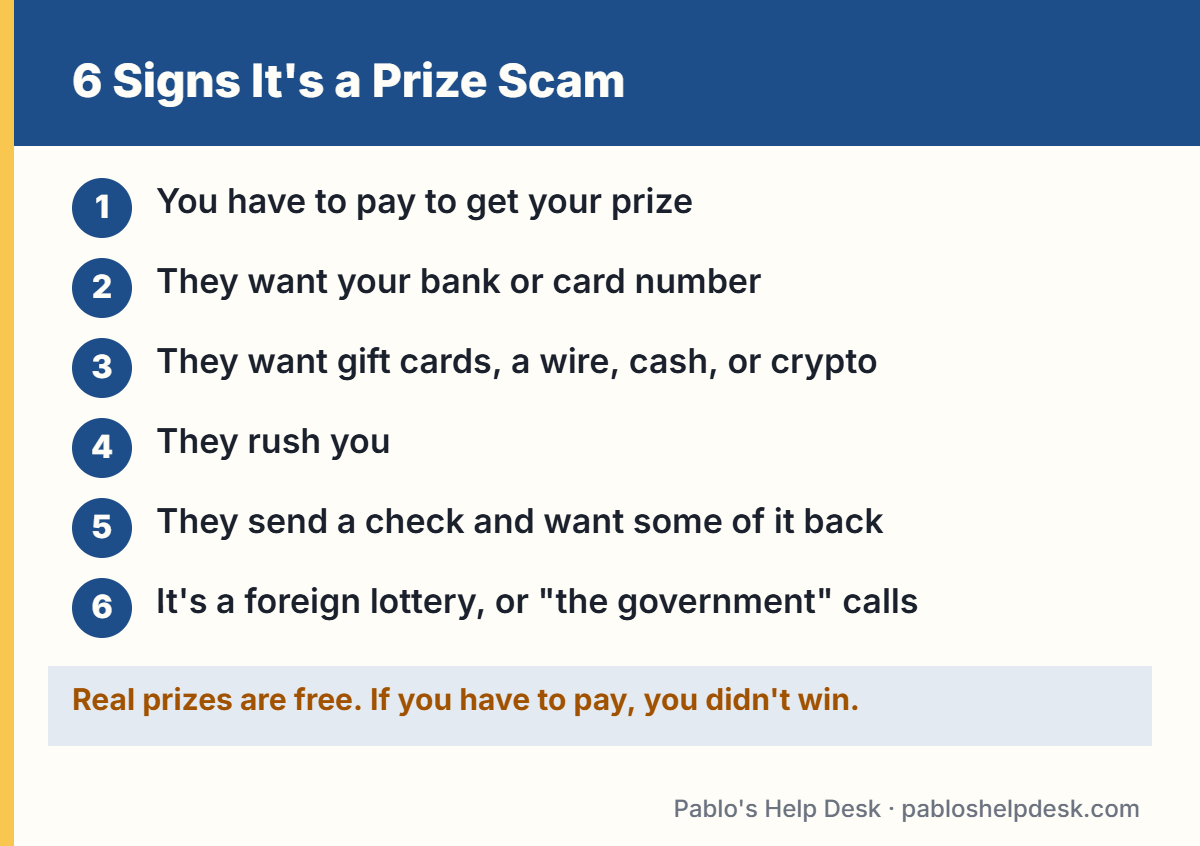
6 signs it’s a prize scam
1. You have to pay to get your prize
This is the big one. The FTC puts it plainly: “If you have to pay to get your prize, it’s a scam.” (FTC)
They’ll call it a lot of things. Taxes. Shipping. Processing. Customs duties. (FTC) It doesn’t matter what they call it. A fee is a fee.
And don’t be fooled by a big name. Scammers use names that sound like real sweepstakes companies. But the FTC says, “no real sweepstakes company will demand money for a prize.” (FTC)
2. They want your bank account or card number
The FTC says there is “absolutely no reason to ever give your bank account or credit card number” to claim a prize. (FTC)
None. Not to “verify” you. Not to “deposit” your winnings.
3. They want you to pay in a strange way
Watch for anyone who tells you to wire money, use a payment app, send cash, or pay with gift cards or cryptocurrency. The FTC warns that once you pay this way, “it’s hard to get your money back.” (FTC)
Gift cards are a dead giveaway. The FTC says “anyone who insists that you pay by gift card is always a scammer.” (FTC)
4. They rush you
“Limited time.” “You must claim it today.” The FTC says scammers push deadlines like these so you won’t stop and think. (FTC)
So take your time. If someone pushes you to pay fast, stop. (FTC)
5. They send you a check and ask for some of it back
Some scammers mail you a check for your “winnings.” Then they ask you to deposit it and send part of the money back for fees.
Here’s the catch. The check is fake. Banks can take weeks to find that out. By then, you may owe the bank all the money back. (FTC)
6. It’s a foreign lottery, or “the government” is calling
The FTC says a message about a foreign lottery is “almost certainly from a scammer.” It’s also illegal for U.S. citizens to play a foreign lottery. (FTC)
Some scammers say they’re with the government. The FTC says, “the government won’t call you demanding money to collect a prize.” (FTC)
What a real sweepstakes looks like
Real contests do exist. Here’s how they work, according to the FTC: (FTC)
- They’re free. Winning is up to chance.
- Paying can’t help you win. “It’s illegal for someone to ask you to pay to increase your odds of winning.”
- They tell you the rules up front. That entry is free, what the prizes are worth, the odds, and how to claim a prize.
- Mailings have rules too. A sweepstakes mailing must say you don’t have to pay to take part. It can’t call you a winner unless you really won. And any check in the envelope that isn’t real must say it’s non-negotiable and has no cash value.
One more thing. Even real sweepstakes may sell your information to advertisers. That can mean more ads, mail, calls, and spam. (FTC) I wrote about how a simple online form can lead to a flood of sales calls in my post on that scary “your data is exposed” scan.
What to do if you “won”
- Don’t pay. Not a fee. Not a tax. Not a dime. “Real prizes are free.” (FTC)
- Don’t give out your bank account or card number. (FTC)
- Check it yourself. Look up the company on your own. Contact it using a phone number or website you found, not the one the caller gave you. (FTC)
- Search the name. Type the company or contest name plus “complaint,” “review,” or “scam.” (FTC)
- Report it. Go to ReportFraud.ftc.gov. You can also tell your state attorney general. If it came in the mail, the FTC says to tell the U.S. Postal Inspection Service. If someone used your personal information, go to IdentityTheft.gov. (FTC)
- Warn your friends and family. The FTC says to do that too. (FTC) The same message often goes out to a lot of people at once.
Got a “you won” text instead of a call? My post on how to tell if a text is a scam walks through the real examples going around.
Already paid? Act fast
If you already sent money, don’t beat yourself up. These crooks do this all day long. Move quickly.
The FTC says “the sooner you act, the better,” no matter how you paid. (FTC) My post on what to do in the first hour after a scam walks you through it, step by step.
- Paid with a gift card? Call the company that sold the card right away. Tell them it was used in a scam. Keep the card and the receipt. (FTC)
- Watch for the second scam. Someone may call later and offer to get your lost money or prize back, for a fee. The FTC says not to trust anyone who says they can recover money you lost in a scam for a fee. (FTC)
The bottom line
The next time someone says you won, ask yourself three questions:
- Did I enter?
- Do I have to pay anything to get it?
- Are they rushing me, or asking for my bank or card number?
But let me state:
Real prizes are free. If you have to pay to get it, you didn’t win anything.
Thanks,
Pablo
This article is for general information only. It isn’t legal or financial advice.
Free · 2 pages · Print it
Get The Scam-Proof Checklist
10 plain-English rules that stop most scams cold, plus what to do if one already got through. Keep it by the phone. I’ll also send you new posts when they come out.
No spam. We never sell or share your email. Unsubscribe any time with one click. Privacy