Worry vs. Planning: How to Tell the Difference
We tell ourselves we’re being responsible.
We’re thinking ahead. Considering the possibilities. Making sure we’re prepared.
And then it’s 2 a.m., we haven’t slept, and the same thought has circled past us forty-seven times without going anywhere.
That’s not planning. That’s worry. And they can look a lot alike — which is why we keep ending up in that loop.
Why they feel the same
Planning is about action. We think about a problem, lay out some options, choose the best one, and do something.
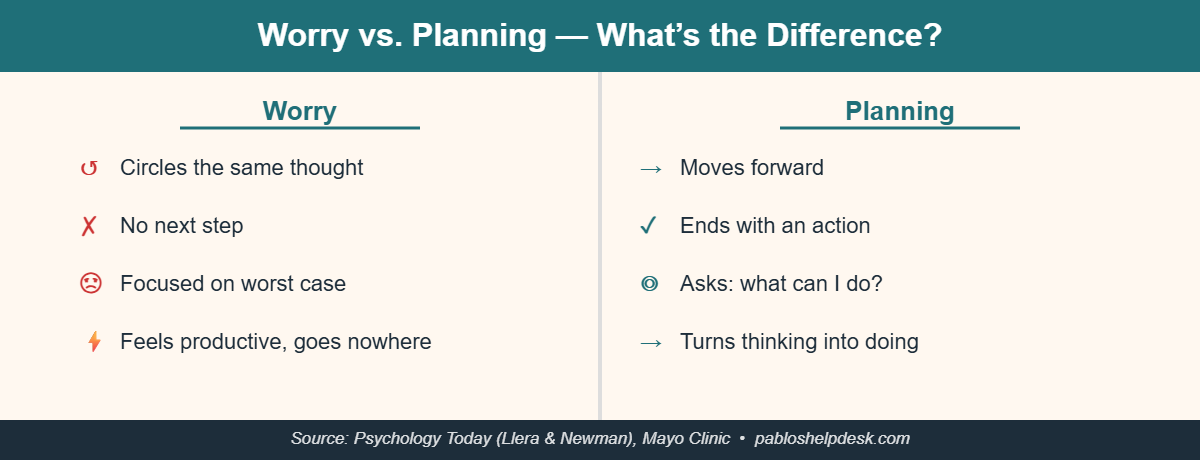
Worry looks similar on the surface. We’re thinking about the problem. We’re considering outcomes. We’re very busy inside our heads.
But the loop never closes. No action. No decision. Just the same worried thoughts, again.
In the anxiety research, worry is defined as a repetitive pattern of negative thinking about unresolved and threatening issues that could end badly. (Psychology Today / Llera & Newman)
The key word is repetitive. Planning moves forward. Worry circles.
One pair of researchers put it plainly: “Worrying is NOT the same as problem-solving.” (Psychology Today / Llera & Newman) They found that worry can actually get in the way of solving the problem you’re worrying about.
The gas-pedal problem
Here’s one way to picture it.
Worry is like sitting in a car with the engine running, pressing the gas, and going nowhere — because the car is still in neutral. Lots of energy. No movement.
Worry feels productive but gets nowhere. (Psychology Today / Llera & Newman) That’s the trap. It feels like we’re doing something. We’re not. We’re using up energy that could go toward an actual next step.
The research backs this up. In a study by Llera and Newman, participants who worried about a problem generated less effective solutions than those who thought about it more calmly and objectively. (Psychology Today / Llera & Newman) Worry also made people less willing to act on the solutions they did come up with.
That loop runs especially hard at night, when there’s nothing to distract from it. Sound familiar?
Three questions to tell them apart
When you notice yourself going in circles, try these three questions.
1. Am I going anywhere?
Planning makes progress, even if it’s slow. Worry visits the same thought again and again. If you’ve thought about something ten times and arrived at the same place each time, you’re worrying.
2. Is there a next step?
Planning ends with something you can do — even a small thing. Make a call. Write a list. Ask a question. Worry doesn’t. If you can’t name one concrete next step, that’s a sign.
3. Am I preparing, or just picturing the worst?
Worry can push you to overestimate how likely bad events are, and underestimate your ability to cope with them if they happen. (Mayo Clinic) Planning looks at what you can actually do. Worry stays focused on what might go wrong.
How to shift from one to the other
The goal isn’t to stop thinking about the problem. The goal is to think about it differently.
Mayo Clinic offers a simple exercise. Write down one to five worries, leaving space for each. Then, for each one, write your answers to these questions: How can I look at this situation differently? How likely is it, really, that the worst will happen? What evidence do I have for and against this worry? Have I handled something like this before? Will this matter in five years? (Mayo Clinic)
That last question is worth sitting with. Most of the things we worry about at 2 a.m. don’t hold up to it.
Another approach is what the researchers call problem-solving. It starts with defining the problem clearly, then setting a goal, then brainstorming options without judging them yet, and finally weighing the pros and cons and picking the best option. (Psychology Today / Llera & Newman)
The brainstorming step is the one people skip. Write down everything — even the ideas that seem unrealistic. Don’t judge yet. The judging comes later. Getting the options out of your head and onto paper interrupts the loop.
About the stuff you can’t solve
Here’s the honest part.
Some things we worry about can’t be fixed by a plan. A diagnosis. A loss. A relationship. Something out of our hands.
For those, the worry loop is especially cruel, because there’s no plan that closes it.
The move there isn’t planning — it’s acceptance. Naming what’s out of our control. And then finding the smallest thing we can do, even if it’s just making the next phone call, or taking a walk, or talking to someone.
Worrying doesn’t change whether or not your biggest fear will happen. (Mayo Clinic) That’s worth reading again, slowly. The worry isn’t protecting you from the outcome. It’s just the cost you’re paying for not knowing.
A place to start tonight
If something is circling tonight, try this.
Write it down. One sentence. Then write one question underneath it: What’s the one next thing I can actually do about this?
If the answer is nothing — if it’s genuinely out of your hands — name that too. Write: This one is not mine to solve. And then put the notebook down.
But let me state: if worry is a constant presence — if it follows you all day, keeps you up most nights, or sits heavy on you in a way that isn’t lifting — that’s worth talking to your doctor about. Worry that heavy isn’t something you have to white-knuckle through alone. (Mayo Clinic)
For more on this, read Acceptance Isn’t Giving Up: How to Tell the Difference — it covers the other side of this same question.
Thanks,
Pablo
This article is for general education only. It is not medical or mental health advice. If worry is significantly affecting your daily life or sleep, talk to your doctor or a qualified mental health professional.
Free · 2 pages · Print it
Get The Scam-Proof Checklist
10 plain-English rules that stop most scams cold, plus what to do if one already got through. Keep it by the phone. I’ll also send you new posts when they come out.
No spam. We never sell or share your email. Unsubscribe any time with one click. Privacy