Plan on Getting Old. Despite Your Best Efforts, You Just Might Get There.
There’s a line I like to say.
Plan on getting old. Despite your best efforts, you just might get there.
It gets a smile. But I mean every word of it.
I’m 70 now. I retired in 2023 after more than 25 years in IT. So I’m not writing this from the outside looking in. I’m right here with you.
Here’s the thing. Most of us plan for all kinds of stuff. Vacations. Holidays. The car’s next oil change. But getting older? A lot of us just hope it works out.
Hope is good. A plan is better.
Why plan at all?
Because the odds say we’ll need some help along the way.
The U.S. Administration for Community Living says someone turning 65 today has almost a 70% chance of needing some type of long-term care services. It also says about one-third of today’s 65-year-olds may never need that kind of support. (ACL)
So some of us will need a little help. Some of us will need a lot. Some of us won’t need much at all. Nobody gets to pick.
What we can pick is whether we’re ready.
And let me state this plainly: planning isn’t giving up. Planning is how we stay in charge. When we decide things ahead of time, we make the call. Not a stranger. Not a crisis.
5 things to do now
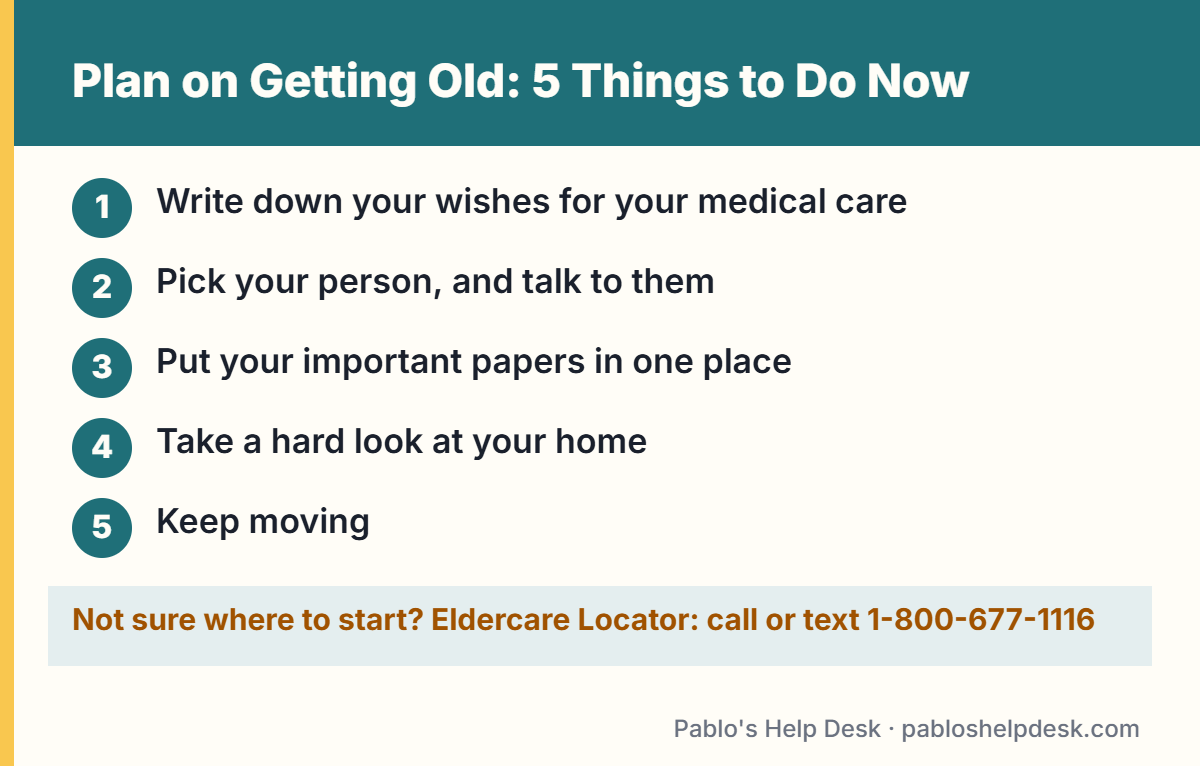
1. Write down your wishes for your medical care
This is called advance care planning. The National Institute on Aging (NIA) says it “involves discussing and preparing for future decisions about your medical care.” (NIA)
The papers you fill out are called advance directives. Two of the main ones are:
- A living will. The NIA says this is “a legal document that tells doctors how you want to be treated” if you can’t decide for yourself. (NIA)
- A durable power of attorney for health care. This names your health care proxy. That’s the person who makes medical choices for you if you can’t. (NIA)
You don’t have to be old or sick to do this. The NIA says, “At any age, a medical crisis could leave you unable to communicate your own health care decisions.” It also says many states have their own forms you can fill out for free. (NIA)
2. Pick your person, and talk to them
Choosing your proxy matters. The NIA suggests asking yourself, “Will this person honor my wishes and do as I ask when the time comes?” (NIA)
Then talk to them.
- Ask if they’re willing to take it on.
- Give them a copy of the signed form.
- Make sure they know your doctors’ names and phone numbers.
- Make sure your doctor knows who your proxy is.
And don’t make it a one-time talk. The NIA says to plan to talk with your proxy “at least once each year about your wishes.” (NIA)
3. Put your important papers in one place
If something happened to you tomorrow, could anyone find your papers? Your will. Your insurance. Your bank and retirement accounts. Your Medicare card. Your passwords.
Put them in one place. Then tell someone you trust where that place is.
The NIA has a free checklist of documents to get ready for the future. It’s a good place to start. (NIA checklist)
4. Take a hard look at your home
Most of us want to stay in our own homes as long as we can. The NIA says, “The best time to think about how to age in place is before you need a lot of care.” (NIA)
Start with falls. The CDC says more than one out of four older people falls each year, but less than half tell their doctor. It also says one fall doubles your chance of falling again. (CDC)
So walk through your home one room at a time. Look for loose rugs, cords on the floor, dark stairs, and a slippery tub. The NIA says to fix the most urgent dangers first, and check again as your needs change. (NIA)
And if you do fall, tell your doctor. Even if you feel fine.
5. Keep moving
The body we bring into our 80s is the one we build now.
For adults 65 and older, the CDC recommends:
- At least 150 minutes a week of moderate activity, like brisk walking.
- At least 2 days a week of activities that make your muscles stronger.
- Activities that improve your balance.
(CDC)
That may sound like a lot. It doesn’t have to happen all at once. Start where you are. And talk to your doctor about what’s right for you.
Not sure where to start? Call this number
The Eldercare Locator is a free public service of the U.S. Administration for Community Living. It connects older adults and families with help in their own community. You can call or text 1-800-677-1116, or visit eldercare.acl.gov. (Eldercare Locator)
Your local Area Agency on Aging is another good call. The NIA says these groups “will be familiar with resources available in your community.” (NIA)
The bottom line
Getting older isn’t a problem to avoid. It’s a trip to plan for. And if we’re lucky, it’s a long one.
So pick one thing on that list. Just one. Do it this week.
Then pick the next one.
Plan on getting old. Despite your best efforts, you just might get there. Let’s be ready when we do.
If you want a little more on this, read Acceptance Isn’t Giving Up: How to Tell the Difference and Avoid Avoiding.
Thanks,
Pablo
This article is for general education only. It is not medical, legal, or financial advice. Talk to your doctor about your health, and talk to a qualified professional (such as an attorney) about legal papers for your state.
Free · 2 pages · Print it
Get The Scam-Proof Checklist
10 plain-English rules that stop most scams cold, plus what to do if one already got through. Keep it by the phone. I’ll also send you new posts when they come out.
No spam. We never sell or share your email. Unsubscribe any time with one click. Privacy