How to Plan Your Week in 15 Minutes (A Simple Sunday Routine)
Monday shows up every week. Right on time. Ready or not.
Some weeks we’re ready. Some weeks the week runs us instead of the other way around. The doctor’s appointment sneaks up. The birthday card goes out late. The thing we meant to do on Tuesday is still sitting there on Friday.
Here’s a fix that takes about 15 minutes. One sheet of paper. One cup of coffee. Sunday afternoon or Sunday evening, whatever works for you.
No fancy planner. No app you have to learn. Just a plan.
Why bother planning at all?
Because it takes a load off your mind.
The National Institute on Aging (NIA) gives this tip for staying on top of everyday life: “Plan tasks, make to-do lists, and use memory tools such as calendars and notes.” It also suggests that you “Follow a daily routine.” (NIA)
Mayo Clinic lists the same kind of thing as a way to handle stress: “Manage your time and prioritize your tasks and commitments.” (Mayo Clinic)
That’s what a Sunday plan does. It gets the week out of your head and onto paper, where you can see it.
Your 15-minute Sunday plan
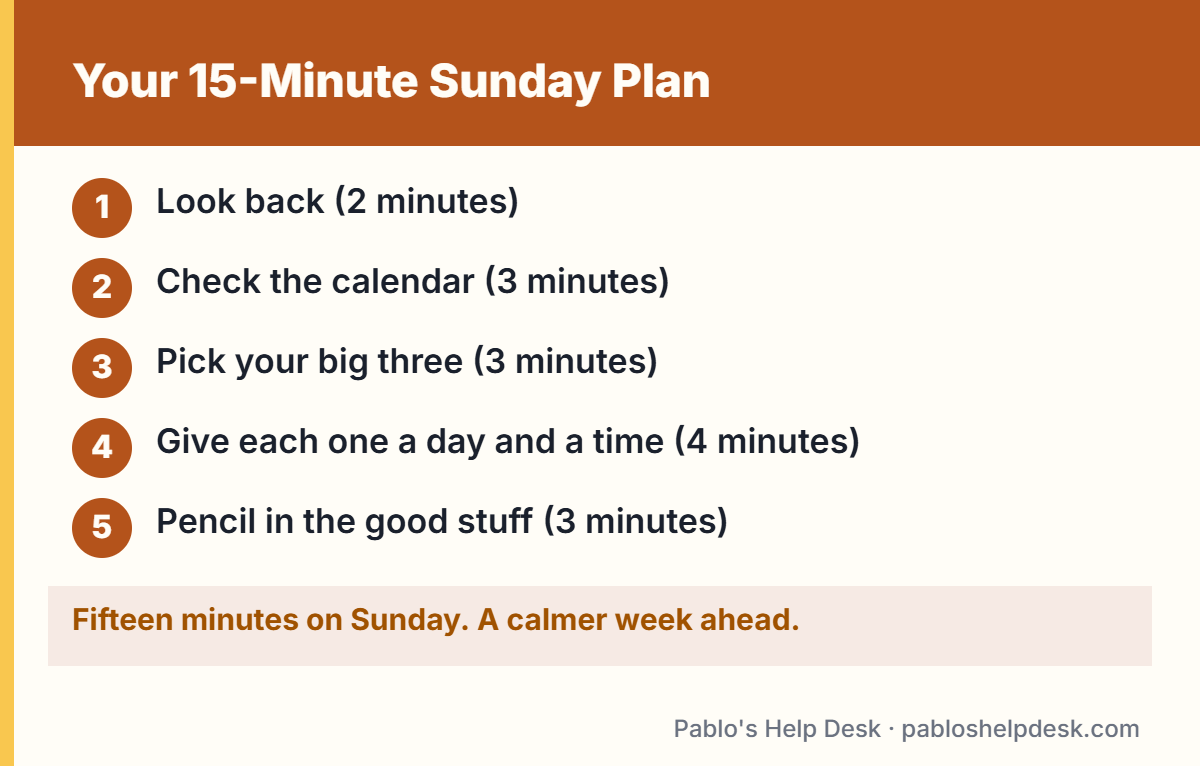
Set a timer if you like. Here are the five steps.
1. Look back (2 minutes).
What’s still open from last week? A call you didn’t make. A form you didn’t mail. For each one, decide. Carry it over to this week, or cross it off for good. Both are fine. Just don’t leave it hanging.
2. Check the calendar (3 minutes).
Write down what’s already set. Appointments. Birthdays. Bills that are due. Trash day. Grandkids’ games. Church, club, or volunteer days. These are the fixed points. Everything else fits around them.
3. Pick your big three (3 minutes).
Not ten. Three. What are the three things that matter most this week?
Mayo Clinic’s advice is to “Figure out what’s most important or what commitments you can say no to.” (Mayo Clinic) If you only get three things done, which three would make you glad on Saturday?
4. Give each one a day and a time (4 minutes).
This is the step most of us skip. And it’s the one that does the heavy lifting.
“Call the pharmacy” is a wish. “Tuesday after breakfast, I call the pharmacy” is a plan.
Researchers call this kind of “when and where” plan an implementation intention. Think of it as an “if-then” plan: if it’s Tuesday after breakfast, then I make the call. One review pulled together 21 studies with almost 16,000 people. It looked at a method that pairs thinking about your goal and what stands in the way with this kind of if-then plan. It found the method helped people reach their goals, with a small to medium effect. (PubMed)
But let me state this plainly: a small to medium effect is help, not magic. The authors also said the real effect may be smaller than it looks. A plan won’t do the work for you. It just makes it easier to start.
5. Pencil in the good stuff (3 minutes).
Don’t fill the week with chores only. Put the good stuff on the calendar, too. A walk. A call to a friend. A nap with no guilt.
Walks count double here, because they’re good for us and easy to skip. The CDC says adults 65 and older need at least 150 minutes a week of moderate activity, like a brisk walk. It says, “This could be 30 minutes a day, 5 days a week.” The CDC also lists at least 2 days a week of activities that strengthen muscles, plus activities to improve balance. (CDC) Write the walks in, just like an appointment. Then keep the appointment.
That’s it. Fifteen minutes, give or take.
Paper or phone?
Either one works. Use the one you’ll actually look at.
- Paper: Keep the sheet on the fridge or by your coffee pot. Cross things off as you go. There’s something satisfying about that line through a finished job. Hum!
- Phone: Put your big three into your phone’s calendar with a time, and turn on a reminder. Then set one repeating reminder for Sunday afternoon that just says “Plan my week.”
Can’t sleep for thinking about Monday?
Some of us lie in bed going over everything we have to do tomorrow.
One small sleep-lab study tried something simple. Before bed, people spent 5 minutes writing either a to-do list for the next few days, or a list of things they’d already done. The to-do list group fell asleep faster. The more specific the list, the faster they fell asleep. (PubMed)
Two things to know. The study had 57 people, all ages 18 to 30. So it’s a small study, and it didn’t include people our age. Still, it costs nothing to try. And if sleep is a real problem for you, talk to your doctor.
When the week falls apart
It will. Some weeks, life doesn’t care about your plan.
When that happens, don’t throw the plan out. Move it. Wednesday’s job becomes Thursday’s job. One of the big three waits until next week. That’s not failure. That’s what a plan is for. It shows you what got bumped, so it doesn’t just disappear.
And next Sunday, you start fresh. Step one is looking back.
The bottom line
A calm week doesn’t just happen. Most of the time, we plan it.
Fifteen minutes on Sunday. Three things that matter. A day and a time for each.
Start this Sunday. Keep it simple. See how your week feels.
If you’d like more on building habits that stick, read The Compound Effect of Small Choices: Why Systems Beat Willpower Every Time and Wanting Isn’t Deciding: How to Turn the Intention to Improve Into Action.
Thanks,
Pablo
This article is for general education only. It is not medical advice. Talk to your doctor before you start a new exercise routine, or if you have trouble sleeping or with your memory.
Free · 2 pages · Print it
Get The Scam-Proof Checklist
10 plain-English rules that stop most scams cold, plus what to do if one already got through. Keep it by the phone. I’ll also send you new posts when they come out.
No spam. We never sell or share your email. Unsubscribe any time with one click. Privacy





One Comment