Achieve Your Goals Faster

Some people may think that goals have a definite timeline to accomplish. In part, this is true, but there are certainly ways on how you can hasten the process. You can achieve more great things by focusing on the current job and getting it done, without any compromise. Here are some guidelines from the experts…

Read More

How to Build an Edge: Develop Your Talent Stack

Talent Stack

Talent stack is a concept coined by Scott Adams, creator of the Dilbert comic. It’s the idea that you can combine normal skills until you have the right kind to be extraordinary.

An example is Scott himself. He’s not the best artist — there are better artists than him. He’s not much of a business expert — there are more savvy experts. He has never taken a college-level writing class. Yet, he created Dilbert, a famous comic strip that appears in 65 countries.[1] Scott is said to have a net worth of $75 million, majority of which comes from Dilbert.[2]

As he says, “When you add in my ordinary business skills, my strong work ethic, my risk tolerance, and my reasonably good sense of humor, I’m fairly unique. And in this case that uniqueness has commercial value.”

Understanding how a talent stack works is important. Normally, people think that success comes from developing talent in one skill. This works well in some fields. In medicine, the natural progression is to pick a specialty. In sports, you train to become best in your field, like Tiger Woods (golf) and Michael Jordan (basketball). In acting, you develop the best acting chops, like Robert De Niro and Morgan Freeman.

But besides becoming world-class in one skill, talent can come from having a unique stack of skills that no one else has. You can utilize different skills to create value in a way no one else can, thus becoming one-of-a-kind in your own league.

More Examples of Talent Stack

Lisa Elfridge is a celebrity make-up artist on YouTube. She was already known prior to starting her website and YouTube channel. But after she started her channel focusing on beauty and makeup tips, her authority and success rose to a whole new level.[3]

Reason? She is one of her kind in her field.

  • Celebrity makeup artists work with their clients for photo shoots, appearances. They don’t publish their work online. Most of their self-marketing happens offline, through networking, connections, etc.
  • On the other hand, online makeup gurus generally show how they do their own makeup. But they are not professionally trained. They cannot give professional advice on what is the best makeup for different skin tones, or for skin that is not like theirs.

Lisa has a unique talent stack to navigate the ultra-competitive beauty space:

  1. Makeup skills. She has professional makeup skills.
  2. Industry knowledge. She has real experience working with celebrities.
  3. Presentation skills. She communicates her makeup tips in an easy-to-understand way. White backdrop, no frills or production gimmicks. No music. Just her and her beauty tips.
  4. Video creation skills. She knows how to create professional-looking videos, or at the least she hires people with the right skills.

People in the celebrity makeup world have the first two skills. Online makeup gurus have the latter two skills. But Lisa is able to harness all four skills, hence becoming extraordinary in her field. That’s her talent stack.

Example: Blogging

When I started my blog, I was not much of a writer — I have never taken a professional writing class. I have average web design skills. I have good marketing and business strategy skills. I have very strong analytical skills. And I have a strong passion for growth.

Put these together and I was able to create a coaching business that thrives despite stiff competition. My blend of skills is strong enough to stand out in the market:

  1. Marketing and business strategy. Most web business owners do not have professional marketing knowledge. What was common sense to me, in marketing my business, was alien to everyone else. After entering the field, I realized no one really knew what they were doing in terms of business strategy and management. Many bloggers were just randomly blogging but no one was thinking about their blog as a strategic platform for their business, not until the 2010s when the commercial potential for blogging became obvious.
  2. Design and coding. Many web business owners do not have web design or coding knowledge. In the end, they get stuck with technical issues as running a web business has become super complicated today. You can hire a designer but you get stuck in the to-and-fro and trying to convey your ideas to them. Even when paying high fees for good designers, there’s still a gap between intention and execution. And that’s not even talking about ongoing maintenance which is part of any website today.
  3. Coaching. My coaching has a unique edge because I can analyze and break down intricate problems, with a focus on solving issues by tackling their root cause. On the other hand, most coaches provide surface solutions and some form of emotional support, but their clients continue to deal with the same problems becauss the root issue is never addressed.
  4. Writing. I am an average writer, but at the very least my writing is passable and good enough for blog articles. I’m also constantly working on my writing skills.
  5. Analytical skills. For everything else, my ability to learn and analyze things helps me fill the gap.

Since starting my blog, I have built new skills to further stand out from the competition: public speaking, podcasting, video editing, and networking skills. With a diverse mix of skills, I’m able to stay ahead despite constant market changes.

How a Talent Stack Works

A talent stack works in this way:

  • You leverage on the skills that you have to create an edge. Marketing, networking, technical, design, etc.
  • Even if you don’t have a skill, you can learn it to set yourself apart from others.
  • You mix seemingly normal skills together and become extraordinary in your own right.

Example: Recruitment

Let’s say you are a software engineer. You are great in your field. You design and develop software with ease. However, you are stuck in a job that pays you almost the same amount every year.

Many software engineers are technically competent but lack the savviness to market themselves. They are simply not taught how to market themselves in engineering and computing classes. A possible talent stack here can be:

  • Technical. You already have this skill if you’re a software developer.
  • Networking. You form positive relationships with people across the organization. You have high visibility among the management. You form relationships with recruiters, headhunters, and peers in different industries to expand your job options. You know how to use Linkedin to connect with industry peers and get potential job offers.
  • Presentation. You can present yourself well, and your ideas eloquently.
  • Marketing. You know how to market yourself and sell your strengths. Your resume is filled with achievements but not responsibilities. You know how to present your skills and job history in the best way.

You don’t need to be the best in networking/presentation/marketing. Just knowing some networking, presentation, and marketing skills puts you at a sweet spot, ahead of others. Because everyone else (in your field) lacks these skills.

One of my recent clients is a technical developer. In the past year, he learned different technical skills (that are emerging in the market now) to widen his skills set. Doing so increased his appeal as a job candidate. At the same time, we worked on his self-marketing skills — giving his resume an overhaul, focusing on achievements rather than responsibilities, learning to position his skills and capabilities. He also began networking — with recruiters, headhunters, industry peers — to get himself out there.

In the end, he got a job offer that paid him 60% more than his previous job.

If he didn’t upgrade himself, chances of such an attractive job switch are virtually zero. He would be locked in his current company, subjected to the offer presented by his company. In fact this was what happened in his previous jobs. But because of his skill sets, he can navigate the industry easily and get the best offer. He’s not the best marketer. He’s not the best networker. But having decent skills in these are enough to put him ahead.

The goal of a talent stack is to stack different skills to create a sweet spot. A sweet point that dramatically raises your value in a competitive field. This applies whether you are a blogger, salaried employee, business owner, baker, software developer, coach, or something else.

3 Questions to You

My questions to you:

  1. What industry are you in? Blogging? Health and fitness? IT? Coaching? Online business? YouTube? Others?
  2. In your industry, what skills do people compete on?
  3. Given that everyone has these skills in #2, what new skills can you learn to 10X your market value?

Another Example: Music

For example, electronic music tends to be very loud music that is used for raves, nightclubs, and festivals. Kitarō is different. He uses electronic and other instruments to create instrumental, East Asian music that is soothing and pleasing to the ear. In the American music industry, his music is a refreshing change.

He is not the best synthesizer player. He’s not the best flute player or drummer. But his ability to integrate western style of music with eastern elements makes him one of the most prominent musical acts of New-Age music, with more than 100 million copies of his 50 albums sold worldwide.[4] Kitarō’s talent stack lies in his synthesizer skills, his general knowledge in music (self-taught), his familiarity with the Eastern culture (he was born into a family of Shinto-Buddhist farmers), and his connection with nature (he lives in the mountains to get inspiration for his music).[5][6][7]

Wrapping Up

What new skills can you learn? If you have absolutely no idea what to learn, some true-north skills that are great for stacking are:

  • Public speaking
  • Marketing
  • Coding (Because the world today is so digitized)
  • Social media marketing
  • Business management
  • Whatever you are passionate about

Again, you don’t need to be the best in every skill. Simply learning a new skill opens up so many options. For some, learning and combining different skills may be the answer to discover your passion and talent — rather than something that you discover by sitting around and waiting for life to happen.

Read:

The post How to Build an Edge: Develop Your Talent Stack appeared first on Personal Excellence.

Read More

Are You Planting the Seeds for Your Future?

Last week, I was researching a software tool for my business. After reading raving reviews, I decided to try it out. So I posted an inquiry in their forums.

Imagine my surprise when the CEO, Deep, responded to me personally with “Celes, you probably don’t remember but you coached me during some of my tough times. You and Tony Robbins helped me tremendously. You helped me do the limitless. 🙂 ”

Surprised, I quickly scanned my memory of the clients I worked with and realized it’s a coaching client whom I worked with in 2009! The details started flooding back. Deep signed up for my coaching back in 2009, which was 8 years ago. At that time he was a manager in a top bank but felt empty with his work and life. He was also feeling negative and low in confidence. During our sessions, we worked on finding his life direction, creating his career vision, and building his business plan, among other things.

After our sessions ended, Deep left his job and freed himself from his baggage. He traveled for a year, evolved to be a different person, and then started to build a product, which led him to create his software company today. With over 15 million client orders processed, it is helping thousands of business owners today with their businesses and the rewards of his labor are paying off!

Planting Seeds

When I looked back at our coaching logs, it’s remarkable to see Deep’s vision manifested into reality:

  • His life vision: “To generate enormous wealth used to help the human community.”
  • His business vision: “To make awesome tools, information products, and online marketplaces to help small business owners across the world. To be a preferred choice for all our clients, customers and partners.”

That’s exactly what he is doing now.

It got me thinking about the concept of planting seeds. How a seemingly small action can blossom and lead to some unimaginable, amazing outcome later.

For Deep, when he decided to act on his emptiness in life, he didn’t have a grandiose plan to start a world-class business. He just wanted clarity on what to do next. He had planted his first seed — to act on his unhappiness. His second seed was when he took the leap of faith to sign up for my coaching. After all, he didn’t know me personally, and the only thing he knew about me was through my articles.

During one of our sessions, I told him: “Don’t restrict yourself with your situation in life. Don’t worry about whether something is possible, realistic or logical. Just imagine this as your anything-goes menu where you can order anything you want from the universe.”

This really struck Deep deep (no pun intended). Following this direction, he opened his heart, wrote his vision and was extremely inspired by what he wrote. This was the third planted seed. Subsequently, we discussed other things during our calls, including his goals, values, and plans. These planted seeds would germinate and grow into his software company today, with him being the CEO of a team of 12 employees across the United States and India.

It is the same for other goals in life. Every goal, no matter how big, starts off as a seed:

  • Dating — You want to meet the love of your life. It starts by clearing your limiting beliefs surrounding love. Then opening your heart to others. Then meeting new people. Then building relationships. Then assessing the right guy/girl, if the connection is for you. These are some of the things I teach in Soulmate Journey, my course on finding love, and some of my participants have been updating me on their new-found relationships and upcoming nuptials.
  • Friendship — Having best friends you can rely on doesn’t happen overnight. It starts by being there for others first. Giving without expecting to receive. Being responsive. Making the effort to maintain your friendships. 
  • Health — Having good health doesn’t come from exercising and eating healthily for one single day. It’s something that you build over time. Choosing healthy over unhealthy food each day. Choosing to be active. Many seeds planted over a long period, every day.
  • Family — Having positive family relationships takes time, especially if your family relationships aren’t perfect to begin with. Caring for them. Doing little acts of kindness. I had a client who made the decision to work on her estranged relationship with her mom. One year after our coaching, their relationship is now in a much more positive place, where they talk with love and understand each other more.
  • Career — Getting an amazing job doesn’t happen overnight. You have to first plan your career. Build your skills and talent stack. Then network and build relationships with industry peers, recruiters, and headhunters.
  • Business — Same for a successful business. It starts with a vision. Then taking an endless series of steps to build your empire. Making endless iterations, adapting every second. Being open to failure and criticism, because these will always be there no matter what you do.

For each seed, you nurture it by giving water, warmth and sunlight. As you do that, it grows into a seedling. Then a sapling. Then a tree.

Big tree

(Image: Gilly Stewart)

The tree here refers to what you want to achieve — run a successful business, have a great career, have a great relationship, have great friends, have great health, be financially abundant, be a prominent figure in your field, have your TV/talk show, move overseas, travel around the world, or some other goal.

The seeds here refer to your first steps to make your goal happen.

Many people often look at the trees, wondering when they are going to get that. Nice, big, gorgeous trees that they want in their garden.

But that’s missing the point. The critical point is not the manifestation of the trees, but the planting of the seeds. Because when you are not planting seeds, how can the trees grow in your backyard? How can you expect to get results, when you have not put in the effort to get things moving?

Corn seed, planted on soil

Corn seeds, ready to be planted into the soil (Image: Mohammed Anwarul)

Planting Seeds in Your Life

This brings me to these questions:

  1. What goals have you been meaning to pursue, but are putting off? In Love? Health? Carer? Business? Family? Friendships? Pick two areas.
  2. What is the first seed you can plant to get it going?
  3. How about the next 3 seeds? What can you do to keep this momentum going?

Say you want to switch to a career in Machine Learning. However, your past experience and skills are not in this area. A possible seed you can plant is to take up a course in Machine Learning. I have a friend who is doing a two-year Masters course in Machine Learning for this very reason — to switch to this field after he graduates. 

If you have an aptitude for programming, you can self-learn with free materials online and tools like TensorFlow. You can develop open-source tools using machine learning, get user feedback and market results (e.g. X number of downloads, featured on XYZ magazine), and highlight these achievements in your resume as validation of your skills in this area. This is exactly what my husband did in the past year, though in a different field, and he’s now able to pivot and switch his career to this new field.

Or say you want to get married at some point. You are 35, single, and constantly tied up with work. Maybe a good first step is to draw some boundaries with work. Stop working all the time and create a cutoff. Set aside a few hours each week to meet new people. Examine if you have inner blocks to love, which is very common for long-standing singles, and engage a coach to help you address these blocks. Staying immersed in work, without opening yourself to others, will not help you get into your dream relationship.

Not all the seeds that we plant will blossom. Sometimes there are seeds that just don’t germinate. For example, when you reach out to a friend to build a connection, but it’s not reciprocated. When you want to build a relationship with someone, but he/she is not interested. When you start a project and put in the due effort, but it doesn’t turn out the way you want. When you try to help someone, but get a negative or lukewarm response. When you open your heart and trust someone, but he/she bites you in the head.

But that doesn’t matter. Not all actions will lead to results. But some will. The goal is to plant as many seeds as possible in pursuing your goal. To plant the right seeds by getting advice from the right people and sources, because these shape your day-to-day thinking and long-term direction. To create so many avenues and possibilities for success, that success is imminent. To never stop taking action.

So… what seeds do you need to start planting? Can you get started right away today? Because the sooner you plant your seeds, the sooner you water them and care for them, the faster they will germinate, grow, and blossom into the beautiful trees you are looking for. 🙂 And how your future will be, 10, 15 years down the road will be shaped by the seeds that you plant today.

Be sure to check out: 

The post Are You Planting the Seeds for Your Future? appeared first on Personal Excellence.

Read More

How to Be Productive, Not Busy

How to be Productive, Not Busy

In today’s world, it is so easy to be busy rather than being productive.

That’s because we have so many notifications, alerts, to-dos, things screaming for attention. Oftentimes, when we are not aware, we could simply spend an entire day just doing things, rushing from place to place, clearing item after item. But these may not be the most impactful things that move us towards our goals.

So how can we focus on the impactful and make the most of our days?

In this episode of The Personal Excellence Podcast, I share

  • 6 tips to be productive, not busy
  • Why you should not start your day with chat [1:25]
  • How to separate communication between inner circle loved ones and others [4:50]
  • Why I turn off alerts and notifications [8:21]
  • How to deal with incoming emails, alerts that you need to respond to [10:59]
  • Starting your day with a priority to-do list [12:44]
  • Why you shouldn’t beat yourself up when you go off task [14:49]
  • Using batching to group similar tasks [17:07]
  • How to create your 80/20 to-do list [20:32]
  • Using a “Will do” list to defer incoming tasks [20:32]
  • The importance of delegating [21:59]
  • Why delegating was my Achilles heel in the past [22:42]
  • 3 factors I used to determine when to delegate [25:05]
  • 5 questions to ask yourself in a weekly/bi-weekly audit [29:16]
  • Asking ourselves WHY, WHAT, and HOW as we live consciously [30:20]

Listen to this episode here:

If you’ve found The Personal Excellence Podcast useful, I’d really appreciate it if you can leave a nice rating and review on iTunes. Your review makes a difference and will help spread the message of conscious living to the world. Thank you!

How to be Productive, Not Busy [Transcript]

Celestine Chua: You’re listening to The Personal Excellence Podcast, the show that’s all about helping you be your best self and live your best life. I’m Celestine Chua, your host, and founder of PersonalExcellence.co. Let’s get started!

Hey everyone. That is Celes from PersonalExcellence.co. Welcome back to the podcast!

Today I want to talk about productivity — specifically how to be productive, not busy. I feel that in today’s world, it is so easy to be busy rather than to be productive. That’s because we have so many notifications, alerts, to-dos, things screaming for attention. Oftentimes, when we are not aware, when we are not conscious of it, we could simply spend an entire day just doing things, rushing from place to place, clearing item after item. But these things may not be the most impactful things that help us move towards our goals.

So today I want to share some simple tips, six tips in fact, on what we can do to focus on being productive rather than being busy.

1) Don’t start your day with chat

My first tip is don’t start your day with chat. It is very instinctual to want to open your chat application in the morning and see who messaged you. Thinking, What do I have in my chat inbox? What messages do I have? It feels exciting because you are getting messages from people, people you care about, or new people you just met. Also, it is sometimes like a little gift, like each message is a little gift and someone has a special message for you and you want to see what’s that. So I totally understand that.

But unless it is an off day where you are not working, for your work days, I recommend not starting your day with chat because it can easily derail your day into a series of chat exchanges where chat is your main focus, as opposed to what you need to get done. This is especially true if you are an entrepreneur, you control your day, you control your routine, or if you are a freelancer. It is very easy to have your entire day derailed because of chat or even because you are looking at your social media news feed. You know, the social media platforms today. I shared in a previous episode on FOMO, the fear of missing out, about how social media applications and platforms today are designed to get you to come back to the platform.

When you start your day with chat and this may be a chat application or a chat tool built into a social media platform, you have already entered their arena where there are all these design elements designed to get you to come back to the website. From the notification button color to the placement to the user interface, and so on. The best way is simply not going into chat at the beginning of the day. But instead focusing on the things you need to do.

Another reason is that at the beginning of the day, our energy is at its highest and you want to direct that to the highest purpose activities on your to-do list. As opposed to pumping that into chat because then you’ll be putting your best energy into chat messages and replies which may not be the best use of your energy.

There is an exception to this rule, which is if the person is a family member, an important loved one, like your partner or your kid. With these people, you should have a channel where they can easily access you. So this could be chat, this could be some other channel. That’s because there could be some urgent family matter or important issue where they need to notify you. Having this instant access lets you know if there anything that you need to tend to and so on.

This is where there is a conundrum. Because then you’ll be wondering, Oh okay, if I need to be easily accessible to these people, the problem is when I check messages from them, I will naturally see messages from others. My answer is to use two different chat applications. This is if you find that it’s worth doing that. Using two different applications: (1) One for your super important, inner circle loved ones. The people who need 24/7 instant access to you; and (2) The second for everyone else.

The good thing is there are so many applications today. Line. WeChat. Whatsapp. Facebook. Telegram. And so on. Simply designate one app to everyone else, I guess the default channel that everyone uses like WhatsApp and Facebook. And use a different channel that very few people use. Use that channel and allocate that to just your loved ones, like your parents or siblings or your spouse, your children. This way you have a separate channel that’s just for these people and you can use that without all these non-stop notifications, all these elements trying to pull you in. At the same time, you can still connect with the other people in your circle using the general application for everyone.

I do that and I find that super useful in helping me stay focused. Before that, I was just using one application for everyone when the one person I communicate with the most and I need to communicate with frequently would be my husband. I found that a lot of times when I was checking the chat application for his messages, I would naturally see the messages from other people. Some of these messages, in fact, most of the conversations were not essential. It’s like banter, casual banter, which is fine and good for socializing, but not to the extent where I need to see it all the time every day. The problem is when you log back onto these chat applications, you know that many of the social media tools today will show what time you were online and many of these tools don’t have a feature for you to turn it off — which is terrible. Then other people will see, “Oh you’re online, but you’re not replying to me. Why are you not replying to me?” And then that’s all this nonsensical stuff which is totally unnecessary.

So I find the best way is to simply use a different app for these inner circle people whom we need to communicate with on a very, very frequent basis throughout the day. And also with them, they understand that each of us has things to do. I have my things to do. You have your things to do. And our priority is to focus on these things. But at the same time, we check back this application throughout the day, just in case there are urgent matters, home matters, household issues, etc. that we need to see and deal with.

Another way that one of my ex-professors uses is having two different phone numbers. One number for close family members. Another for everyone else. That can work too if you are okay with using two different numbers or you have a dual SIM card phone. Otherwise, using the two chat applications,  that works pretty well.

2) Remove distractions

My second tip is to remove distractions. By that I mean the notifications, the alerts, all these different things that are so common and part and parcel of every application, software, website that we use or visit nowadays.

I find them very intrusive. I always turn off all these notifications and alerts. Whenever I install something new, if I have to install — So firstly, I rarely install new apps or software, only the essential ones. That’s very important, knowing the key things you need to have and saying no to everything else.

Then, with the apps that I do install, I will disable all the alerts, notifications, and so on. On your phone, there is an overriding feature in Android — I’m not sure in iPhone — where you can disable notifications. This is a phone-level setting, not a setting with the individual app. In the “Settings,” I think it’s there on most Android phones, there’s a feature in “Applications” where you can turn off notifications for each individual app. Doing so overrides the notifications for that app, if it doesn’t give you that option to turn off its notifications (which I find quite common in today’s applications).

So turning off these alerts. Email alerts as well. I don’t have email alerts. I only check emails at specific moments of the day when I’m taking a break from my core task. Because when I’m doing a task, especially a high-level task, just having this stream of incoming notifications, be in terms of SMSes or email alerts or any app notifications, I find them very disruptive and they often take my mind from a high-level mode to a very low-level reactive mode. When there are all these notifications going on, even if no active notifications right now, I don’t enter into high-level mode because I’m constantly sitting in wait for the next alert, the next message, the next notification. So I’m sitting there, in reactive mode, anticipating, Okay there could be a next alert, so I don’t want to enter into this high-level thinking mode where I’m thinking about ideas or writing an article and so on.

Some of you may be in positions where you need to be accessible all the time. For example, maybe you are an account manager at a PR agency and you need to be accessible to your clients. That is totally understandable. For these situations, I recommend designating fixed moments throughout the day where you check your messages, emails, return calls, and so on. This could be once every hour, at the start of the hour or once every 40 minutes. It could also be after you finish a task or a segment of a task. This way you introduce some structure into your days, as opposed to being in reactive mode 100 percent of the time.

You want to be clear on the Quadrant 2 priority tasks that you want to get done, while being responsive to the incoming alerts, the firefighting staff you have to handle as part of your job. In our job, it’s common to have a lot of Quadrant 1 tasks, which are the firefighting stuff, the urgent and important tasks. And there are the Quadrant 2 — the very important but never urgent tasks. We want to strike a balance between getting the Quadrant 1 tasks handled, and also having the time to work on the Quadrant 2 tasks that never become urgent but it is important to work on them to make significant headway towards our goals.

3) Have a priority to-do list

My third tip is to have a priority to-do list. Get clear on the 2-3 key things you would like to accomplish for the day for it to be rewarding.

As part of this priority to-do list, you can have other things that you need to get done too. For example, scheduling this doctor’s appointment or returning this critical email and so on. These are little tasks that may not be in the top 2-3 things you need to get done, but you need to get them done as part of moving things forward. But in this to-do list, you want to be clear of what are the 2-3 key things, the big rock items, that you want to spend a substantial or considerable amount of your time working on and make good progress in them.

When we don’t have a priority to-do list, it is really easy to spend our entire day working on 10 to 20 little things. But these 10 to 20 little things often don’t make a significant change or a significant dent in our Quadrant 2 goals in the long run. So we could be spending our entire day doing all these little things every day and constantly busy, thinking, I’m rushing and doing this and that, I’m multitasking, I’m doing all these different things. But that is not a good use of our time. If anything, when we are doing all these things, we are running in our rat wheels, as opposed to taking a good look at the tasks that require our time and energy, the tasks that we should be working on.

When trying to transit from this working on 10-to-20-different-things mode, to the work-on-2-to-3-big-items mode, we can often feel a lot of resistance. Because there’ll be all these things trying to pull us away from our priority tasks. All these things screaming for attention, firefighting stuff, seemingly super urgent critical stuff. I would recommend not seeing it as an absolute change that you need to make. Like, Oh, okay, I must just do these 2-3 big things and that’s all. I don’t want to do anything else. Oftentimes it is a transition that we do where, okay, we spend some time on the 2-3 big things. We know what they are. We spend some time on them. But there would still be the little things that come in.

Do what you can do. Do your best to hand those little things. Once you’re done, go back and focus on those 2-3 big items. See this priority to-do list as something to anchor you, to remind you of your priority to-dos. But don’t get pressurized or stressed by those things.

For example, if you don’t make significant progress on these things, or you don’t even get to spend any time on these things today, don’t beat yourself up, okay? Don’t feel bad about it. Because it’s really normal. It is super normal especially when you are at the intersection of a million to-dos and a million things demanding attention, to sometimes have days where you’re working on these million things as well. That’s fine. Just do what you can to get these things sorted out and then direct your focus back to your 2-3 priority to-dos.

That is the most important thing. Constantly making the effort to shift back to your priority to-dos, as opposed to taking it as an absolute standard that you have to follow. Because that can lead to a self-defeating mindset, a self-defeating situation where you feel bad, and you beat yourself up, and that isn’t what we’re going for here.

4) Batch similar tasks

My fourth tip is to batch similar tasks. Often times you will probably find a recurring pattern in the tasks that you do. And when you start seeing a similarity in certain tasks, it helps to batch them.

Batch them meaning, let’s say you need to return email number 1 and then, later on, you need to return email number 2, and number three, and number four, and so on. So as opposed to logging into your inbox every 5 minutes to return one email, I recommend batching all these tasks together. So you can spend 1-2 hours on a Quadrant 2 task, and then at a specific point in the day, log into your email and reply to all these emails together.

Another example is, say, you are a website designer. You are maintaining four different client websites. Say there are several changes that you need to make to website number three. And there are constantly new changes streaming in each day. Maybe it makes sense to batch all these little changes you need to make, and then make them at the end of the day or at a fixed moment of each day. As opposed to making no changes on an ongoing basis throughout the day. Because there is always a set-up cost involved for each task. Where you need to log into a certain interface, you need to key in certain details, you need to set your mind in that mode, and then you need to assess that situation and think about what you need to get done.

This setup cost happens each time you work on a task. When you have many little tasks for an overall project, and you keep repeating the same steps even if each time you are doing one small little task… Say you have five little tasks for this big project. This setup time quickly accumulates. Before you know it, you would have spent the entire day on this setup time and this “switching cost” where you’re constantly switching from task one to task two. Even if you are a superb multitasker, which I’m sure many of you guys are, there’s always this cost involved. Again like what I share in Tip #2 on removing distractions, you’re forever spending your time in this reactive mode, this low-level mode, where you are doing all these administrative switching things, as opposed to getting into the high-level mode where you are making significant changes.

So as much as possible, batching similar tasks together. This does require you to take a step back to evaluate and assess what are the tasks that keep taking up your time each day. Often times we are not aware that this is happening until we take a step back to write down the tasks that have been taking our time throughout the day, and start to see a similarity or trends in these tasks.

This is where having a “Will do” to-do list helps. In Live a Better Life in 30 Days Program, the task for Day 8 is to work on your 80-20 to-do list. For the to-do list,

  • 20% high-impact tasks. I recommend having a column where you write down your 20 percent high-impact tasks, i.e. the tasks that will make the biggest impact, that will be the best use of your time for the day. This would correspond to the priority to-do list in Tip #3.
  • 80% low-impact tasks. Then have another column which consists of your 80 percent low-impact tasks, and these will be the tasks that need to get done, the little tasks that are not the best use of your time but need to get done.
  • Will-do tasks. And then another column which would be the “Will do” to-do list where you write down the tasks that stream in throughout the day and you need to get them done. But you don’t need to do them right away. Oftentimes a lot of the things that we think what we need to do right away, we don’t really need to do them right away.

Putting them in the “Will do” column and then assessing them at the end of the day and tending to them, helps us see the similarity in these tasks and batch them so that we can deal with them more effectively.

5) Delegate

My fifth tip would be to delegate. Now I know that this tip wouldn’t be applicable to those of you who are not in a position to delegate. But for those of you who are, maybe you are an entrepreneur, or you are at a managerial position, or you’re working in a team where the other co-workers handling different tasks, then it is important to learn to delegate. Even if you are not in the position to delegate right now, there will likely be a time in the future when you move to a different position in your career or you move up the value chain in your career ladder, where you would need to learn to delegate.

I have to say that delegating has always been my Achilles heel because firstly, I like to be hands-on. I like to be in the thick of the things that I’m working on. I will say that I’m a creator. I get the satisfaction of creating stuff and you guys can see that. Like with my entire website, Personal Excellence, I’m very hands-on. The entire website is built by me and so on. When I delegate, I stop working on that particular stuff that I’m delegating. That removes one small piece of satisfaction because the creation process is where I get a lot of satisfaction.

The second reason is that I don’t like to trouble people. I don’t like to implicate others or burden people with my problems. I just like to handle things myself and internalize and deal with them as much as possible.

So for a long time, I just didn’t like to delegate. I would just do everything myself as much as I can to the point where I would feel like bursting. But I have found that delegating is an important skill. It is a crucial skill if you want to do much more than you are able to with your own bare hands. Because we can never accomplish as much if we are always relying on ourselves. We can always do more when we have an extra set of hands helping us. We can always do more when we have two different brains working on a problem.

This is something that I took very long to learn. Nowadays I’m learning to do that more. Delegating, identifying which are the parts of my business where I should delegate and let someone else handle and help me in them, while I work on the higher-level stuff that is the best use of my time.

With regards to delegating in my business, I have three factors that I use to evaluate whether I should consider outsourcing or hiring.

  1. Repetitive. Is this task repetitive? Is it highly recurring? If it is highly recurring, it has a high frequency, that means I should potentially look at hiring someone to handle this.
  2. Value of the task vs. my time. Is it the best use of my time? Or can my time be better spent elsewhere? When you are running a business and as your business matures and as your customer base grows, you start to be involved in many, many different tasks of many different functions. So you could start your business and many things are important. But there will be a point where there are just so many tasks and many things are important, but it’s just not possible for you to handle everything. And that will be certain tasks that are more important than others and that are a better use of your time.

    For example, in my business, there could be marketing, editing, audio editing, video editing, site maintenance, content creation. And all these things individually by themselves are important. But is every task the best use of my time? Or can my time be better spent elsewhere? And it is a very critical question because unless we consciously evaluate the value of our time and whether this time can be better spent on Task A or B or C, we will forever be in this mode where we feel that everything is important and everything deserves our time.

    But when we stack up all these tasks side by side, it becomes clear that there are certain tasks are a better use of our time than other tasks. And these tasks that the best use of our time, oftentimes they are the critical aspects of our business and our work. And us putting energy into them can create the biggest rewards.

  3. Pros vs. Costs of hiring. The last factor, whether the pros of hiring outweigh the costs. Because there will always be a cost involved when you’re looking at hiring or outsourcing. Now if you’re delegating to someone in your team, in the company that you’re working in, then the cost element wouldn’t really be applicable. But if you are a business owner or entrepreneur, then the cost element would be involved. Even if say if you are delegating something in your personal life — so you could be working in a company but you are looking at delegating aspects of your personal life, say household cleaning, grocery shopping, or potentially getting a helper, then the pros need to be weighed against the costs and whether it’s worthwhile.

When you’re dealing with something that is highly repetitive, is not the best use of your time, and the pros of hiring outweigh the costs, then you should look at kickstarting the hiring process. It can be pretty difficult to get good talent, good people to help you or good services to help you. In some cases, it may not be hiring someone as much as you are engaging a service to help you in that thing.

But once you find someone who can help you or a service that can help you, you will find the rewards tremendous. Because now you can take a load off your shoulders and dedicate your mind space, your time, your energy on the things that truly would be the best use of your time.

6) Do a regular audit

My sixth and last tip is to do a regular audit. Audit meaning you look back at how your week has been and you ask yourself:

  1. How has this week been?
  2. Am I satisfied with how I’ve spent this week?
  3. Have I spent this week on the most important things on my task list?
  4. Could I have spent this week in a better way?
  5. Moving forward what changes would I like to make, if any?

Asking yourself these questions can be very helpful because oftentimes we are just heads down in our work, our tasks, trying to complete item after item. We often don’t take this step back to get a macro focus on what we are doing, how we are doing things, whether that’s a better way for us to do something. Without this audit, we can forever be stuck in this micro mode, just rushing from place to place, finishing task off the task. Before we know it is already been weeks and weeks or even months, and we look back and we wonder, Where has all this time gone?

Doing this audit helps us take a step back and think about these three points:

  1. WHY. Why are we doing this? Is this the best use of all time?
  2. WHAT. The things that we are doing. Are these truly the best use of our energy? Are these the things that will be moving us towards our highest goals?
  3. HOW. The way that we are doing things, the approach that we’re using right now, is this the best approach? Can there be a better approach? Can there be a better way to do things?

So you can do an audit every week, every two weeks, or even every month. But the point here is to do an audit. Use the audit as a chance to evaluate how you have been spending your time, because it is so easy to be stuck in work mode, busy mode, and spend all the time that way without really thinking about whether this time has been spent effectively. An audit is this chance, this opportunity where we can take that step back to really think about how our days have gone, how weeks have been spent, and whether we can do things in a different way.

Closing Note

Productivity is when we are consciously spending our time. Consciously approaching our days and thinking about how we can make the most out of it.

Busy, in a way, can be considered a lazy way of living. In that, you’re not really thinking about the things that you’re doing as much as you are just doing them.

While it is very important to have a good work ethic, which is what being busy is about, you want to make sure that your time is being spent in the most impactful way. This is what productivity is about: Working hard, while at the same time making sure that your hard work is creating the highest impact. Making sure that your energy and your efforts are creating the biggest impact in the world.

So that’s it for today’s episode. Thank you so much for listening. I have an article that shares more tips on how to be productive versus busy that you can check out in the show notes. I’m going to link that in the show notes, along with links to some other resources related to today’s podcast.

If you have found today’s podcast helpful, I would super appreciate it if you can leave a review on iTunes. You can do that at personalexcellence.co/itunes. Every review goes a long way to helping the podcast to grow and towards spreading the message of conscious living further.

I want to take this chance to thank all of you guys who have posted such positive reviews and sending such wonderful feedback to me through the contact form. I read everything single one of your messages and I’m so grateful for your support. So thank you so much to you guys. You guys know who you are.

So that’s it. Until next time, remember: you are beautiful, you are perfect, you’re perfect the way you are. Talk to you guys in the next episode. Bye guys and have a great week ahead. 🙂

Endnote: Thanks for listening to The Personal Excellence Podcast. If you have found today’s podcast helpful, I would really appreciate it if you can leave a review on iTunes at personalexcellence.co/itunes/. Every review goes a long way to letting others know about the show and spreading the message of conscious living to the world. For more tips and articles on how to live your best life, visit www.personalexcellence.co. Be sure to stay in the loop of my free content and updates by subscribing to my free newsletter at personalexcellence.co/newsletter/.

Related Resources:

The post How to Be Productive, Not Busy appeared first on Personal Excellence.

Read More

The Shiny Object Syndrome: How to Stay Focused and Stop Getting Distracted

The Shiny Object Syndrome: Stay Focused and Stop Getting Distracted

Have you heard of the Shiny Object Syndrome? It is the tendency for someone to chase something new — be it a new business idea, tool, or goal — rather than stay focused on what they’re doing.

It is similar to a child who is attracted to anything that’s shiny and new. I have a nephew who is 18 months old, and he is constantly attracted to anything that moves or emits sound. As a child approaches a new object that he’s never seen, he’s intrigued at first, but quickly loses interest as the item loses its appeal. He’s then attracted to the next new shiny thing, only to lose interest and seek the next new shiny object!

You know that you have experienced the shiny object syndrome if you belong to the following:

  • You have a list of business ideas but nothing gets executed.
  • You constantly start new goals but never see them through to the end.
  • You jump from one internet course to another, drawn by the wild claims of each course.
  • You frequently jump from one goal to the next rather than sticking with what you’re doing to the end.
  • You keep registering new domain names, even launching new websites, but you never work on building those sites.
  • You have a collection of plugins and tools, but you don’t actually use them.

The Issue with the Shiny Object Syndrome

At the heart of it, the issue with the shiny object syndrome is distraction. Being constantly drawn to new ideas and tools, and abandoning important tasks in the process.

When you’re constantly distracted, a few issues happen:

  1. You never get things done. That’s because you’re always on to something new, rather than completing your current plans.
  2. You spend too much time on new ideas and fancy tools, of which 95% are noise, rather than building the fundamentals.
  3. You become a jack of all trades, master of none. That’s because you don’t spend enough time to become good at something. There is a difference between a Beginner vs. Intermediate vs. Veteran vs. Expert, and you spend too much time being a Beginner since you’re switching focus and learning things from scratch all the time. This is different from the talent stack, which means being good enough in a variety of skills, hence giving you an edge over others.
  4. Because you never get good enough at something, you never reap the market leader rewards. The market leader effect is the phenomenon where the winner takes all. Most people will only ever know the top leaders in each industry, and hence market leaders often enjoy a huge lead in market share over everyone else. When you’re constantly chasing new things, you spend too much time learning the basics of each tool, each skill, rather than building on your skills. This causes you to miss out on market leader gains.
Market Sales Chart (Market Leader Effect)

When you are the best in your field, you enjoy significant gains — whether monetary gains, brand name recognition, or opportunities. This is the market leader effect. (Image: Personal Excellence)

The Shiny Object Syndrome

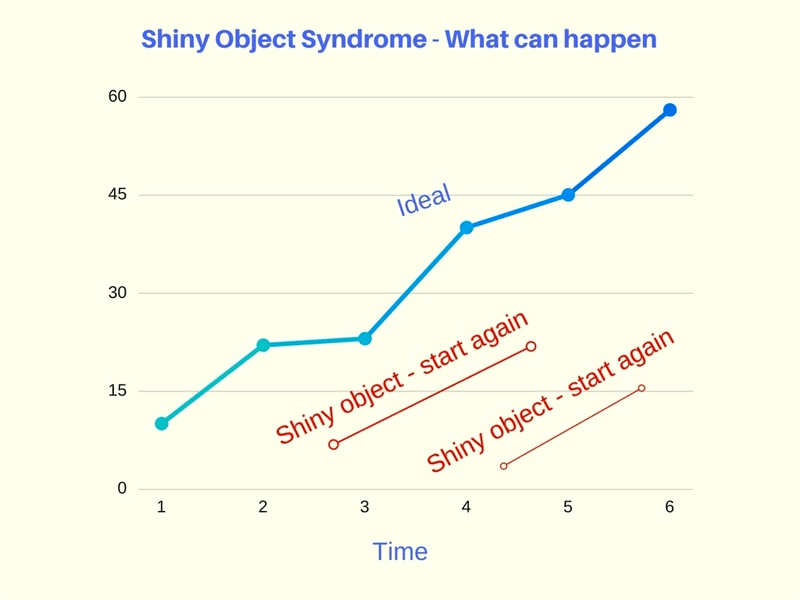
But when you are constantly attracted to shiny objects, you never have the chance to become great at something. You’re always climbing the learning curve for each new thing you chase. (Image: Jan Sullivan)

How to Avoid the Shiny Object Syndrome: 7 Tips

So how can you stay focused and avoid the shiny object syndrome?

  1. Understand that new does not mean better. To be clear, addressing the shiny object syndrome is not about ignoring every new thing. In today’s world, it is important to keep in touch with the latest trends and updates. However, when all you do is follow every new tool and idea, you waste your time chasing trends rather than getting things done. Understand that new doesn’t mean better. Just because a company just launched something new doesn’t automatically mean that it’s better.
  2. Learn to see past the hype. There are constantly new, shiny objects in the online world. New startups, new products, new services. On social media, seeing raving reviews creates a mob mentality where you feel the need to jump in and follow what others are doing.

    But see past the hype. While people may brag about how great a product/service is, what’s good for others may not be good for you. Even though a company can promise the world on what their product can do, many startups, ideas come with birthing pains and issues. Rather than jump headfirst into something, question how it fits in with your priorities.

  3. Assess its fit with your work (and life). Before jumping into a new idea or tool, assess its fit with your work and life. Don’t follow what others are doing just because it’s the hottest thing now — it’s not sustainable. Ask yourself,
    1. Is this what I really need?
    2. Will it add value to my work and life?
    3. What are the pros vs. the cons of doing this?

    Only do something if it’s what you need and it adds genuine value to your work and life. Just because others are doing something doesn’t mean you have to.

  4. Improve your signal-to-noise ratio. The best way to manage distraction is not through discipline, but by managing the sources of distraction. When you are part of groups and newsletters that keep recommending new products, new offerings, it disrupts your focus and train of thought. You have to deal with the mental load of looking up each recommendation, assessing if it’s good for you, and making a decision about it. This is known as cognitive load, something that I mentioned in my How to Say No podcast.

    Instead of sieving out noise which takes up precious mental energy, remove low-quality information sources. Evaluate your social media news feeds, Facebook group memberships, email subscriptions, and RSS feed subscriptions. What is your noise-to-signal ratio for each channel? Noise refers to information that’s irrelevant to you, while signal refers to information that’s useful and relevant. A high noise-to-signal ratio means the channel has a high proportion of unhelpful, irrelevant suggestions (noise) vs. helpful suggestions (signal). Unsubscribe from groups and newsletters with a high noise-to-signal ratio. Get your information from sources with a high signal-to-noise ratio instead.

  5. Understand the concept of switching costs. Even though there are new tools released all the time, I only look into a new tool when (a) it has something that my current tools can’t provide, and/or (b) there are very strong reviews from multiple sources. Otherwise, I simply take a cursory glance at what’s available and return to my work priorities.

    One reason is that when you shop even though you don’t need anything, you’re invariably going to end up buying something. The second reason is switching costs, which are invisible costs incurred as a result of switching to something new. Switching costs can be monetary. They can be the time taken to learn a brand new system. They can also be the mental cost of changing your focus. When you keep switching to new ideas, new projects, and new tools, you are just incurring switching costs all day long and getting nothing done. Always factor such costs in when you are enticed by a new idea or tool.

  6. Adopt a “wait and see” approach. When you’re unsure, it helps to adopt a “wait and see” approach. With rapid technological changes today, many tools tend to become obsolete after a couple of years. For example, many WordPress plugins are no longer supported or have died out. Products that claim to be the best often get replaced by better products one to two years later.

    My personal approach when I feel 50/50 about something is to wait and see. If it’s a new tool, I take the chance to look at the company’s background, preview the tool, and assess if I really need it. For new online tools, there are often integration issues and unknown bugs, and it can be costly to be an early adopter if you already have a live business with customers. Unless this is something that I need to use now and I have no other alternative, I find that “waiting and seeing” a much more prudent approach.

  7. Differentiate between shiny objects and real opportunities. Last but not least, learn to differentiate between shiny objects and real opportunities. Shiny objects are things that look good and exciting, but are really distractions at the end of the day. There are many new products these days that look promising but don’t add value to your work and life. By the time you are done with it, you realize you have no need for that tool — after which you get distracted by another shiny object.

    Keep a watch out for real opportunities — and be ruthless in saying no to shiny objects. Real opportunities make a real impact in your work. For example, tools that dramatically improve your workflow. Tools that help you grow your business. Tools that help you better engage with customers. Tools that help you deliver better products and services.

Have you been distracted by shiny objects? It’s time to get your focus back on. Get clear on your big rock priorities, invest your 10,000 hours, and pursue ideas that make a real change. Let’s get a move on and work on our real priorities! 🙂

Read:

The post The Shiny Object Syndrome: How to Stay Focused and Stop Getting Distracted appeared first on Personal Excellence.

Read More

8 Habits That Can Really Change Your Daily Life

You’re reading 8 Habits That Can Really Change Your Daily Life, originally posted on Pick the Brain | Motivation and Self Improvement. If you’re enjoying this, please visit our site for more inspirational articles.

habits that can really change your daily life

Your mind decides your altitude. Jack Canfield, an American author, and entrepreneur has said – Successful individuals do not simply drowse off to the highest. Obtaining there needs targeted action, personal discipline and plenty of energy daily to create things happen. And he could not be a lot of correct.

So, do not let ancient habits hold you back. Begin setting up these easy yet necessary habits for a more joyful and increasingly beneficial life:

1. Say Thanks

Having a constant gratefulness habit has several verified health advantages like high relationships, more noteworthy mental and physical health and higher self-respect.

So whenever you see something that you admire having in your life, keep a silent yourself or perhaps a not speechless when suitable – thanks. Be it a short conversation with an unknown person, a sapid meal, a reliable vehicle, a useful fellow worker, no matter it’s for you – say thanks.

2. Continue to keep a daily journal

Like contemplation, you do not have to be compelled to log multiple journal pages each day to be generative. However, obtaining your unchanged thoughts out on the page habitually notwithstanding for only a couple of minutes or one-page value continues to be extremely helpful.

Journaling clarifies your mind for the day, keeps your brain in innovative mode, enables you to mark out purposes for the day, assists you achieve them and an additional also, it is relaxing.

3. Take exercise regularly

Notwithstanding all the physical advantages of daily exercise, moving your body has numerous psychological and emotional advantages also. Improved confidence, a lot of energy, enhanced brain power, diminished pressure, and better sleep are only some of the mental advantages of having a daily exercise schedule.

If you’ve got access to a gymnasium and utilize it, it’s great. If it is not, don’t be worried. Only ten to a half-hour of moving, yoga, walking or reinforcing with light weights will give all of the equivalent benefits of figuring out at a gymnasium.

4. Hear uplifting music or play a musical instrument

The nature of what you consume without a doubt influences your energy and mindset. Media filled with negativity may adversely influence your temperament and health, yet higher vibration media can make active and do well you.

Attempt starting your day by abstinence from social media and TV. Rather, put on some great music to go with your morning schedule or commute. If you do not get the music you like already, find out positive music or motivational video from online.

On the other hand, you can play any kind of musical instrument. If you have, it’s OK. If you don’t have, you can buy a guitar, ukulele, piano or any other musical instrumen that you like best and play at any time of the day for only 15-30 minutes.

With motivating music or playing a musical instrument in the background, you will find your regular tasks are very enjoyable.

5. Work on Morning Meditation

A meditation practice does not require to be a half-hour in length to be helpful. In fact, 5 minutes of sitting quietly along with your eyes stopped whereas concentrating on your breath, worship, or mantra can diminish pressure and nervousness, decline blood glucose, enhance brain, and promote positive thoughts.

6. Read books

Reading books could be a good way to achieve knowledge and awaken creativity. Plunge reading also promotes focus and contains a calming impact the same as meditation. In addition, reading before sleep will assist you to sleep higher. Non-fiction books, specifically, are a wonderful tool to widen horizon, improve new thoughts, look for inspiration. In addition, they also provide an actionable recommendation on a way to exceed all types of difficult circumstances through true-life examples.

7. Encircle yourself with positive people

Jim Rohn, the American author, and entrepreneur said – “A person is the average of the 5 people he spends the most time with”. This can be exactly why you ought to deliberately think about whom you are expending time with. Let go of friendships that pull you down rather than lifting you up. And expend time with people who understand how to support and share the delight. As happiness is infectious, it is one of the simplest ways to make positivity in your life.

8. Keep positive

It’s anything but difficult to think about how remaining positive can enable to create your life better. Well, consider about it this way – once you are positive, you manage frustrations better and are consequently more possible to conduct pressure in a very healthy manner. This alone is sufficient argument to find out a way to keep positive particularly while everything feels to be falling down.

Remaining positive additionally suppresses your dread of making an attempt out new things. An individual with a positive mood will be more valiant about applying for that activity and since we all know, confidence is essential throughout these interviews.

Positive thinking results in more sound living as people are increasingly worried about what’s beneficial for them and what is not. So, positivity is a more helpful quality than you might imagine.

Some simple habits have the highest influence, therefore don’t be worried about creating life-changing choices overnight. Change is continuous and it occurs through frequent motions that we tend to habits.

You’ve read 8 Habits That Can Really Change Your Daily Life, originally posted on Pick the Brain | Motivation and Self Improvement. If you’ve enjoyed this, please visit our site for more inspirational articles.

Read More

How to Identify Your Creative Block and Succeed

There is untapped creativity inside you that will enrich your life if you learn to identify and remove the creative blocks in your way. Identify Your Creative Block and Thrive! By Lien Potgieter      Untapped creativity is detrimental to your life, relationships, business, and career. If you believe that you are not creative or that there is no need for creativity, you could even become obsolete. According to the World Economic Forum, the Future of Jobs report creativity will be third on the list of the top ten critical skills by 2020. In the short space of just five years, creativity has moved up seven places from ten to number three. You can increase your creative intelligence (CQ) despite the outdated notion that people are either right- or left-brain dominant. New research shows that we need to use both sides of the brain to be successful. Unconventional paths often lead to brilliant solutions. Color, which you find all around you, could act as a catalyst to identify what exactly is causing you to feel, think or believe that you can’t connect the dots. Many problems can be solved, and challenges overcome with the help of these vibrational energies.   How can color help? By becoming aware of the colors in your environment, you can pinpoint your creative block. It is a simple yet powerful method. Your color attractions and rejections demonstrate where you are stuck: Physically, emotionally, mentally, or spiritually. Only when we know what the heart of the matter is can you take action, unblock your creativity, and live a life of success and happiness.   Tell-tale signs of a creative block and how to overcome it How do you know where the block is? Here are a few signs to look out for. Body: If your block has a…

Continue Reading

Read More

4 Steps to Transform Your Life

Are you happy with where you are?  If not, follow these steps to transform your life! Transform Your Life  By Sivarama Swami     We all know nothing comes easy in life. Warren Buffet said, “We don’t have to be smarter than the rest. We have to be more disciplined than the rest.” And with so many distractions like the internet, social media, smartphones, fashion, and so on, discipline is usually the last thing on our minds. But self-discipline is the foundation upon which skills, professions, and life-choices are built. Think of where you would be now if you didn’t go through the discipline of driving lessons and learning the rules of the road. Probably six feet under. Similarly, self-discipline is necessary for all other aspects of life, whether it’s education, health, marriage, business, or raising children. The result of all activities depends on how committed we are to be practicing the disciplines that come with that activity. In other words, in any endeavor, the rule of thumb is that as much as you put into it, that much you get out of it. You can’t withdraw money from a bank account you haven’t put money into. But we often face obstacles to discipline like a lack of motivation or just plain procrastination. Here are 4 tips to help you on your path to transform your life – tips you can add to your life right now. 1. Wake up early! Benjamin Franklin said, “Early to bed, early to rise makes a person healthy, wealthy and wise!” As a practicing monk for 50 years, it is my habit to rise before 4 am. Rising early may require adjustments and rescheduling, but the benefits of being more focused and more “ready to go” are extraordinary.   2. Add a spiritual dimension…

Continue Reading

Read More