How to Sleep Better After 50: What Changes and What Helps
Bed a little earlier. Up a little earlier. Awake at 3 a.m. for no good reason.
Sound familiar?
If it does, you’re not alone. Sleep changes as we get older. The good news is that a lot of what helps is simple. Most of it is free. And you can start tonight.
What changes after 50
Here’s what the National Institute on Aging (NIA) says happens to many of us.
We go to bed earlier, and we wake up earlier. “Older adults tend to go to bed earlier and wake up earlier than younger adults,” the NIA says. (NIA)
Our sleep gets lighter. “Sleep tends to be shorter and lighter, and you may wake up more often during the night.” (NIA)
Trouble sleeping gets more common. “Insomnia is the most common sleep problem in adults age 60 and older.” (NIA)
And many of us take medicines now that we didn’t take at 30. The NIA notes that older adults “are also more likely to take medications and have medical conditions that affect sleep.” (NIA)
What doesn’t change
Here’s the part a lot of people get wrong. We don’t need less sleep just because we’re older.
The NIA puts it plainly: “Older adults need about the same amount of sleep as all adults — seven to nine hours each night.” (NIA)
The CDC breaks it down by age. It lists 7 to 9 hours for ages 61 to 64, and 7 to 8 hours for ages 65 and older. (CDC)
So the hours are about the same. What changes is how easy it is to get them.
7 habits that help
These come straight from the NIA, the CDC, and Mayo Clinic. None of them cost a dime.
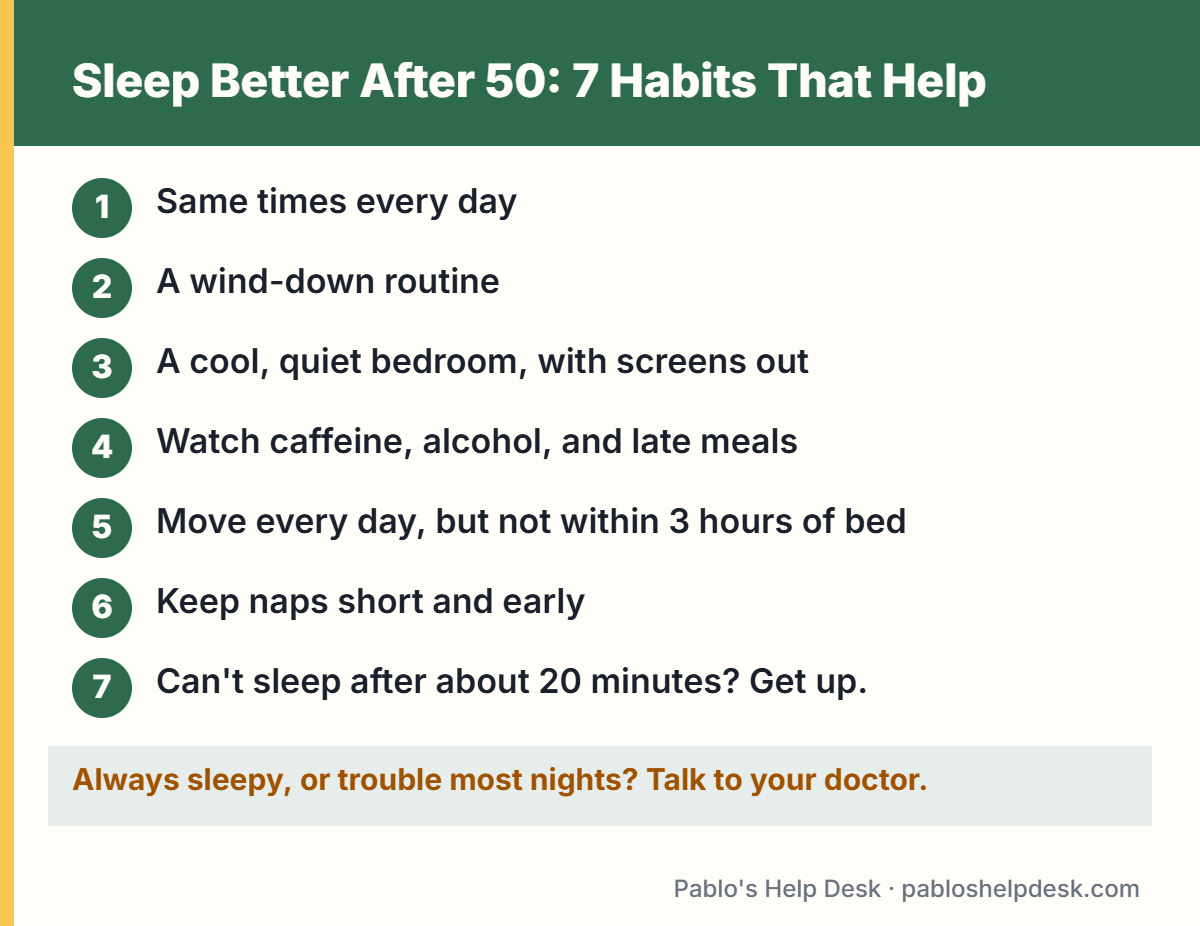
1. Same times every day.
Go to bed and get up at the same times. Every day. The NIA says, “even on weekends or when traveling.” (NIA) The CDC says the same thing. (CDC) This one matters most. Your body likes a schedule.
2. A wind-down routine.
Give yourself a little time to slow down before bed. The NIA suggests you “Read a book, listen to soothing music, or take a warm bath.” (NIA) Do the same thing most nights. After a while, it tells your body that sleep is coming.
3. A cool, quiet bedroom.
The CDC says to keep your bedroom “quiet, relaxing, and at a cool temperature.” (CDC)
And move the screens out. The CDC says to turn off electronic devices “at least 30 minutes before bedtime.” (CDC) The NIA says to try not to watch TV or use a computer, cell phone, or tablet in the bedroom. (NIA) Yes, that means the phone, too. Hum!
4. Watch the clock on food and drink.
Three things to know here.
- Caffeine. The NIA says to avoid caffeine late in the day. That includes “coffee, tea, chocolate, and soda.” (NIA)
- Alcohol. That nightcap may not help. Mayo Clinic says alcohol may make you sleepy at first but can disturb your sleep later in the night. (Mayo Clinic) The NIA’s advice is to avoid it, “even small amounts.” (NIA)
- Big meals and lots of liquid. The NIA says to avoid large meals within two to three hours of bedtime, and to avoid drinking large amounts of liquid late in the day. (NIA) Fewer trips down the hall at 2 a.m.
5. Move every day.
Regular exercise helps. Just watch the timing. The NIA says to get regular exercise, “but not within three hours of your bedtime.” (NIA) A morning or afternoon walk works well.
6. Keep naps short and early.
Naps are fine. Late naps are the problem. The NIA says to avoid napping in the late afternoon or evening. (NIA)
Mayo Clinic says, “A 20- to 30-minute nap is ideal.” It also says, “Take naps in the early afternoon,” because napping after 3 p.m. can make it harder to sleep at night. (Mayo Clinic)
7. Can’t sleep? Get up.
Lying there staring at the ceiling doesn’t help. Mayo Clinic says, “If you don’t fall asleep within about 20 minutes of going to bed, leave your bedroom and do something relaxing.” Then go back to bed when you feel tired. (Mayo Clinic)
If a busy mind keeps you up, the bedtime to-do list in my post on how to plan your week in 15 minutes is worth a try.
You don’t have to do all seven at once. Pick one or two. Stick with them for a couple of weeks. Then add another.
When to talk to your doctor
A bad night now and then happens to all of us. But some things are worth a call.
The NIA says, “If you’re always sleepy or you find it hard to get enough sleep at night, it may be time to talk with a doctor.” (NIA) Mayo Clinic agrees: “If you often have trouble sleeping, contact your health care provider.” (Mayo Clinic)
Talk to your doctor if:
- You’re tired during the day most days, even after a full night in bed.
- You have trouble falling asleep or staying asleep most nights.
- Someone tells you that you stop breathing for a few seconds while you sleep. The NIA lists this as a sign of sleep apnea, which “causes you to stop breathing for a few seconds repeatedly during sleep.” (NIA)
- You wonder if one of your medicines is keeping you up. Bring your list of medicines and ask your doctor or pharmacist. Don’t stop or change a medicine on your own.
But let me state: don’t just put up with being tired all the time. It’s not “just getting old.” It’s worth asking about.
The bottom line
Our sleep changes after 50. Our need for it doesn’t.
Same times every day. A wind-down routine. A cool, quiet room. And a talk with your doctor if it’s not getting better.
Start with one habit tonight. See how you feel in two weeks.
If you’d like more on the daily practices that hold us up, read Foundations of Well-Being: The Four Practices That Actually Hold You Up. And if building a new routine is the hard part, The Compound Effect of Small Choices: Why Systems Beat Willpower Every Time can help.
Thanks,
Pablo
This article is for general education only. It is not medical advice. Talk to your doctor if you have trouble sleeping, feel tired most days, or have questions about your medicines.
Free · 2 pages · Print it
Get The Scam-Proof Checklist
10 plain-English rules that stop most scams cold, plus what to do if one already got through. Keep it by the phone. I’ll also send you new posts when they come out.
No spam. We never sell or share your email. Unsubscribe any time with one click. Privacy