Just Got Scammed? What to Do in the First 60 Minutes
It happened. You paid. Or you gave out a password. Or you let a stranger into your computer. And now your stomach just dropped.
First, take a breath. You are not the first. You won’t be the last.
The FBI got 201,266 complaints from people 60 and older in 2025. Those folks reported losing $7.7 billion. That’s up 59% from the year before. (FBI IC3 2025 report)
That’s our money. A lot of it. And these crooks are good at what they do.
So no beating yourself up. Not today. Today we move.
Part of my “Know the Trick” series. This one: pressure to act now.
The trick they just used on you
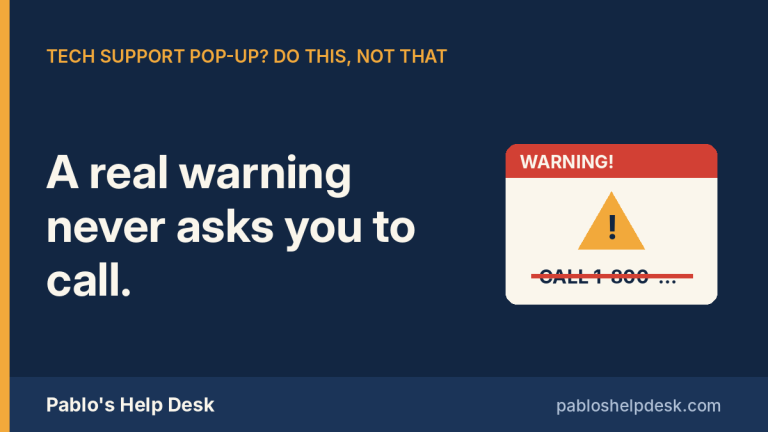
The FTC lists four signs of a scam. One of them is this: scammers pressure you to act right away. They may even tell you not to hang up, so you can’t check their story. (FTC)
Here’s the funny part. Now you need to move fast. But this time, you set the pace. You call the numbers you trust. You do it in order.
Here’s the order.
Step 1: Stop
- Hang up. Close the chat. Don’t reply.
- Don’t send more money. Not even “one more fee to fix it.”
- Tell someone you trust. The FTC says, “Before you do anything else, tell someone — a friend, a family member, a neighbor — what happened.” (FTC)
A second set of eyes helps. It also helps you slow down.
Step 2: Call the company you paid. Right now.
This is the big one. The FBI says, “If you discover a fraudulent transfer, time is of the essence.” (FBI IC3 2025 report)
And speed can work. In 2025, the FBI’s team that works with banks helped freeze about 58% of the money in the cases it worked on. (FBI IC3 2025 report) No promises for any one case. But it’s a reason to call now, not tomorrow.
Use a phone number you know is real, like the one on the back of your card or on your statement. Not a number the scammer gave you.
Here’s who to call, based on how you paid. All of this comes from the FTC. (FTC)
- Credit card: Call the card company. Tell them it was fraud. Ask them to reverse the charge. Federal law protects you from unauthorized use of your credit card.
- Debit card: Call your bank or credit union. Ask for a refund. Federal law protects you here too.
- Bank transfer or Zelle: Call your bank or credit union right away. Ask them to reverse it.
- Payment app (Venmo, Cash App, PayPal): Report it in the app right away and ask for a reversal. If the app is linked to a card or bank account, call them too. (FTC)
- Wire transfer: Call the wire company. Tell them you were tricked. Ask for your money back. The FTC lists MoneyGram at 1-800-926-9400 and Western Union at 1-800-448-1492. (FTC)
- Gift card: Call the company that sold the card. Say it was used in a scam. Keep the card and the receipt.
- Crypto (including a Bitcoin ATM): Call the exchange or the ATM company right away. Ask them to reverse it. But let’s be honest about this one. The FTC says crypto doesn’t have the same legal protections as credit and debit cards.
- Cash in the mail: Call the U.S. Postal Inspection Service at 1-877-876-2455 right away.
Some money comes back. Some doesn’t. The FTC says plainly, “your money might be gone already.” It’s still always worth asking. (FTC)
Step 3: Lock things down
What did you give them? Fix that next. (FTC)
- A password: Change it. Change it anywhere else you used the same one. Turn on two-step login (the FTC calls it two-factor authentication).
- Your Social Security number: Go to IdentityTheft.gov. It gives you a step-by-step recovery plan.
- Remote access to your computer: Update your security software. Run a scan. Delete anything it flags. Then change your passwords.
- Control of your phone number: Call your phone company to get your number back. Then change that account’s password. (FTC)
Step 4: Freeze your credit
If the crook got your Social Security number, your bank info, or other personal details, the FBI says to protect your credit by contacting the three big credit bureaus: Equifax, Experian, and TransUnion. (FBI IC3)
A credit freeze stops a crook from opening new accounts in your name. Here’s what the FTC says about it: (FTC)
- It’s free. “There’s no cost to place or lift a credit freeze.”
- It doesn’t hurt your credit score.
- You have to contact all three bureaus. One call won’t cover the others.
Not ready to freeze? A fraud alert is a lighter step. You call just one bureau, and it must tell the other two. It lasts one year, and you can renew it. (FTC)
Step 5: Report it
Reporting feels like extra work when you’re upset. Do it anyway. The FBI says, “Do not be afraid to report a suspected crime.” (FBI IC3)
- The FTC: ReportFraud.ftc.gov. The FTC uses reports to build cases and warn other people. (FTC)
- The FBI: ic3.gov. If you’re 60 or older, pick the Elder Fraud option. (FBI IC3)
- Your local police. The FBI says to contact local authorities too. (FBI IC3)
Want a real person to walk you through it? You have two free choices:
- AARP Fraud Watch Network Helpline: 877-908-3360. Monday to Friday, 8 a.m. to 8 p.m. Eastern. Free support for people targeted by scams. (AARP)
- National Elder Fraud Hotline: 1-833-FRAUD-11 (833-372-8311). Monday to Friday, 10 a.m. to 6 p.m. Eastern. They help with filing your FBI report. (U.S. Department of Justice; FBI IC3)
Step 6: Watch out for round two
Some crooks buy lists of people who have already been scammed. The FTC calls them “sucker lists.” (FTC) Then they call, text, or email and say they can get your money back. They may say they’re from a government agency, even the FTC, or a law firm. (FTC)
The catch? They want a “fee” first.
But let me state: “Government agencies and legitimate organizations will never ask for money to help you get a refund.” (FTC)
So if anyone wants money to get your money back, that’s a scam too. Hang up. Look up the agency’s number yourself. (FTC)
Learn the tricks so it doesn’t happen again
Once the dust settles, take a few minutes to learn how these scams start. Two places to begin:
- If a text started it, read how to tell if a text is a scam.
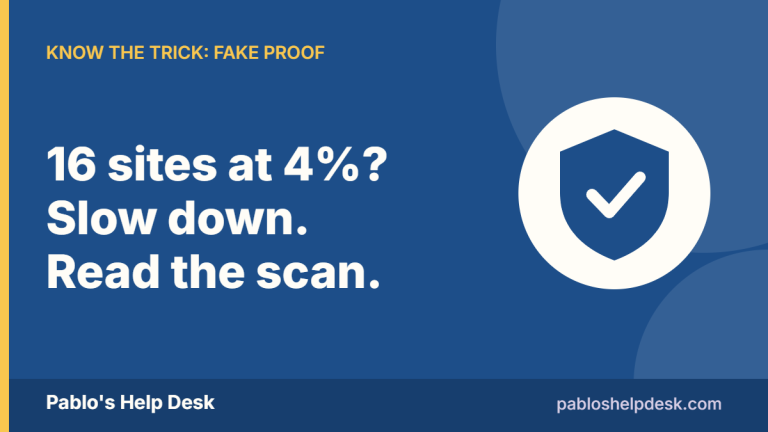
- If a scary “your data is exposed” scan started it, read the 4 signs that scan is a sales pitch.
The bottom line
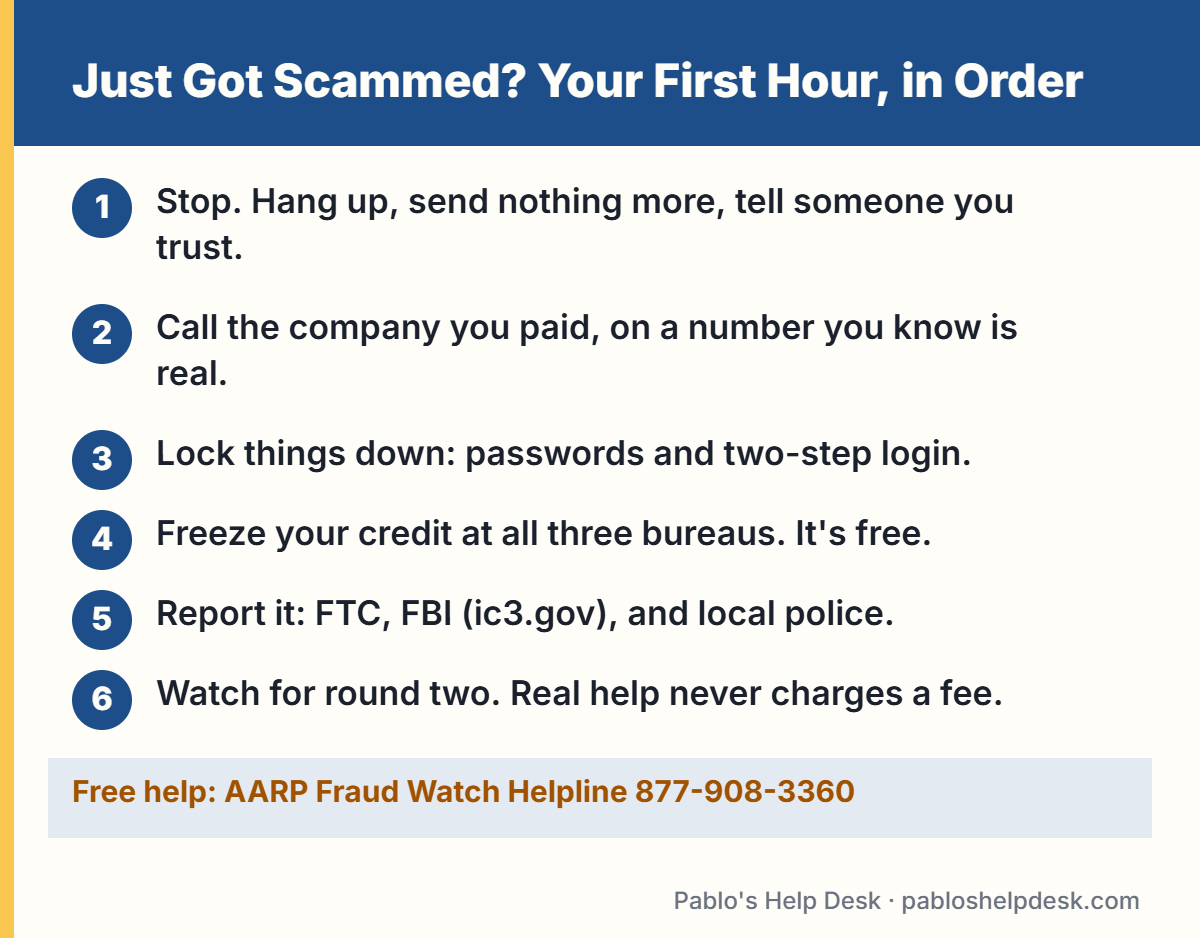
If you just got scammed, here’s your first hour, in order:
- Stop. Hang up, send nothing more, tell someone you trust.
- Call the company you paid, on a number you know is real.
- Lock things down. Passwords, two-step login, IdentityTheft.gov if they got your Social Security number.
- Freeze your credit at all three bureaus. It’s free.
- Report it to the FTC, the FBI, and your local police.
- Watch for round two. Nobody real charges you to get your money back.
The tell: A scammer rushes you to pay. Real help gives you time, and it never charges you to get your money back.
Thanks,
Pablo
This article is for general information only. It isn’t legal or financial advice. Every case is different. Your bank, card company, or a lawyer can tell you what applies to you.
Free · 2 pages · Print it
Get The Scam-Proof Checklist
10 plain-English rules that stop most scams cold, plus what to do if one already got through. Keep it by the phone. I’ll also send you new posts when they come out.
No spam. We never sell or share your email. Unsubscribe any time with one click. Privacy
One Comment