An 81-year-old man, who has not yet been identified, managed to shrink his tumors in half after being diagnosed with lung cancer and refusing traditional cancer treatment such as chemotherapy and radiation.
The man, who previously smoked around 18 cigarettes per day but quit 45 years ago, repeatedly refused medical treatments offered by doctors after being diagnosed with adenocarcinoma of the lung, opted to take cannabidiol (CBD) oil instead. After three months of almost daily use, scans of the man’s lungs showed that, not only did the tumors reduce in size by half, but the progression of the disease was completely reversed.
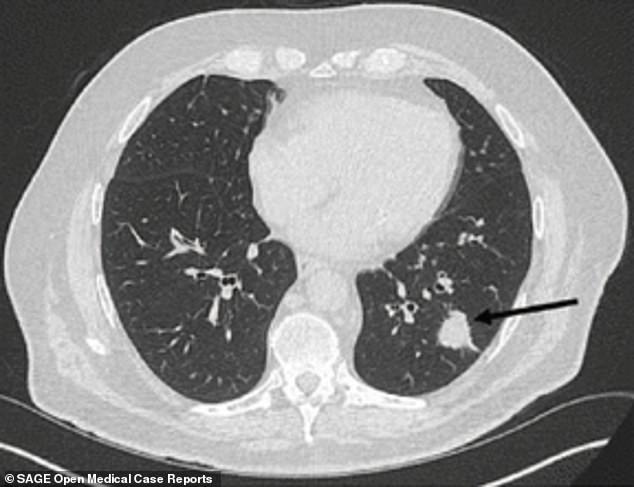
The man’s doctors have published the stunning scans and detailed his case in SAGE.
In October 2016, the man, who had previously been diagnosed with chronic obstructive pulmonary disease (COPD), diabetes, and prostate cancer (in remission), made an appointment with his primary care doctor after dealing with shortness of breath but no cough for the previous three weeks. An x-ray revealed a shadow in his left lung, which a follow-up CT scan confirmed as a 2.5 × 2.5 cm mass. A biopsy confirmed the diagnosis of lung adenocarcinoma and mediastinal lymph nodes.
CT scan of the man’s lungs from July 2017. The arrow indicates the location of the tumor.
CT scan of the man’s lungs from November 2017. The arrow indicates the location of the tumor, which reduced in size since the previous scan.
The report highlights the fact that, despite the improvement of targeted therapy in lieu of conventional therapy for lung cancer as well as the availability of new drugs, “lung cancer is associated with a very poor prognosis.” Because “it is not uncommon for many patients to have only a partial response, and relapse during follow-up,” it is not unusual for some patients to decline medical treatment altogether or opt for a natural alternative instead, especially later in life when available treatments tend to have a more detrimental effect on the body.
According to the report:
“Prior work has shown that cannabidiol may have anti-neoplastic properties and enhance the immune response to cancer. The data presented here indicate that cannabidiol might have led to a striking response in a patient with lung cancer.”
The man reported that he began taking CBD oil (200 mg CBD in 10 mL) in September of 2017. He began with two drops twice daily for a week before increasing to nine drops twice daily for the rest of the month. After a November CT scan, he increased his dose to nine drops twice a day, save for a short break in which he felt the taste caused slight nausea, but never actually made him physically ill.
During the period of the time in which the tumor’s shrunk, there were no notable changes in the man’s diet, lifestyle, or medication.
CBD oil is a non-psychoactive phytocannabinoid found in cannabis plants (or Cannabis sativa). It has been shown to aid users in treating anxiety, arthritis, pain, depression, and more and is being used with increasingly frequency to relieve pain associated with cancer and cancer treatment and in an attempt to treat the cancer itself.
While experts warn that the case presented is just one instance of a cannabis success story and that the ability of cannabis to have any impact on cancer whatsoever is unproven, the report noted the importance of being “attentive to patients where the disease responds to treatments not considered standard in clinical practice.”
It was reported last year that an 83-year-old man named Gary Hill, who was also diagnosed with lung cancer, was also able to successfully shrink his tumor by using CBD oil. Reports citing anecdotal evidence continually surface detailing how cancer patients using cannabidiol were able to shrink or completely cure their cancers including skin, breast, and liver cancers. In extreme cases, some patients have even halted conventional treatment due to a significant risk that they may not even survive it, only to later cure their cancer using CBD oil. Such a case, involving a three-year-old girl, was reported by People magazine in 2018.
We’ve gathered 10 mindfulness practices created by women to help you live a generous, compassionate, healthy life.
1) Loving-Kindness with Sharon Salzberg
Loving-kindness meditations point us back to a place within, where we can cultivate love and help it flourish. Developing care toward ourselves is the first objective, the foundation for later being able to include others in the sphere of kindness. Here’s a simple explanation of the loving-kindness practice, which involves silently repeating phrases that offer good qualities to oneself and to others:
To be kind to others, you need to start with yourself. Read More
Sharon Salzberg
October 5, 2015
2) Mindful Conversations with Lili Powell
Practicing mindfulness in social interactions isn’t a solo pursuit, or still, or quiet. By definition, you have to be with others, you have to act, and you have to communicate. So what’s a well-meaning practitioner to do? You can get started with these simple practices for cultivating poise in crucial conversations. Start by practicing the following exercises solo one at a time, then graduate to putting them together in conversations with others:
To perform at our best in crucial conversations, marrying mindful intentions with mindful actions helps to ensure that you can make good on your good intentions. Read More
Lili Powell
July 1, 2016
3) Loving Connection with Tara Brach
Tara Brach and her husband, meditation teacher Jonathan Foust, have developed a regular practice for keeping the lines of communication open and maintaining a deep, loving connection. They engage in the practice two mornings a week. Here’s how Tara suggests going about it.
Explore this practice for building connection—a sneak peek from Mindful’s feature story on relationships in the April 2017 issue. Read More
Tara Brach
April 13, 2017
4) Meditation on Your Self-Critical Voice with Diana Winston
There seems to be this epidemic of self-judgment in the world, where people are often self-critical and have a lot of self-hating voices in their heads. Self-compassion is not the build up of self-esteem, because the build up of self-esteem tends to lead people to needing a lot of external validation to feel ok. Instead, self-compassion is the idea that even with all of our flaws, we can still care about ourselves, that we can make mistakes, that we can screw up, that we can have problems, but we’re still fundamentally a good human being.
A guided meditation to get familiar with self-judgements and how we relate to our flaws, so that you can cultivate compassion and recognize your own worthiness. Read More
Diana Winston
November 6, 2018
5) Radical Listening with Mirabai Bush
We give very little attention to learning to listen, learning to really hear another person or situation. Yet think back to the moments with other people when our hearts were engaged and we felt fed by being together. In those moments, weren’t we hearing one another? Here’s how mindful listening leads to real change:
When we think we already know what there is to hear, we are simply moving a little too fast to really listen—That’s where meditation comes in. Read More
Mirabai Bush
January 31, 2017
6) Loving-Kindness for Mothers with Sona Dimidjian
The loving-kindness practice that taught in Mindfulness-Based Cognitive Therapy with moms who have a history of depression has been a touchstone for many during hard times. We share a portion of the guided meditation here with you with our wish that you and your children are well and live with ease:
Parenting is beautiful and rewarding, and it is hard work, even on the best of days. Try leaning on this mindfulness practice when things get rough. Read More
Sona Dimidjian
June 23, 2016
7) Breathing Compassion In and Out with Kristin Neff
The good intentions cultivated by loving-kindness meditation lead to more supportive self-talk and better moods. You can hold your own suffering fully, and also hold the suffering of this other person. Ride it like the waves on the ocean—in and out.
Kristin Neff guides us through a twenty-minute compassion meditation, first directing kind phrases to ourselves and then to others. Read More
Kristin Neff
September 4, 2018
8) Taming Shame with Patricia Rockman
Becoming familiar with a difficult emotion means getting interested and curious about it, like you might do when visiting a new city. Take it slow, uncovering new “territory” a bit at a time instead of trying to get to know it all at once. As you do, you learn that you can sit with uncomfortable feelings, and that they will eventually pass. Over time, you develop resilience, self-knowledge, and trust in yourself—the best antidotes to the self-judgmentthat shame inspires.
Exploring difficult emotions and experiences may be the key to loosening their hold over us. Try this 10-minute mindfulness practice from Patricia Rockman, MD. Read More
Patricia Rockman
September 7, 2017
9) A Meditation for Moving on from Holly Rogers
Sometimes there are things in our life that we’re not crazy about, that are quite unpleasant, very distressing even—and yet there’s nothing we can do about it. And in those moments acceptance, acknowledging what is true without adding on layers of “I don’t want this to be true,” “It’s not fair,” “I don’t like this,” “Why did this happen to me,” can help us get through these difficult times with more ease.
We can’t ignore the hard stuff. Here’s a 10-minute mindfulness practice for navigating—not resisting—everything life throws our way. Read More
Holly Rogers
November 27, 2017
10) A Body Scan with Elaine Smookler
IWhen we can notice what we feel without having to hold on to it, we can let it go and return to the present moment over and over. And that feels damn good.
There’s a balancing of gender power happening across the professional world—including the mindfulness world. Ten leaders in the field share how they claim their power and bring the diversity of their experiences in the mindfulness movement to bear in their work. Read More
A thought/concept… If we are to make an assumption that good and evil do exist, that they are opposites of the same condition of existence and strive against each other, that existence is the state of being, that reality is simply the observable portion of existence…I am rambling, but this is the way my thoughts, my conscious and unconscious are struggling at the moment.
To the point; good is love that tends towards order and higher functioning, the opposite is evil, anti-love that tends to chaos and entropy, however neither can exist without the other. What if the ultimate expression of order is disorder and vice versa? Would then existence strive against itself to become more and more ordered to eventually create a state of disorder that would create a new existence? Could the opposite be true; that chaos can eventually become a new ordered state of existence?
Do the two seemingly diametrical opposed forces eventually end up at the same point of singleness and begin again?
By teaching “Do not judge”, the great teachers are saying that you cannot start seeing or understanding anything if you start with “no.” You have to start with a “yes” of basic acceptance, which means not too quickly labeling, analyzing, or categorizing things as in or out, good or bad, up or down. You have to leave the field open, a field in which God and grace can move.
Ego leads with “no” whereas soul leads with “yes.” The ego seems to strengthen itself by constriction, by being against things; and it feels loss or fear when it opens up. “No” always comes easier than “yes,” and a deep, conscious “yes” is the work of freedom and grace. The soul lives by expansion instead of constriction. Spiritual teachers want you to live by positive action, an open field, and studied understanding, and not by resistance, knee-jerk reactions, or defensiveness, and so they always say something like “Do not judge,” as judging is merely a control mechanism.
Richard Rohr, The Naked Now: Learning to See as the Mystics
No-one can cause you to feel inferior without your consent Are you affected by reduced self-confidence or inferiority intricate? I will talk about some self-help tips on how you can get over might acquire your assurance. You might have inferiority sophisticated mainly because he / she feels that you’ve a have to make an impression…
We have all tasted the “boundarylessness” of awareness on those occasions when we were able to suspend our own point of view momentarily and see from another person’s point of view and feel with him or her. We call this feeling empathy.
If we are too self-absorbed and caught up in our own experience in any moment, we will be unable to shift our perspective in this way and won’t even think to try. When we are self-preoccupied, there is virtually no awareness of whole domains of reality we may be living, immersed in every day but which nevertheless are continually impinging on and influencing our lives. Our emotions, and particularly the intensely afflictive emotions that “sweep us away,” such as anger, fear, and sadness, can all too easily blind us to the full picture of what is actually happening with others and within ourselves.
A Guided Meditation for Resting In Awareness
A Guided Meditation for Resting In Awareness
29:48
Through our practice of mindfulness, we have been cultivating an awareness that can become more and more stable and vivid, especially the more we practice with wise effort and intentionality. And this awareness can be either narrow or broad, depending on the circumstances it can recognize and embrace any and all sensations within the body, including the breath sensations. It can recognize and embrace seeing, hearing, smelling, tasting and touching, as well as those activities of mind we call thinking and feeling, and it can rest in a non-conceptual direct knowing of any or all of these aspects of human experience, beyond thinking, without separation or identification.
Or if on occasion we fall into identification and separation into a subject—a me—and the objects I am observing, either inwardly or outwardly, then awareness is capable of recognizing that as well and re-establishing the knowing itself, beyond any separation, beyond any identification, beyond the personal pronouns, beyond I, me, or mine, beyond thinking altogether. So the final expansion, if you will, within this framework is to abandon the framework. In the sense that we no longer choose a focus for awareness, but allow the field of awareness to be boundless. Since awareness actually is, and always has been boundless.
We no longer choose a focus for awareness, but allow the field of awareness to be boundless. Since awareness actually is, and always has been boundless.
But as we know from our own efforts, in minds that have not encountered training and mindfulness, awareness does tend to contract and nucleate around particular arisings, especially events that have emotional charge for us. And then it tends to fixate and either be very narrow, or very self interested and self centered. Or on the other hand, to fall into utter rebellion. In other words, no awareness at all, merely obsession or dullness.
So in this moment, resting in awareness, perhaps at first allowing the field of awareness to feature the soundscape, which is as we have experienced over and over again, always here, presenting itself to our ears comprising everything that presents itself in the form of sound and the spaces between sounds. Everything, without exception. So resting in hearing, being the hearing, without necessarily creating any distance between a you and what is being heard. But simply hearing. Being the hearing. Being the hearing right now, in this moment.
And of course if there are thoughts that make their way in, letting them be known because awareness can include the knowing of thought. And expanding the field of awareness whenever you care to, to include the air caressing the skin, the air that is the breath, the air that carries sound, and resting in the knowing of the air and the breath again through the sensations in the body, since it is only through the senses, including mind, that we can know anything. And we can naturally allow a field of awareness to include of course, not just the sensations associated with breathing or the touch of the air on the skin, but any sensations and all sensations in the body right here as we sit.
And so in this moment, with the field of awareness expanded this far, we have sounds and the spaces between sounds, we have the breath and we have the air, and we have sensations in the body. That’s a lot, and it is all happening in this one moment. And it’s not separate, although we can isolate any feature of it. So just allowing it all to be present without separation in this moment, and to rest in awareness of the experiencing of it, of it all. Sitting, breathing, feeling, hearing, knowing and why exclude thinking, since it’s going on anyway. So allowing the field of awareness to expand even further to include thought, the thought stream, the bubbles of thought. And any emotional currents, eddies or whirlpools that may arise in the mind or in the heart, accompanied or unaccompanied by images and thoughts, memories or fantasies. And just allowing ourselves to rest in this awareness, this bigger basket that holds it all.
And now in one last jump, let’s allow the field of awareness to expand infinitely to allow the mind, heart to be boundless, hugely spacious, as big as the sky or space itself, with no beginning and no end, no boundary, no circumference, no periphery. No center. And rather than focusing on anything in particular, just allowing the quality of our awareness to be choiceless. To rest in the non-conceptual knowing quality of mind itself. Not seeking out anything, not pursuing anything, not rejecting anything and not featuring anything, but like an electromagnetic field so to speak, that would instantly know any perturbation any movement whatsoever that would arise within it.
So the field of awareness, like a mirror but in many more dimensions knows, detects, feels sees and senses whatever moves, whatever arises, whatever it lingers, whatever dissolves. So resting in awareness itself, in the choiceless, boundless, vast, spacious quality of awareness itself. If sound predominates in some moment, then sound is known. If the thought follows on the sound, then the thought is known as thinking now. Conceptually it’s recognized, known, felt neither pushed away nor pursued, neither condemned nor extolled.
If in the next moment the sensation arises in your lower back or in your knee and predominates in the field of awareness for a moment, that is also felt, seen, known and neither pushed away nor pursued, condemned nor extolled. Awareness functions an open, empty, spacious mirror, empty and full, able to contain anything and needing nothing to complete itself. Undisturbed, imperturbable, never not here. Like the sun always shining even when clouds obscure it. And even if we become irritated or vexed, this boundless and accepting field of awareness embraces irritation and vexation, grief, joy. Anything and everything: pain, discomfort, agitation, boredom, depression, sadness.
Awareness functions as an open, spacious mirror, empty and full, able to contain anything and needing nothing to complete itself.
There is no mind-state and no body-state that can’t be held seen, felt, known, in this infinite, boundless spaciousness. This knowing quality of the heart, mind resting in its natural luminosity and radiance with nowhere to go, nothing to do, nothing to attain, no choices to make. And no one to make them sometimes.
This is known in the Chinese tradition as silent illumination, with the method of no method. Nothing missing, nothing extra, resting in this choiceless awareness that the Tibetans sometimes call non-meditation, when all the scaffolding falls away. They don’t call it meditation anymore, they call it non-meditation but it’s got a few adjectives that make it more precise. And demonstrate how challenging it is they refer to it as undistracted and fabricated non meditation just this moment, seen and known as it is by this boundless spaciousness. This all inclusive knowing that is truly what distinguishes us as human so is best you can. With effortless effort, resting in choiceless awareness.
If thoughts arise, they are met with mindfulness, seen and known in their arising like bubbles coming off the bottom of a pot. They just burst on their own. The Tibetans refer to this as self liberation the thoughts self liberate nice way to put it you don’t have to do anything just resting in awareness just attending with sounds sensations impulses perception’s thoughts emotions all coming and going in this fast benign kind compassionate, accepting and inclusive spaciousness, with no center, no periphery, no agenda, no preferences, no watcher, no words at all. Just this.
Of course if you get lost in the just this and that can happen very very easily. That may be featuring some object or other letting the field of awareness narrowed down reestablishing the stability of mind and then allowing it to expand out again to whatever degree you like either stepwise in the way that we’ve just done or jumping straight to choiceless awareness, because the awareness is never not here, it’s always available. And we’re beyond time, space, liking and disliking, meditating and not meditating. Just the wake of vast open field of heart-full awareness, resting here, nothing happening, nothing special. Simply life expressing itself and knowing it, and in the remaining few moments of this sitting if you care to coming back to the breath, letting go of the vast spaciousness for a moment and featuring the breath once again or the breath in the body, the body as a whole sitting here breathing, or anything else that you care to feature. Or if you care to simply continue dwelling in choiceless awareness, then of course. And in the spirit of this practice, it’s your choiceless choice.
Resting here until the sound of the bells signals the end of this period of formal practice, and keeping in mind that this pristine open spaciousness of heart and mind is available to you in any and every moment of your life, unfolding now first separate from you and inhabitable. As you cultivate ongoing awareness in your daily life through the practice of mindfulness. And as you commit yourself, if you care to, if it makes sense to, using the regular discipline of formal mindfulness practice, a commitment that is tantamount to giving yourself over and over again to the adventure of a lifetime, to the cultivation of wakefulness. For the sake of being free from the anguish, of unnecessary suffering from afflictive emotions. From ignoring what is most fundamental to life and for the sake of embracing with loving kindness and compassion and wisdom. All beings including, yourself who are living and breathing, and sometimes suffering in this mysterious and awe inspiring world we find ourselves in.
The above is adapted from Jon Kabat-Zinn’s Guided Mindfulness Meditation Series 3, available here. These guided meditations are designed to accompany Jon Kabat-Zinn’s book Meditation is Not What You Think and the other three volumes based on Coming to Our Senses.
This 9-minute guided walking meditation from Jon Kabat-Zinn explores embracing mindfulness with every footfall—varying the practice for speed and distance. Read More
This 20-minute guided meditation from Jon Kabat-Zinn explores embracing sensations as they arise in the body in order to ground ourselves in the here and now. Read More
A 20-minute meditation from Jon Kabat-Zinn to allow you to tap into your capacity to be in touch with your experience, and be awake and aware with no agenda other than to be awake and aware. Read More
First and foremost I would like to tell you that I am a tremendous fan. I have listened to all of your audio tapes repeatedly. They are so enjoyable, peaceful and so full of knowledge. However, I have a few questions. But I will start with one. In your book Seven Spiritual Laws of Success you state that one should chose the path of least resistance. I am currently doing pediatrics and entering child neurology. before transitioning from peds to child neurology, I informed my Peds Director about entering child neurology, she disapproved and then she made my life very difficult. My father also told me to just stick to peds and not do neurology. I listened to your tapes and thought about forgetting about child neuro. I was confused. But in the end, I kept saying that I should do it because it makes me happy regardless of the havoc it created around me. So what extent should I apply the rule of least resistance? What about minorities who fight for equality and are met
with resistance. Should they not fight for equality? I want to lead a spiritual and peaceful life but sometimes decisions I make upset people. What can you offer with regards to the philosophy of least resistance in my life?
Knowing yourself and feeling confident about yourself helps a lot in finding your passion at work. This begins with accurate understanding of your strengths and values – it’s what makes you feel good about yourself. The process starts by evaluating the factors that molded your personality – family, experiences, education, and trainings. Majority of your…
A few weeks ago, local Utah politicians (Rep. Chris Stewart and Sen. Orrin Hatch) helped get a suicide prevention bill onto President Trump’s desk that he signed into law. It tasks the government with creating a three-digit number that works as a shortcut to the National Suicide Prevention Lifeline (1-800-273-8255) for suicide and mental health crises, much like 911 for medical emergencies. It also authorizes an investigation into the effectiveness of both the lifeline and the Veteran Crisis Line.
If you would like to see changes to either of these services, now is a very good time to contact your congress critters and give them your feedback.
Without comment, President Donald Trump signed into law on Tuesday legislation sponsored by Rep. Chris Stewart and Sen. Orrin Hatch, both Republicans, to require the Federal Communications Commission to study the feasibility of such a hotline.
It is also ordered to recommend which three-digit number would be best for the hotline, examine the effectiveness of the current National Suicide Prevention Lifeline and Veterans Crisis Line, and recommend ways to improve the current system.
Stewart and Hatch hailed the new law and said it is long overdue.
“We now have the opportunity to make the National Suicide Prevention Hotline more accessible and easier to remember,” Stewart said. “By creating a hotline dialing code that is short and easy to remember, we are taking an important step towards potentially averting tragedy. This new law truly has the ability to save lives.”