Your Brain Preforms Better If You Feel Better

Now, isn’t meditation just the right boost to your brain power? Through meditation, your concentration will be strengthened, thus you can fully focus on any mental activity that you are working on. So you should learn to control your mind and use it efficiently for your own goals, do this by starting with breath techniques…

Read More

Building A Dream

Motivation is an intriguing stuff. Sometimes, you need big things – life events that have the power to turn you around – and sometimes, you only need those tiny motivators – a cute saying on a poster – to make you feel like you have to power to call your own shots. Build a dream…

Read More

Better Your Brain Power

The human brain is a multifaceted organization of cells and around fifty million neurons that work with utmost complexity in order to keep you going healthy and strong. It is believed to be five times bigger than an average brain of a mammal with the same body size. In human beings, the frontal lobes and…

Read More

How to Build an Edge: Develop Your Talent Stack

Talent Stack

Talent stack is a concept coined by Scott Adams, creator of the Dilbert comic. It’s the idea that you can combine normal skills until you have the right kind to be extraordinary.

An example is Scott himself. He’s not the best artist — there are better artists than him. He’s not much of a business expert — there are more savvy experts. He has never taken a college-level writing class. Yet, he created Dilbert, a famous comic strip that appears in 65 countries.[1] Scott is said to have a net worth of $75 million, majority of which comes from Dilbert.[2]

As he says, “When you add in my ordinary business skills, my strong work ethic, my risk tolerance, and my reasonably good sense of humor, I’m fairly unique. And in this case that uniqueness has commercial value.”

Understanding how a talent stack works is important. Normally, people think that success comes from developing talent in one skill. This works well in some fields. In medicine, the natural progression is to pick a specialty. In sports, you train to become best in your field, like Tiger Woods (golf) and Michael Jordan (basketball). In acting, you develop the best acting chops, like Robert De Niro and Morgan Freeman.

But besides becoming world-class in one skill, talent can come from having a unique stack of skills that no one else has. You can utilize different skills to create value in a way no one else can, thus becoming one-of-a-kind in your own league.

More Examples of Talent Stack

Lisa Elfridge is a celebrity make-up artist on YouTube. She was already known prior to starting her website and YouTube channel. But after she started her channel focusing on beauty and makeup tips, her authority and success rose to a whole new level.[3]

Reason? She is one of her kind in her field.

  • Celebrity makeup artists work with their clients for photo shoots, appearances. They don’t publish their work online. Most of their self-marketing happens offline, through networking, connections, etc.
  • On the other hand, online makeup gurus generally show how they do their own makeup. But they are not professionally trained. They cannot give professional advice on what is the best makeup for different skin tones, or for skin that is not like theirs.

Lisa has a unique talent stack to navigate the ultra-competitive beauty space:

  1. Makeup skills. She has professional makeup skills.
  2. Industry knowledge. She has real experience working with celebrities.
  3. Presentation skills. She communicates her makeup tips in an easy-to-understand way. White backdrop, no frills or production gimmicks. No music. Just her and her beauty tips.
  4. Video creation skills. She knows how to create professional-looking videos, or at the least she hires people with the right skills.

People in the celebrity makeup world have the first two skills. Online makeup gurus have the latter two skills. But Lisa is able to harness all four skills, hence becoming extraordinary in her field. That’s her talent stack.

Example: Blogging

When I started my blog, I was not much of a writer — I have never taken a professional writing class. I have average web design skills. I have good marketing and business strategy skills. I have very strong analytical skills. And I have a strong passion for growth.

Put these together and I was able to create a coaching business that thrives despite stiff competition. My blend of skills is strong enough to stand out in the market:

  1. Marketing and business strategy. Most web business owners do not have professional marketing knowledge. What was common sense to me, in marketing my business, was alien to everyone else. After entering the field, I realized no one really knew what they were doing in terms of business strategy and management. Many bloggers were just randomly blogging but no one was thinking about their blog as a strategic platform for their business, not until the 2010s when the commercial potential for blogging became obvious.
  2. Design and coding. Many web business owners do not have web design or coding knowledge. In the end, they get stuck with technical issues as running a web business has become super complicated today. You can hire a designer but you get stuck in the to-and-fro and trying to convey your ideas to them. Even when paying high fees for good designers, there’s still a gap between intention and execution. And that’s not even talking about ongoing maintenance which is part of any website today.
  3. Coaching. My coaching has a unique edge because I can analyze and break down intricate problems, with a focus on solving issues by tackling their root cause. On the other hand, most coaches provide surface solutions and some form of emotional support, but their clients continue to deal with the same problems becauss the root issue is never addressed.
  4. Writing. I am an average writer, but at the very least my writing is passable and good enough for blog articles. I’m also constantly working on my writing skills.
  5. Analytical skills. For everything else, my ability to learn and analyze things helps me fill the gap.

Since starting my blog, I have built new skills to further stand out from the competition: public speaking, podcasting, video editing, and networking skills. With a diverse mix of skills, I’m able to stay ahead despite constant market changes.

How a Talent Stack Works

A talent stack works in this way:

  • You leverage on the skills that you have to create an edge. Marketing, networking, technical, design, etc.
  • Even if you don’t have a skill, you can learn it to set yourself apart from others.
  • You mix seemingly normal skills together and become extraordinary in your own right.

Example: Recruitment

Let’s say you are a software engineer. You are great in your field. You design and develop software with ease. However, you are stuck in a job that pays you almost the same amount every year.

Many software engineers are technically competent but lack the savviness to market themselves. They are simply not taught how to market themselves in engineering and computing classes. A possible talent stack here can be:

  • Technical. You already have this skill if you’re a software developer.
  • Networking. You form positive relationships with people across the organization. You have high visibility among the management. You form relationships with recruiters, headhunters, and peers in different industries to expand your job options. You know how to use Linkedin to connect with industry peers and get potential job offers.
  • Presentation. You can present yourself well, and your ideas eloquently.
  • Marketing. You know how to market yourself and sell your strengths. Your resume is filled with achievements but not responsibilities. You know how to present your skills and job history in the best way.

You don’t need to be the best in networking/presentation/marketing. Just knowing some networking, presentation, and marketing skills puts you at a sweet spot, ahead of others. Because everyone else (in your field) lacks these skills.

One of my recent clients is a technical developer. In the past year, he learned different technical skills (that are emerging in the market now) to widen his skills set. Doing so increased his appeal as a job candidate. At the same time, we worked on his self-marketing skills — giving his resume an overhaul, focusing on achievements rather than responsibilities, learning to position his skills and capabilities. He also began networking — with recruiters, headhunters, industry peers — to get himself out there.

In the end, he got a job offer that paid him 60% more than his previous job.

If he didn’t upgrade himself, chances of such an attractive job switch are virtually zero. He would be locked in his current company, subjected to the offer presented by his company. In fact this was what happened in his previous jobs. But because of his skill sets, he can navigate the industry easily and get the best offer. He’s not the best marketer. He’s not the best networker. But having decent skills in these are enough to put him ahead.

The goal of a talent stack is to stack different skills to create a sweet spot. A sweet point that dramatically raises your value in a competitive field. This applies whether you are a blogger, salaried employee, business owner, baker, software developer, coach, or something else.

3 Questions to You

My questions to you:

  1. What industry are you in? Blogging? Health and fitness? IT? Coaching? Online business? YouTube? Others?
  2. In your industry, what skills do people compete on?
  3. Given that everyone has these skills in #2, what new skills can you learn to 10X your market value?

Another Example: Music

For example, electronic music tends to be very loud music that is used for raves, nightclubs, and festivals. Kitarō is different. He uses electronic and other instruments to create instrumental, East Asian music that is soothing and pleasing to the ear. In the American music industry, his music is a refreshing change.

He is not the best synthesizer player. He’s not the best flute player or drummer. But his ability to integrate western style of music with eastern elements makes him one of the most prominent musical acts of New-Age music, with more than 100 million copies of his 50 albums sold worldwide.[4] Kitarō’s talent stack lies in his synthesizer skills, his general knowledge in music (self-taught), his familiarity with the Eastern culture (he was born into a family of Shinto-Buddhist farmers), and his connection with nature (he lives in the mountains to get inspiration for his music).[5][6][7]

Wrapping Up

What new skills can you learn? If you have absolutely no idea what to learn, some true-north skills that are great for stacking are:

  • Public speaking
  • Marketing
  • Coding (Because the world today is so digitized)
  • Social media marketing
  • Business management
  • Whatever you are passionate about

Again, you don’t need to be the best in every skill. Simply learning a new skill opens up so many options. For some, learning and combining different skills may be the answer to discover your passion and talent — rather than something that you discover by sitting around and waiting for life to happen.

Read:

The post How to Build an Edge: Develop Your Talent Stack appeared first on Personal Excellence.

Read More

8 Tips to Be Empathetic to Others

Back view of two friends walking through a field

(Image: Joseph Pearson)

What is empathy? It is the ability to understand and share the feelings of another person. The ability to put yourself in other’s shoes, and try to relate and understand where they are coming from, even if the situation is not familiar to you.

Recently I was sharing a personal problem with a good friend from London. Not only did he respond right away, which I didn’t expect because it was late at night his time, but he gave very thoughtful remarks. There were several things he did/said that made me feel better:

  • He asked questions to understand my situation further.
  • He didn’t judge but understood things from my perspective.
  • He considered things from various angles.
  • He gave helpful suggestions on what could work.
  • He constantly related to my feelings, which were unhappiness, hurt, and frustration, rather than dismiss or brush them away.

I later realized that he had woken up in the middle of the night, but had chosen to respond and engage in an hour-long conversation with me, rather than return to sleep. I later texted him, “Thanks X. I really appreciate having you as a friend. 🙂 “

How to Have Empathy

It goes without saying that empathy is important. I have shared personal problems with friends before but got replies that made me feel worse and regret sharing my problem. I have also made casual remarks that good friends picked up, which later turned into heartfelt conversations, because it created the opening for me to share.

When you have empathy for others, you help them feel better about themselves. You help others relieve their problems. You also strengthen your relationship with the person, because empathy is like a conduit that lets thoughts and emotions flow.

So how can you have empathy? Here are 8 tips to be empathetic to our friends, loved ones, colleagues and family.

  1. Put yourself in the person’s shoes. It’s easy for us to make comments and judge. We can also say “This is no big deal” or “I don’t see why you feel this way” or “You’re over-reacting.” However, put yourself in the person’s shoes and walk a mile. Maybe they are undergoing great pain and difficulty. Maybe they are experiencing deep problems from other areas of their life. Maybe there are little issues that led them to behave this way. Without knowing the full details of a person’s problem, how can we make a conclusion? Imagine you are the person. Imagine going through this problem right now, and try to understand things from their perspective. This will allow you to connect with their emotions and perspective better.
  2. Show care and concern. When someone tells you a personal problem, chances are he/she doesn’t feel well and needs your emotional support. Show care and concern. Ask, “How are you feeling?” to show concern. “Is there anything I can do for you?” is a great way to show support. If you are close friends, offering to talk on the phone or meet up, can make a big difference to them. If he/she is your partner, give him/her a hug and be there for him/her.
  3. Acknowledge the person’s feelings. One of the biggest problems I find in communication is that many people don’t acknowledge the other person’s feelings. Acknowledging means to recognize the importance of something. So for example, someone says “I feel so frustrated with X.” Acknowledging this feeling means saying, “Why are you frustrated?” or “I’m sorry to hear that. What happened?”

    On the other hand, when you brush off or dismiss that emotion (e.g. “Relax,” “What’s the big deal?”), or you try to avoid the topic or say something irrelevant, you are not acknowledging — or respecting — their feelings. Think about emotions as the connecting point in a conversation. How you respond to an emotion is central to whether the person continues to share or closes off. When someone expresses an emotion, like “I’m sad,” “I’m angry,” or “I’m frustrated,” acknowledge the emotion. For example: “I’m so sorry that you are feeling this,” “This must be really frustrating,” or “What happened?”

  4. Ask questions. Questions open a conversation. When someone gets the courage to share, especially a personal problem, asking questions encourages them to share more. Think about what the person said and ask meaningful questions.

    For example, say your friend confides to you that she just broke up with her long-term boyfriend. Asking questions like, “What happened?”, “Are you okay?” or “Why did you guys break up?” can help her open up. It also tells her that you want to hear more. On the other hand, giving nondescript remarks like, “I see, hope you can move on,” or “Breaking up is normal,” or “Rest well and take a break” are not only unhelpful, but shuts them from opening up further.

  5. Mirror. A big conversation stopper is when someone types 10 paragraphs of text while you respond with one short line. Same when you respond to a deeply personal message with a mono-syllabic response, like “I see” or “Ok.” That’s because the person is being very open, while your response is closed off. You are not responding in resonance with the person.

    This is where mirroring comes in. Mirroring means to imitate someone’s nonverbal signals — gesture, speech pattern, or attitude  — to build rapport. In my opinion, NLP practitioners have made a bad rep out of mirroring. They teach people to replicate a person’s mannerisms from head to toe. But this misses the point — mirroring is about connecting authentically with others. The goal is not to “copy” someone’s mannerisms blindly, but to use it to build rapport.

    For example, if your friend shares a personal fact, reciprocate by sharing a personal fact of your own (if relevant). If they make eye contact, reciprocate by giving eye contact. If they look away, look away and give them some private space. Don’t copy every aspect of their body language without thought. Instead, adjust your behavior to match their’s in tone and vibe.

  6. Don’t run ahead of the conversation. A big mistake I notice people making when someone is sharing a problem, is that they simply jump to the end point of the conversation.

    For example: Someone tells you he just got retrenched. You reply, “I see. Hope you can get a job soon.” What’s wrong with this? Firstly, the person just got retrenched, so he’s likely feeling hurt and depressed. The more empathetic thing to do is to understand how he is feeling first. Secondly, the person may be retrenched because the job market is bad. Saying “Hope you can get a job soon” can feel like you’re rubbing salt into a wound, because it reminds them of the uncertainty ahead.

    What will help is to (a) connect the person based on their current emotional state, and (b) move them forward with forwarding questions. In the retrenchment example, a good way to approach the conversation will be asking the following questions, in this order: “I’m so sorry to hear that. What happened?” → “How are you feeling now?” → “What are your plans?” → (and if he wants to look for a job soon) → “What kind of jobs are you looking for?” Insert other questions in between, depending on the exchange.

    Another example: Someone just ended a long-term relationship. Saying “Cheer up and be happy” right away is insensitive as it downplays the person’s pain. Instead, ask questions like “How are you feeling?”, “Are you okay?”, “What happened?”, or “Do you want to talk?” to move them out of their pain. While you may have good intentions in telling the person to be happy, it doesn’t help as you are not recognizing their pain. Put yourself in the person’s shoes and imagine how they feel (tip #1). Pace and match the person’s emotional state, rather than trying to rush the conversation to a specific end point.

  7. Don’t judge. Judgment shuts off a conversation. This is the same for pre-judgement, which means forming a judgement on an issue (or person) before you have adequate information. For example, say your friend gets into an argument with her boss, and you assume she is in the wrong because her boss is a manager. Or say, your friend scored poorly for exams, and you assume that he didn’t study — even though there could be other reasons like family problems. The best way is not to pass judgment. Give the person the benefit of the doubt. Everyone is struggling to do their best in life, so why judge and bring someone down?
  8. Show emotional support. Last but not least, give emotional support. This means, give them your trust and affirmation. Encourage them. Let them know that no matter what happens, you have their back. A supportive statement I often get is from my god-sister, which is: “Knowing you, you always consider things very carefully. So whatever happens, I will support you.” Sometimes, what people are looking for is not answers. It’s also not solutions. Sometimes, all people are looking for is empathy and support. That in this big world of strangers, filled with fear and uncertainty, that there is someone here to support them, without judgment or bias.

How can you apply the above to your relationships today? 🙂

Read:

The post 8 Tips to Be Empathetic to Others appeared first on Personal Excellence.

Read More

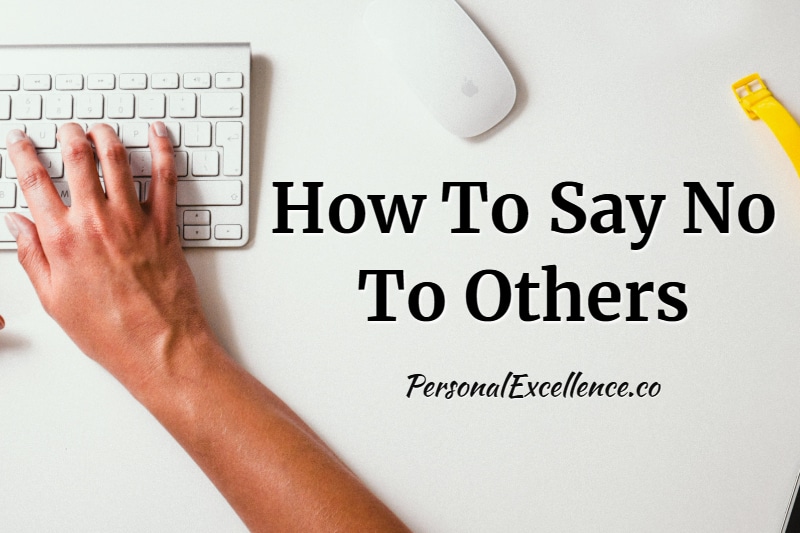
How to Say No: The Definitive Guide

How to Say No

“I find it a challenge to say no to people and often, I end up with too many commitments than I’m comfortable with. However, if I say no, I worry about them being unhappy or offended. Why do I feel this way? How can I learn to say no and not end up feeling bad about it or not offending the other person?” – Ruth

Do you hate saying no? Are you always saying yes to others at the expense of yourself?

I’ll admit it — I used to find it very hard to say no. Whenever someone approached me for something, be it to pick my brain or assist them on a personal project, I would say yes. Part of it was because I didn’t want to leave others in the lurch. Part of it was because I didn’t want to disappoint people. Another part was because I was afraid that the other person would be unhappy if I said no.

Over time though, I realized that saying yes came with its consequences. Because I kept saying yes to everyone, I would have little time for the things on my agenda. My days would be filled with things that others wanted from me, with little to no time for things of my own. I would regularly sacrifice my sleep just so that I could be there for everyone.

It wasn’t long before I became weighed down by the constant pressure to be there for everyone. I was utterly miserable, burnt out, and unhappy. My time was no longer my own — it was taken over by what others wanted from me.

Why It’s Important to Say No (And Why We Find It So Hard To Do So)

In an ideal world, we want to say yes to everyone, sure. But as you can see from my case, saying “yes” to everyone isn’t the way to go. You need to say no in order to

  • Manage your time. In an ideal world where we have unlimited time, we could easily say yes to everything. But the reality is that we have limited time a day. In order to get things done, we need to say “no.”
  • Set boundaries. When you don’t draw a line between your needs and others’ needs, people will assume that you should give by default. When you say no, you start to set boundaries and protect your personal space.
  • Have time for your Quadrant 2 goals. Quadrant 2 goals are the most important goals in your life, such as finding your passion, starting your business, and building your relationships with your loved ones. Saying no is about protecting your Q2 goals and making sure that you have time for these goals.
  • Be happy. When you say no, you control your time. You control what goes into your day. And you get back to being in the driver’s seat of your life.

Yet for many of us, we find it tough to say no. This can be due to reasons such as…

  1. Fear of being rude. You are afraid that if you say no, you would be regarded as being rude. I was brought up thinking that saying no, especially to older people, is rude. This is especially so in the Asian culture where seniority is valued and disagreement is seen as defiance.
  2. Desire to conform. You want to be a positive and well-liked person, so you say yes. You don’t want to be seen or labeled as difficult.
  3. Fear of conflict. You are afraid the person may get unhappy if you reject him/her, which may lead to an ugly confrontation.
  4. Afraid to burn bridges. Some people take “no” as a sign of rejection, and you’re afraid to burn bridges.
  5. Fear of lost opportunities. You are worried that saying no means closing the door to new opportunities.
  6. You want to help. Deep down, you want to help the person. So you say yes even though you really can’t afford the time.

Yet these are not real reasons to say no. Why do I say that?

  • Saying no doesn’t mean that you’re being rude.
  • Neither does it mean that you’re being disagreeable. Having an opinion is part of being an individual. If we say yes all the time to things that we don’t want to do, then we’ll be busy doing things that others want us to do, not things that we want to do.
  • Saying no doesn’t mean creating conflict — it’s about asserting your needs and boundaries. If we don’t assert ourselves, people end up assuming that we are okay with something when we are not.
  • Saying no also doesn’t mean a loss of opportunity. It’s more important to say yes to the right things and opportunities rather than to say yes to everything, including things that are irrelevant to you.
  • Last but not least, when we keep helping others without regard for ourselves, we end up sacrificing our personal goals, our time with our loved ones, and our health. We need to first say yes to ourselves before we can be of service to the world.

Ultimately, it’s your right to say no. Every “yes” comes with its costs — the commitment, the time, and the effort to honor the request. While the cost may be small for each “yes,” little trickles of yes’es over a long time will eventually deviate you from your long-term goal.

How to Say “No”

When it comes to saying no, you want to achieve two aims: you want to say no effectively, and you want to say no tactfully. Here are my 7 tips to say no.

1. Be direct

It’s easier to say “no” right away rather than put it off (assuming that you already know that you want to say no). The longer you stall, the more complicated it becomes, because now you have the added pressure of explaining why you took so long to reply. Just be direct and get to the point.

As a general rule, when I find it hard to reject someone, I have a two-sentence rule to get it over and done with. Start off with a “Sorry, I can’t.” Then, give your reason in one sentence. (Or if you don’t want to give a reason, just end it there.) Limiting your rejection to two sentences makes the rejection easier, because rather than give some lengthy explanation about why you can’t do something, which makes you procrastinate saying no, you cut right to the chase. Even if you end up replying in 3-4 sentences or more, the 2-sentence rule helps you get started.

E.g.

  • “I’m sorry, I can’t make it for this appointment.”
  • “I’ll pass this round, sorry about that.”
  • “This doesn’t meet my needs at the moment. Thanks for having me in mind!”
  • “I’m tied down with something and won’t be able to do this.”

2. Be sincere

Often times we are afraid that if we say “no,” we’ll burn bridges. So we hum and haw and pretend to be okay and say yes. Or we relent and say yes after the person persists.

Here’s the thing — most people will accept your no when you are sincere in your rejection. No games, no gimmicks. Just plain raw honesty, for example, “I’m not free to meet for this period as I’m busy with [X]”, or “This isn’t what I’m looking for, sorry about that.” The people who care enough will understand, while those who take offense probably have unhealthy expectations to begin with.

Note that this tip only works for people who respect your personal space. If you’re dealing with persistent folks who don’t respect your space, then it’s better to just say no without giving too much information.

3. Focus on the request, not the person

One of the reasons I struggled with saying no in the past was that I didn’t want to reject the person. My mom wasn’t there for me when I was a child (in that she was emotionally vacant as a person), and that made me want to be there for others. However, as I shared above, saying yes to everyone caused me to burn out. I was downright miserable.

In learning to say no, I learned to focus on the request and not the person. This means that instead of feeling obligated to say yes because I was afraid to let the person down, I learned to look at the request and assess if it is a fit with my plans. Is this something I can realistically do? Is this something I can afford to do right now? In light of all the things on my to-do list, can I do this without compromising on my other to-dos?

If the answer is a “no,” then I’ll reject it. It’s not about the person. It’s nothing personal. It’s simply about the request itself, and the request simply isn’t something I can fulfill at the moment. When you review requests as they are, you objectively reject requests that are not compatible with you, vs. feeling bad for saying no when it’s simply a necessary step in your communication with the person.

4. Be positive

We’ve been taught to associate no with negativity, and that saying no will lead to conflict. But it is possible to say “no” and maintain a harmonious relationship. It’s about how you do it.

To start off, stop associating “no” with negativity. Realize that it’s part and parcel of human communication. When you see “no” as a bad thing (when it isn’t), this negative energy will inadvertently be expressed in your response (when it doesn’t have to be). There’s no need to feel bad, feel guilty, or worry about the other person’s feelings (excessively). This doesn’t mean that you should be tactless in your reply, but that you should not obsess over how others will feel.

Next, when saying “no,” explain your position calmly. Let the person know that you appreciate his/her invite/request but you can’t take it on due to [X]. Perhaps you have conflicting priorities, or you have something on, or you simply have no time. You would love to help or get involved if possible, but it’s not something you can afford to do now.

Even though you are rejecting the person’s request, keep the options open for the future. Let the person know that you can always reconnect down the road to meet, collaborate, discuss possibilities, etc.

5. Give an alternative

This is optional, but if you know of an alternative, share it. For example, if you know of someone who can help him/her, then share the contact (with the person’s permission of course). This should only be done if you happen to know an alternative, not to compensate for not saying yes.

6. Don’t make yourself responsible for others’ feelings

Part of the reason I resisted saying no in the past was that I didn’t want to make others feel bad. I felt like I was responsible for how others would feel, and I didn’t want others to be unhappy.

The result was that I would bend over backward just to make others happy. I spent countless late nights catching up on work as I put others’ needs before myself and only had time for my own stuff at night. This was terrible for my health and well-being.

At some point, we need to draw a line between helping others and helping ourselves. To be of service to others, we need to prioritize our own health and happiness. Don’t make yourself responsible for others’ feelings, especially if they are going to respond negatively to your “no’s.” If the person accepts your “no,” great; if not, then that’s too bad. Do what you can, and then move on if it’s beyond what you can offer… which leads me to point #7.

7. Be ready to let go

If the person is disrespectful of your needs and expects that you should always say yes, then you might want to re-evaluate this relationship.

Too often we are taught to maintain harmony at all costs, which is why we dislike saying no — we don’t want to create conflict. But when a relationship is draining you; when the other party takes you for granted and the dynamics of the relationship is skewed in the person’s favor, then you have to ask yourself if this connection is what you want. A healthy relationship is one where both parties support each other. It’s not one where one party is constantly giving and giving, while the other person keeps asking and taking.

When I evaluate the relationships that drain me, I realize that they are the relationships where I’m not my real self, where I’m expected to say yes and the other party gets unhappy if I say no. For such relationships, the other person is unhappy as long as there’s a “no” — it doesn’t matter how the “no” is said as the person simply expects a “yes.”

If you’re dealing with such a person, then the question to you is, is this relationship worth keeping? If no, then it’s simple — simply let go of it. If this is an important relationship to you, then let the person know about this issue. It’s possible that they are not aware of what they are doing and an open, honest conversation will open their eyes to it.

So instead of worrying about saying no all the time with this person, which isn’t the real problem, you address the root of the issue — that you’re in a connection where you’re expected to be a giver. Perhaps in the process of doing this, you strengthen your relationship together. Because now you can be openly honest with him/her and say yes or no as you desire, without feeling any guilt, fear, or hesitation — which is what saying no should be about.

Check out related resources:

The post How to Say No: The Definitive Guide appeared first on Personal Excellence.

Read More

How To Know If A Relationship Is Worth Saving

How To Know If A Relationship Is Worth Saving

“Hi Celes, may I ask, how would you know if a relationship is worth saving and how would you know if it’s going nowhere? Thank you so much.” – Drizzle 🙂

Are you at a relationship crossroads? Are you wondering if your relationship with your significant other is worth saving or if it’s going nowhere?

We’ve all been there — a stage where you wonder if this relationship is right for you, whether you should fight for it or give up. When you’re constantly fighting with your SO or when you’re trying so hard to make things work out, it’s normal to doubt yourself and wonder if there is a future in this union.

While every relationship is different, here are 7 signs that your relationship is worth saving.

1) Your partner is trying to make things work

Silhouette of couple riding on bicycles

(Image: Everton Vila)

This is the number one sign you need to look for — that your partner is trying to make things work. A relationship can’t thrive if only one half of the union is doing the work. If you’re the only person who has been trying, who has been showing up for therapy, and who has been doing the work, then clearly something is wrong. Your partner needs to be on board in healing the relationship, otherwise there is no relationship to speak of.

I have a friend who used to be in a toxic relationship, and one of the clear signs that the relationship was not worth saving was the fact that her boyfriend never put in the effort to make things work. She was always the one trying to salvage the relationship while her boyfriend did nothing. If that’s you, consider if this is the kind of person you want to be with. You want to be with someone who genuinely cares for you and puts in the effort to make things work, not someone who doesn’t even blink an eye when the relationship is failing.

2) You still feel love for each other

Couple smiling at each other

(Image: NeONBRAND)

It’s easy to suggest breaking up when you’re in the middle of an argument. But ask yourself: Do you still love him/her? And does he/she love you?

If the answer is “yes” to both, then perhaps the relationship is worth saving. It’s not easy to find a relationship where the love is still there after all the struggles. Sometimes there is love at the start but it fizzles out. Sometimes there was never love from the start. If both of you still deeply love each other, cherish this love and give your relationship another chance.

3) You share similar values

Hold hands

Do you share the same values? For example, do you have a common long-term vision? Do you value the same things? Do you have the same philosophy and belief in a lot of things?

Even though you may have your differences — and that’s normal as part of any relationship — what determines the long-term potential of a relationship is whether you share the same values. When you have the same core values as your partner, you have common ground to build your future on and to build a strong, steady relationship. What you’re going through now may just be a temporary blip and if you manage to work through this problem now, you may well end up with a stronger relationship than ever.

4) There is no one else like him/her

Yellow umbrella among many umbrellas

(Image: zentilia)

You’ve met many people and there is simply no one else like him/her. Despite your differences, when you stop to think, your partner has many good things about him/her. He/she has many good qualities that you value and adore. He/she is a perfect match with you in many ways. He/she is unlike anyone you have ever met. If you let him/her go, you’re not sure if you can ever meet someone like him/her again because he/she is one in a million.

5) There is remorse for wrongdoings

Sad woman in forest, sunlight behind here

(Image: Riccardo Mion)

Maybe your partner did you wrong. Maybe he/she lied, lost his/her temper, or was unreasonable in his/her behavior. Maybe he/she cheated and saw someone behind your back.

If there is any wrongdoing, maintain a clear head and assess the situation. Firstly, is this a mistake you can forgive? Next, has he/she shown remorse for his/her behavior? Lastly, is he/she doing anything about the issue? 

Different people have different thresholds on what they can accept, and you should never stay with someone if he/she did something that you cannot forgive. But if (a) your partner is remorseful and is taking active steps about the issue, and (b) this mistake is something you can forgive, then consider giving him/her a chance. If the issue recurs, give your partner an ultimatum and let him/her know that you cannot be together if this issue persists. Give him/her a timeline to work on this issue and assess if things have improved sufficiently by the end of it.

If you’re dealing with deep-seated problems like abuse or anger management issues, seek professional help right away. Don’t attempt to deal with it alone. No matter how much you love your partner, you must always protect and take care of yourself first. Help him/her by first removing yourself from the situation, and then seek professional help. To save the relationship, you need to work on the roots of the problem.

6) You’ve been through a lot together

Silhouette of a couple holding hands, looking at sunset

(Image: Alex Iby)

Having a shared history shouldn’t be the only reason to stay together, but it is a reason to save the relationship. After all, if both of you have been through a lot in the past, chances are you have a strong understanding of each other’s likes and dislikes, how each other thinks, and how to best support each other. Such camaraderie is difficult to find without going through the same hurdles together with someone. If you and your partner have a strong history together, consider if you want to give this relationship another go.

7) Things have been improving, even if slowly

When all you do is argue non-stop with your partner, it’s easy to feel that all is lost and this relationship is a goner.

But take a step back and ask yourself: Have things been improving? Compared to when things were at their worst, have things been improving? Has your partner been listening to your feedback? Is he/she working on the issues between the both of you?

Maybe your partner has a lot of problems and it’s overwhelming you. But if things are improving, even if slowly, then consider giving him/her a chance. Sometimes things may not improve at the speed that you want, but that doesn’t mean that all is lost. Focus on the overall trajectory of the relationship instead.

What if you don’t meet the signs above?

If you don’t meet the signs above, not all is lost. These signs are really meant as a general guide. Ask yourself: Do you love your partner? Is this a relationship worth fighting for? Have you had many good moments together? If so, maybe you want to give your relationship another shot.

If your partner hasn’t been trying and if he/she keeps taking you for granted, then let go — you’re better off with someone who truly appreciates you. Check out my other article Top 12 Signs It’s Time To Move On From A Relationship.

The post How To Know If A Relationship Is Worth Saving appeared first on Personal Excellence.

Read More

Birth

Some of you may have noticed that updates at PE have been slow of late. There have been lots that I want to share, but I haven’t had the chance to share them as I’ve been waiting for the right time to do so.

Today, I want to announce the birth of my baby girl, Baby A. 🙂

Buchup Week 1

Buchup Week 1: Mama Kiss

Buchup Month 2: Smiling

Buchup Month 3

Buchup Month 3: Looking Over

Buchup Month 4: "I'm So Sweet" Sweet-Pink Top

Buchup Week 4

Buchup Week 2: Mama & Papa Kiss

Born with the entire water bag intact (also known as an en-caul birth) on April 18, Baby A is now almost 4 months old. 🙂 Between exclusive breastfeeding and taking on the new duties of motherhood, I haven’t had time to take a breather, but I hope to get back to updating PE and letting you guys in on what’s been going on in my life soon.

I look forward to sharing more in time to come, but in the meantime, just wanted to do this quick post to let you guys in on what’s been going on in my life. 🙂 If you have any questions, or anything you want me to answer on PE, let me know!

Update (Sep 2019): I’ve since updated the blog sharing my pregnancy journey and birth story:

The post Birth appeared first on Personal Excellence.

Read More

My Pregnancy Journey (And Why I Kept My Pregnancy A Secret)

This is part 1 of my birth series, where I share my pregnancy journey and my birth story.

Hi everyone! Five months ago, I gave birth to Baby A. 🙂 Some of you may have wondered if you had missed my announcement on my pregnancy. The truth is, I didn’t post about my pregnancy anywhere, choosing to keep the news a secret. In total, I only shared the news with less than five people (including my husband), and a select group of close friends when I was getting close to birth.

Why I Kept My Pregnancy A Secret

Positive Pregnancy Test

The start of our pregnancy journey (July 2018)

The reason was that I simply wanted the personal space to focus on my pregnancy. For a while, I had been feeling boxed in by my culture. From the invisible pressure to have children, to the endless taboos and practices, I felt trapped by the many expectations of my culture, many of which are rooted in outdated beliefs and practices. The issue isn’t that they are tradition, but that many of these beliefs are not compatible with who I am, yet they are constantly forced onto me without regard of my wishes.

So since I was born, I was constantly told to shut up by my mom, who said that children should be “seen, not heard,” and that children “know nothing” — both of which are common beliefs in the traditional Chinese culture. As a girl, I was made to believe that my menstrual blood was dirty, and that a girl’s underwear is shameful, because these are the beliefs of the older generation. These beliefs are not specific to the people around me, but are common beliefs in my culture, particularly in my parent’s generation and among people who hold traditional beliefs. Yet I never questioned them or thought that they were suspect until I grew older and became more conscious as a person.

I thought this was the last of it, until I got married and became subjected to a new host of taboos and restrictions. After I got married, I became subjected to a never-ending pressure to have children, even though I had said that I had not decided if I wanted kids. Yet I would be fear mongered with stories of women who delayed having kids and subsequently regretted it when they couldn’t have them, suggesting that I would regret it if I didn’t have children. Subsequently, conversations when I was around would always involve some implicit nudge to have children. It was as if I was a human with no identify, no life, and no purpose, that my sole objective in life was to have kids, and that I had no worth as a woman if I didn’t have them.

It didn’t end there, for I began to get unsolicited advice on pregnancy from a close member of my family. While well-intended, I had not even decided if I wanted kids, yet I would be inundated with a long list of overly restrictive, archaic taboos, ranging from not using scissors to not eating bananas to not looking at animals, all with their own stories to back them up. I was drained by the end of the interaction, and I knew that this was the start of more to come if I were to actually be pregnant one day.

So when Ken and I decided to have kids, and I soon became pregnant, I knew that it was the best if (a) we didn’t share the news with anyone, and (b) we only shared the news with selected people when I was ready. Chinese moms-to-be tend to receive intense scrutiny as everyone floods them with endless restrictions on what not to do (many of them rooted in old wives’ tales), ranging from diet to daily actions to home renovations, and I just didn’t want to deal with them. These restrictions are very strictly enforced depending on how traditional your kin are, and not following them would cause you to be repetitively reminded, criticized, reprimanded, and fear mongered, eventually causing you to follow these “rules” out of (a) mental fatigue, (b) weariness of hearing the same thing over and over, and (c) guilt if anything were to happen to your baby.

Rather than deal with that, I felt that my priority should be to focus on what needed to be done to ensure a smooth and safe pregnancy, and to nurture my baby the best I could.

So for my entire pregnancy, we only shared the news with my dad, Ken’s parents, and later on with selected close friends toward the end of my term. Everyone else only knew post-birth. I didn’t share the news with my mom pre-birth as I had felt distanced from her in recent years, and I couldn’t trust her to keep the news to herself, something which my dad agreed with as well. (In the Chinese culture, people rapidly share news with everyone, and individual privacy is a poorly understood concept.)

For the whole time, I made sure to keep a low-profile, and kept social meetups to a minimum. This wasn’t that difficult as I’ve been living a low-key life for the past few years out of a desire for more privacy in my life.

My 9-Month Pregnancy Journey (Jul 2018 – Apr 2019)

Keeping my pregnancy a secret gave me a lot of mental relief, and the quiet space to focus on it. I spent most of my free time outside work reading articles, research studies, and pregnancy forums to learn about other moms’ experiences.

As I consume a vegan diet, I followed vegan pregnancy groups, on top of normal pregnancy groups, to get information pertaining to a vegan pregnancy.

After much research, I realized that I wanted a fully natural birth without drugs or unnecessary medical intervention, and found an excellent gynae to help me achieve that. Ken and I took a course to educate ourselves on birthing, breastfeeding, and baby care, and I did a lot of reading up online.

Food & Nutrition

Throughout my pregnancy, I ate a nutrient-dense vegan diet with a strong focus on fruits and vegetables.

I didn’t eat much during my first trimester due to nausea (mine started at Week 6 and lasted till Week 11), and suffered very bad bloating which only improved in the second trimester (it would return in my final trimester, though not as bad as during my first trimester). In total, I lost 2kg (4.4 lbs) during this time.

As I developed very bad acne during my pregnancy, I realized, through an elimination diet, that the best diet where I wouldn’t have acne is an oil-free, allergen-free, high-carb low-fat vegan diet. As almost every food sold today has some kind of oil or allergen (like soy), I had to learn to prepare my own meals (something that I hated doing in the past), and eventually developed simple recipes that I could adopt even on a busy schedule. I’d continue to eat this way post-birth, and I consider this one of my best rewards from my pregnancy (besides Baby A of course)!

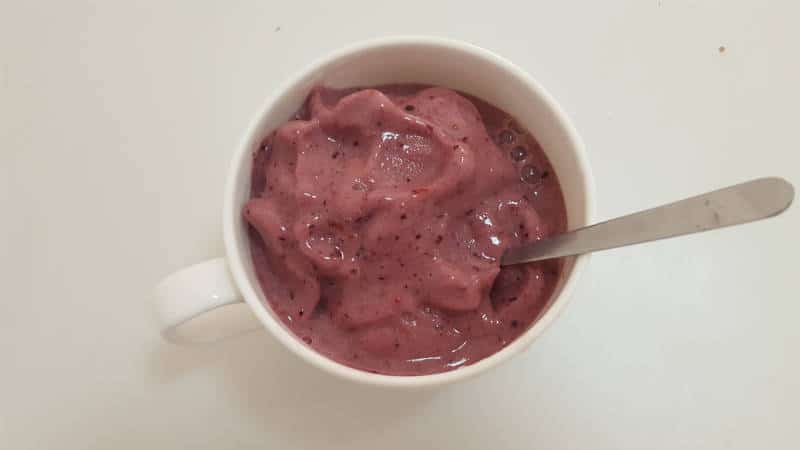
Vegan Ice Cream: Banana and Berries Ice Cream Sorbet

My favorite morning snack: Vegan Banana and Berries Ice Cream Sorbet (made by blending frozen banana and mixed berries). I eat this along with whatever fruits I have for the day throughout the morning.

Vegan Meal: Potato, Brussel Sprouts, Asparagus

Lunch part 1: Steamed Potatoes, Brussel Sprouts, Asparagus (Vegan, no oil)

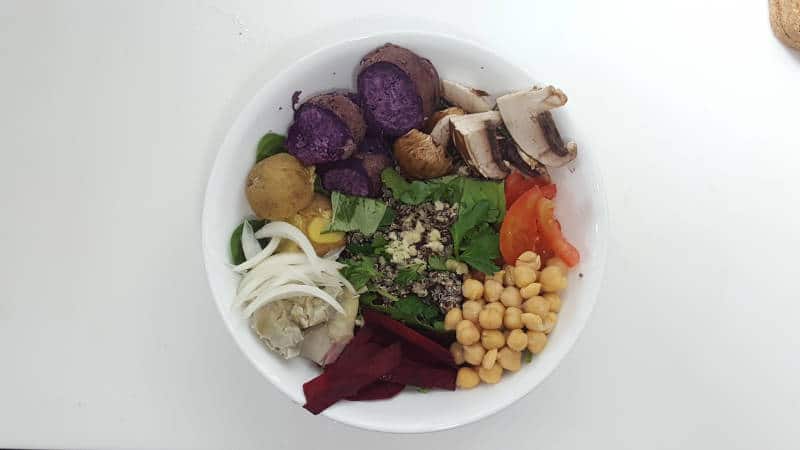
Vegan Salad: Quinoa, Potato, Sweet Potato, Mushroom, Tomato, Chickpeas, Beetroot, Onion, Artichoke (Vegan, No Oil)

Lunch part 2: Quinoa salad with assorted veggies (Vegan, no oil). I also enjoy eating a big pot of cooked oats (not in picture).

Vegan Meal: Tomato Pasta with Pumpkin

One of my standard dinners: Tomato pasta with mushroom and spinach, plus pumpkin (Vegan, no oil)

Vegan Meal: Brown Rice with Lentil Stew

Another dinner staple: Brown rice with lentil curry stew (Vegan, no oil)

Vegan Meal: Vegan risotto with peas, spinach, broccoli, and mushroom

Yet another dinner staple: Vegan risotto with peas, spinach, broccoli, and mushroom (Vegan, no oil)

Weight & Exercise

Throughout my nine-month term, I only gained 5 kg (11 lbs) despite eating a lot daily (!). If you consider that I lost 2 kg (4.4 lbs) during my first trimester, then I really gained 7 kg (15.4 lbs) baby-wise.

While I was initially very concerned as it was below the recommended weight gain of a typical pregnancy (12-15kg or 25-35 lbs), I later realized that this is simply a guideline and is not a target to hit if (a) you’re already eating healthy, (b) you’re not trying to lose weight, and (c) your baby is growing fine and everything is going well. The notion of “eating for two” is entirely false — based on NICE guidelines, a woman does not need to consume more calories in her first two trimesters, only an extra 200 calories per day in her last trimester,[1][2][3][4][5] and it’s more important that she consumes quality food (via a nutrient-dense diet) vs. a high quantity of calories. 

I dropped to my pre-pregnancy weight on the day right after birth (57 kg or 126 lbs; I’m 1.7 m or 5′ 7″), and I credit this entirely to eating a very clean diet during my term.

As swimming is a great exercise for pregnant women, I swam twice weekly from my 5th month leading up to birth, for about 30-40 minutes each time.

Supplements

The only supplements I took were folate (a few weeks before I got pregnant and for the first four months of my term), B12, and Omega-3 EPA/DHA, of which the latter two I normally take as a vegan. I didn’t take any prenatals as (a) I would break out when doing so, even with fully organic and raw ones, and (b) unless you have a deficiency, prenatal vitamins are really unnecessary and it’s about eating a nutrient-dense diet instead.

I also did not take calcium supplements which are routinely given to pregnant women. If you research this, there is actually controversy surrounding calcium supplements, where researchers have found from analyzing 10 years of medical tests that taking calcium supplements may raise the risk of plaque buildup in arteries.[7][8] Moreover, a study showed that women who consume their calcium from food have healthier bones than women whose calcium comes from supplemental tablets, even when the supplement takers have higher average calcium intake.[9][10] Instead, I consumed my calcium through diet (leafy greens, vegetables, beans), which is the most reliable way to increase a body’s calcium intake.

Screening Tests

Ken and I knew Baby A’s gender (it’s a girl! ❤️🥳) by the end of Month 3 as we took the Harmony Test. Typically, parents only know their baby’s gender at the end of Month 5 when they do the 5-month scan. We didn’t have a gender preference to be honest, but if you were to make me pick a gender, I would have a slight preference for a girl, so I was pleasantly surprised and happy that Baby A turned out to be a girl. 🙂

Harmony Test is a test commonly offered from Weeks 10 to 14 to test for fetal abnormalities, with the option of knowing your baby’s gender. The other commonly offered test is the Oscar Test, though you can’t find out your baby’s gender through it. The Harmony Test has a 99.9% accuracy rate while the Oscar test has a 80% accuracy rate. The former is much more expensive, at 3-4 times the price of the latter (in general the Oscar Test starts from S$300 or US$200 while the Harmony Test starts from S$1,000 or US$700, though the prices can differ a lot from clinic to clinic).

As I read about parents who did the Oscar Test and had unnecessary scares due to false positives (after which they had to spend extra money to take the Harmony Test, plus spend weeks living in uncertainty), and I was 34 years old then (pregnancies over 35 tend to have more risks), we decided to take the Harmony Test to avoid guesswork and to know the gender in advance. All the results were normal, and it was a huge weight off my mind. ❤️

The other major screening we did was the 5-month anomaly scan, a standard mid-pregnancy scan to check your baby’s development and to scan for any growth abnormalities. Everything was normal as well, which was another huge weight off my mind. ❤️ My amniotic fluid index (AFI) was on the lower end of the normal range, so I started swimming regularly and drinking lots of water daily thereafter, which are instant ways to improve your AFI.[11][12] I also had bilateral notching which my gynae said was not uncommon and was not something we should worry about after assessing my report, and everything did indeed progress normally and uneventfully in the end!

Throughout my pregnancy, I did not have gestational diabetes, blood pressure issues, or preeclampsia, which can be common in the third trimester, and I credit a large part of this to my diet. I also did not have Group B Strep which is routinely tested between Weeks 35 and 37.

Symptoms: Age Spots, Frequent Peeing, Round Ligament Pain

Besides nausea, bloating, and bad acne, another side effect I experienced was little bumps on my neck and a couple of pigmentations on my cheek which wouldn’t go away. In total, I had about 20 bumps on my neck by the time I gave birth. Moles also seemed to form very easily when I was in the sun, and were darker than usual. I later found out that these are normal pregnancy side effects due to hormone changes, and they faded or disappeared over a few months after I gave birth.

If you have a retroverted uterus like I do, you’ll experience frequent urination in your first trimester, where you have to wake up 2-3 times a night just to pee. This stops once your uterus flips forward by itself during your second trimester. Frequent urination (4-5 times a night) will return in your third trimester as your bump grows larger and presses on your bladder. 🤣

At Month 6, I started to experience a very sharp stabbing pain in the lower right side of my abdomen whenever Baby A stretched or kicked, and later my left side as well in Months 7-9. As Baby A is a very active baby, this happened very often, and it was so painful at times that I thought my uterus was going to burst!!! 😱

I later found out that it’s a normal symptom called round ligament pain.[13] I would experience it sporadically after giving birth, particularly when turning in bed, and it disappeared after two months.

Other funny observations during my pregnancy were feeling Baby A’s hiccups (starting from Week 27 — she would hiccup a lot!), feeling her movements (starting from Month 4 — this became a few hundred times a day as she is very active!!), and feeling her punches and kicks. My pregnancy belly line (linea nigra) appeared on Week 25 and darkened over the next few months.

Also, I started snoring from Week 28 when I had never snored before in my entire life. 😑 This is apparently a common pregnancy symptom due swollen nasal passages from higher levels of estrogen.[14] Because I’m a light sleeper, I would wake myself up with my first snore. 😑 This snoring only happened a few times and stopped after I gave birth.

While swelling and swollen feet (edema) are common pregnancy symptoms, I didn’t experience any of this, and I personally credit a large part of this to my diet.

Leading to Birth

Celes 9 months pregnant

When I was 9 months pregnant. This one was taken just two weeks before I gave birth!

My Birth Story: Celes' 9-Month Pregnancy Bump

My 9-month bump! 😊

Towards the end of my term, I became very tired. I could sleep for many hours and still feel tired in the day. My body would ache whenever I woke up, initially at my neck and back, and then later spreading to my body in the final two weeks. This would disappear 20-30 minutes after waking up. There were days when I literally felt like a 90-year-old in the morning! This is normal and due to the body producing relaxin, a hormone that loosens joints to prepare for delivery.[15]

My bump “dropped” (known as lightening) in Week 35. During my third trimester, I had to wake up very frequently to go to the loo as my bump grew bigger and pressed on my bladder. It became quite tiring as I had to wake up 4-5 times per night in the final weeks while moving around with my big bump!

These were all normal and were signs that my body was preparing itself for birth, which would happen soon enough!!! 🤣 

Proceed to the next part where I share my birth story!

This is part 1 of my birth series, where I share my pregnancy journey and my birth story.

The post My Pregnancy Journey (And Why I Kept My Pregnancy A Secret) appeared first on Personal Excellence.

Read More

My Birth Story: Birth of Baby A!

This is part 2 of my birth series, where I share my pregnancy journey and my birth story. If you’ve not read part 1 yet, you can do so here: My Pregnancy Journey (And Why I Kept My Pregnancy A Secret)

Right when I was approaching 37 weeks, on April 16, at about 10-11pm, I experienced my first contraction. 😅

While a full-term baby can arrive anytime from 37 weeks, we were only expecting Baby A to arrive starting from Week 38 since most moms give birth in Weeks 40-41. As I had not experienced any Braxton Hicks to date, I thought that it could be Braxton Hicks, but suspected that they were real labor pains when they refused to go away! 🤣

On April 17, as my contractions became more frequent from once every 1-1.5 hours to every 10-20 minutes by late afternoon, I went about the day as per normal with Ken: first to our routine gynae checkup, then final shopping for birth items, then meeting our agent to sign the cord blood banking contract for Baby A, and then finally dinner.

Throughout the day, I kept moving my bowels, which I knew was a pre-labor sign. (In total, I moved my bowels 7 times each on April 16 and April 17, and 3 times on April 18!)

At about 11+pm, as Ken and I were watching Maleficent on his laptop, my contractions started to get quite uncomfortable, after which I said that I wanted to rest.

April 18, 2019 – THE Day!

At 1am, as it became undeniable that these weren’t Braxton Hicks, I told Ken to pack the hospital bag as I was very sure that Baby A was coming today. He immediately jumped into action while hiding his excitement and nervousness. 🤣

I then labored by myself in the bedroom, using different laboring positions. I found standing while using my bed as my support, and sitting on the toilet, to be most helpful for me. I used a contraction app to monitor my contractions, and as the night went on, they progressed from once every 10 minutes to every 4-5 minutes. 

Knowing that hospitals tend to time moms once they admit into the hospital and intervene in the natural birth process when they don’t hit the dilation target of 1cm per hour (which is actually an outdated guideline), I made sure to wait until I was well into labor before we set off.

At 5am, as my contractions became 2-3 minutes apart, I told Ken, “This is it, it’s time for us to go!”
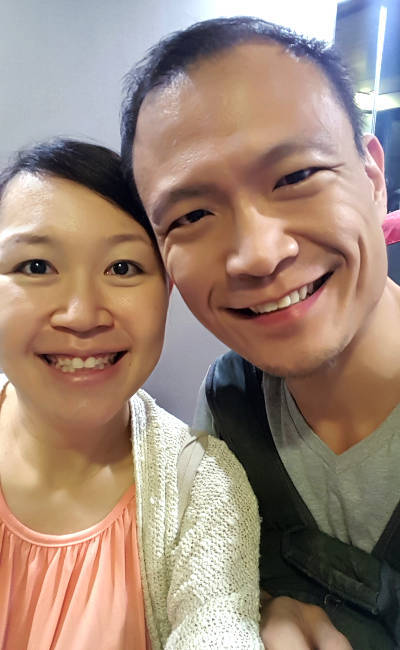
My Birth Story: Ken and Celes, before going to hospital

At the lift, before we set off!

Reaching the hospital (2-3cm)

After what felt like eternity (even though it was a short cab ride), we reached the hospital. Ken did the check-in while I was directed to the delivery room.

At this point, I was 2-3cm dilated. 10cm is the point where the baby gets delivered. I was offered the epidural but refused as I wanted a drug-free birth.

My Birth Story: Delivery Suite

The delivery room, where things are about to happen!

My Birth Story: Ken and Celes, at the hospital for delivery

A quick shot before things get serious

The nurse then read my birth plan, which was basically an outline of my preferences for a natural birth (no enema, no epidural, no episiotomy, etc.).

I was then strapped to the CTG machine, which the nurse said would only be for 30 minutes as my doctor had approved my request for intermittent CTG monitoring so that I could labor freely in different positions. Being strapped to the machine meant that I could only lie flat on my back, and I noticed my contractions, which were initially coming quickly at every 2-3 minutes, began to slow down to every 5-10 minutes, something which I already knew would happen as lying flat on your back is one of the worst ways to labor.

Reaching 4-5cm

When the nurse did not return after 30 minutes, we decided to call her back in to remind her to unstrap me as my contractions felt much worse on my back. This time, she wanted me to be on the machine for another 20 minutes, which frustrated me as my readings were normal.

The nurse finally unstrapped me when we called her back in 20 minutes later. I jumped right back to a standing position, swaying while using the hospital bed as my support, with Ken supporting me by my side.

My contractions soon returned back to their 2-3 minute frequency, becoming stronger and more intense. Soon, they were spreading from my abdomen to my lower back. My entire lower back became very, very achy, and we had to keep rubbing it in-between contractions to ease the ache.

Forty minutes after I was unstrapped, I had my bloody show, an indication that labor was imminent (warning: graphic image below)

My Birth Story: Bloody Show

My bloody show! (I’d subsequently have another round of this before I give birth)

One hour after my bloody show, I asked the nurse to do a cervix check. I had reached 4-5cm dilation! By then, I was feeling quite exhausted, and wondered how much longer it would take.

Back onto the CTG machine

At this point, the same nurse wanted to strap me down with the CTG machine again. While she said that it would only be for 30 minutes, she again did not return after 30 minutes, which annoyed me as my contractions were getting extremely strong at this point. They were also significantly more painful lying flat than in other positions.

After 45-50 minutes, we called her back in to get me off the machine. When the nurse refused to take me off even though my vitals were completely normal, and she also refused my request to do another cervix check even though I suspected that I was getting near delivery, I began to get irritated with this nurse, who was quite condescending in her tone. I felt trapped, like I was hindered rather than being supported in my birth. I knew that my labor was going to stall if I continued lying down, and I didn’t want that to happen.

Reaching 10cm and Feeling My Waterbag

At this juncture, I requested to go to the loo, where I labored by myself in privacy. For the next 20-25 minutes, my contractions quickly increased in intensity, to the point of being excruciating. I also felt a huge weight descending near my rectum area, as if I was moving an extremely large poop.

After a huge, extremely intense contraction, I reached below and felt a bouncy surface. My first thought was, Wait, is this my waterbag?!?! …And if this is my waterbag, does that mean that Baby A’s head is just beyond my fingers???? I quickly called Ken in to take a look, and he immediately called for the nurse.

This time, a different, much nicer nurse came in (the previous one had ended her shift).

“We think we can see the waterbag???” Ken exclaimed.

The nurse quickly took a look and said, Mdm, I need you to get out of the bathroom now!!”

Delivering Baby A!!!

Everything from the 10cm mark was a blur. Once the nurse (the nice one) saw my waterbag, she started shouting at me to get out of the bathroom (LOL!!). 🤣

She got me back on the bed where she quickly did a cervix check and said, “Congratulations Mdm, you’ve reached 10cm dilation — you are now ready to give birth!!!”, which was like music to my ears. In my mind, I was like, Yes, I’ve been waiting for this moment!!!

(Image: Giphy)

They quickly set up the bed for me to labor on it (I used the hands and knees position, using the headboard as my support), pressed the emergency call button for my doctor, and prepared the necessary labor equipment.

Reaching the 10cm mark, the contractions (they call them “surges” in hypnobirthing) were excruciating. It’s the kind of pain where your brain goes numb because all your nerves are flooded with pain, and there’s nothing you can do but to surrender to it. The redeeming factor is that you aren’t in pain the whole time as there is a gap in between contractions to recover, though this gap gets very short toward the end.

My contractions were about a minute long at this point and were coming fast and furious (about 30-40 seconds apart), and they would come even faster (about 20-30 seconds apart) as I entered into full-on birthing mode.

With each contraction, I would focus on breathing down my baby (vs. pushing which is actually not something we need to do). And with each increase in pain, I kept on going, knowing that (a) this pain was fully normal, and (b) I was getting closer to my baby.

After 10 minutes, I reached a point where it was excruciatingly painful — it felt like someone was trying to pry open my vaginal canal with all their might using their fingers, except that no one was doing that!

This was when I realized, Wait, this must be the “Ring of Fire!!!”, which gave me new-found energy to go on!!

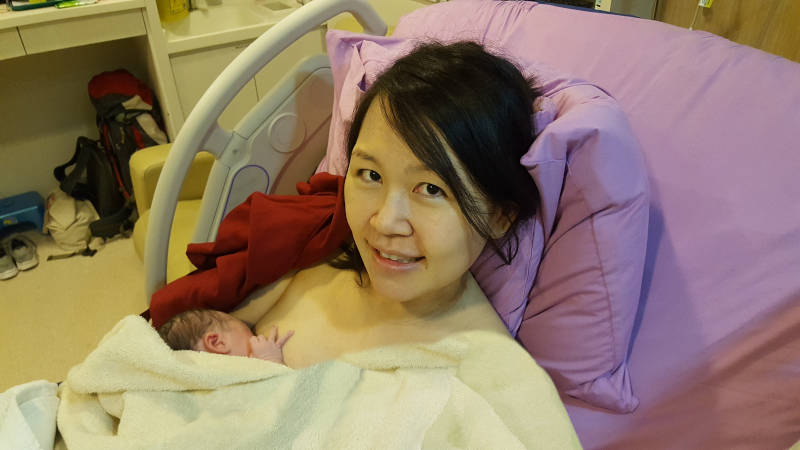
My doctor entered the room at this point, minutes before I gave birth. I soon heard Baby A’s crying, and the nurses quickly passed her to me for skin-to-skin and breastfeeding. 😊

Baby A was born encased in my waterbag, a phenomenon known as an en-caul birth and apparently happens in less than 1 of 80,000 births. It is considered good luck in many cultures, and I hope this means Baby A will be blessed with lots of good luck in her life! 🙂

In total, it took me just 1.5 hours to reach from 4-5cm to 10cm dilation, and I feel that this was possible because of all the research and preparatory work I had done leading to my delivery. My labor would have easily stalled if I had simply followed the typical processes administered to me, and if I hadn’t stood up for myself (and with Ken’s help) when I did.

My placenta was delivered a few minutes later. I would breastfed Baby A for an hour in the delivery suite before she was weighed/measured, and we were wheeled into our hospital ward for recovery. ❤️

Positive Pregnancy Test

The start of our pregnancy journey 🙂 (July 2018)
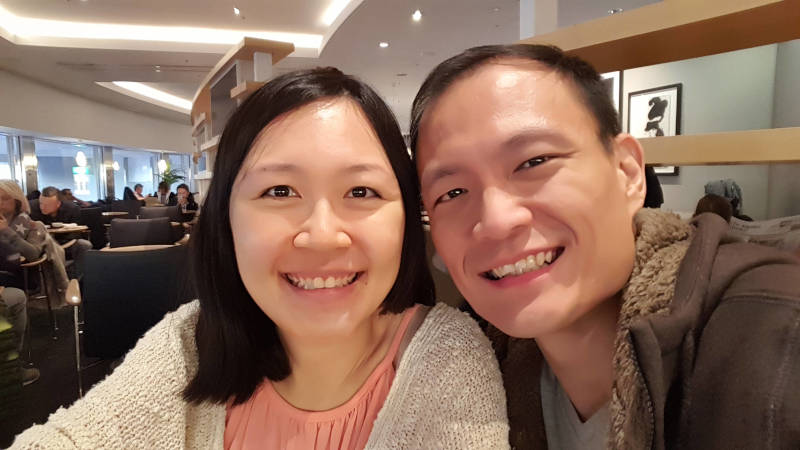
My Birth Story: Celes & Ken at Narita Airport, Delta Lounge

Midway through our pregnancy, at Tokyo Narita Airport en-route to US, Atlanta (I was with Ken on a work trip). I was five months pregnant here!

My Birth Story: Celes' 5-Month Pregnancy Bump

My 5-month bump. Baby A basking in the sun! 😊

My Birth Story: Celes' 9-Month Pregnancy Bump

My 9-month bump 😊

My Birth Story: Breastfeeding post-birth

Right after she was born: Skin-to-skin and breastfeeding ❤️

My Birth Story: Ken, Celes, and Baby A post-birth

At the hospital ward

My Birth Story: Buchup as a newborn

A few hours old 🙂

My Birth Story: Buchup as a newborn

Hello 🙂

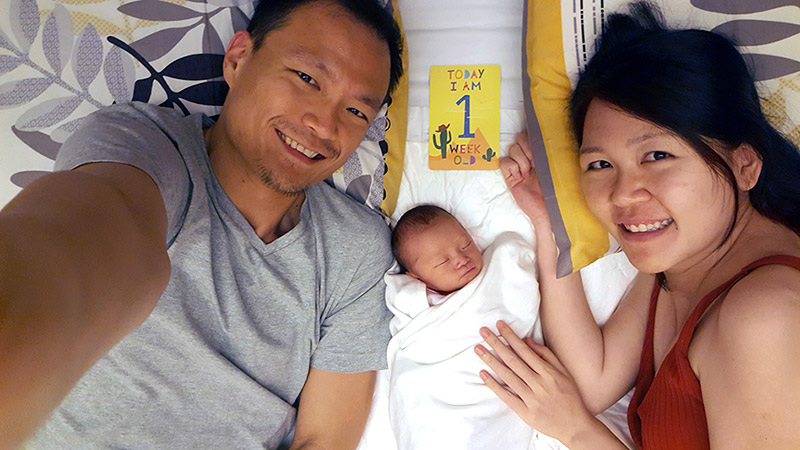
Buchup Week 1

1 week old

Buchup Week 2: Mama & Papa Kiss

2 weeks old

Buchup Month 1: Sleeping with Papa

1 month old

Buchup Month 2: Smiling

2 months old 🙂

Buchup Month 3

3 months old

Buchup Month 3: Taking a peep

Taking a peep 🙂

Buchup Month 4: "I'm So Sweet" Sweet-Pink Top

4 months old ❤️

So Far (Sep 2019, 5 Months Post-Birth)

For the same reason as why I kept my pregnancy a secret, we didn’t share the news of Baby A’s birth until after we were discharged. As much as others were excited to see a new baby, I felt that our priority should be to focus on our role as first-time parents, not to deal with guests. This allowed us to really familiarize ourselves with Baby A’s needs, and we only started having guests at the end of her first month.

As we didn’t have help (we didn’t hire a confinement nanny as I didn’t want to deal with more taboos and we didn’t want a stranger in the house, and we don’t have a helper), Ken took six weeks of leave and we jumped onto the vertical learning curve and a crazy roller coaster ride right after Baby A’s birth. It was truly tough managing between exclusive breastfeeding without help, taking care of a baby as first-time parents, post-birth recovery, along with housework, but somehow we survived. 😅

It’s been 5 months so far, and it has been an extremely tiring yet rewarding journey. Tiring because Ken and I have to work while taking care of Baby A, and we don’t have help, and I’m exclusively breastfeeding which makes it extra tough as I’ve to be with her at all times for her feeds (I’m latching rather than pumping). We also had to move house when Baby A was 2-3 months old, so we had to look for a new place, pack everything, and then unpack everything in our new home, and it was pretty insane how we managed this while taking care of a newborn. Nightimes are crazy due to multiple night wakings, ranging from 4-6 times (usual) to over 10 times a night (sometimes). We refuse to sleep train and we know that sleeping through the night is a developmental milestone that she’ll hit at some point. ❤️

While it’s tough, I’m happily doing all of this (even if it’s extremely tiring sometimes 🤣). I enjoy each day that I spend with Baby A, along with her little quirks (she loves to clutch her little hands together), her smiles (she has a cute little dimple on her right cheek at the same place as mine), and her laughter. I love latching her, watching her grow, and seeing her little drunken smile after her feeds. She’s the sweetest baby and she loves interacting with us, along with smiling and laughing. Ken and I celebrate each time she achieves a new milestone (she just started rolling over a few weeks ago, and now she’s beginning to crawl!). Severe sleep deprivation is definitely an issue, but somehow you just have to roll with it and move on.

Right now, my biggest challenge is getting uninterrupted time to work, since most of my time is spent on baby care. Ken has been working part time for the past few months so that we can take care of Baby A together, but even then it is tough as we are both working and we take turns to care for her throughout the day. In the rare moments of free time that I have, it’s to quickly poo/pee, prepare my meals, shower, wash the dishes, buy groceries online, and research stuff related to Baby A, and there is usually little to no time left for work. Running live courses is not possible for the moment since I need a stretch of uninterrupted time (3-4 hours) for each live session (plus months to prepare my content), and neither are podcasts as I ideally want 4-5 hours of uninterrupted time to edit my episodes. So I’ll probably be focusing on article writing for the time being, and I hope that all of you guys will be patient with me as I find a way to get back to creating regular content at PE.

Buchup Month 4: Laughing with papa

With papa ❤️

Buchup Month 4: With mama on the bed

Buchup Month 4: With mama on the bed, smiling

With mama ❤️ 🙂

To Pregnant Moms-To-Be

If you’re pregnant or are planning to get pregnant, know that this is your pregnancy, and it’s up to you to do what’s best for you and your baby. There will be many people who will try to tell you what to do, usually out of good intention, but this advice may not be correct or useful. Educate yourself so you can make the best decision for yourself. Block out naysayers if that’s what you have to do to protect yourself.

Know that your baby’s birth is the start of a long journey ahead — once he/she is born, you will be on a never-ending cycle of feeding the baby, changing diapers, baby bathing, wiping drool, and easing baby to sleep for a few years, unless you’re lucky enough to have a helper. Taking care of your baby will be an around-the-clock event, at least until he/she sleeps through the night (which can happen anywhere from a few months old (rare) to three years old). If you’re breastfeeding, your baby will be feeding almost all the time initially (for the first weeks/months) as your supply adjusts to meet her demand and she goes through multiple growth spurts, and this is completely normal. You’ll be severely sleep deprived as you struggle between post-birth recovery, your baby, and day-to-day duties, so have as much help ready as possible. Get help ready by your third trimester, so that you’ll not be caught surprised by an early birth.

If you’re planning to exclusively breastfeed, read up as much as you can before your baby is born. Join breastfeeding groups on Facebook. Go for courses that are wholly on breastfeeding so that you will know what to do once your baby is out. Have a list of qualified lactation consultant contacts ready such that you can engage them right after birth if needed (some can visit you at the hospital, so call and check in advance). Have all these prep work ready, because feeding starts right after your baby is born and happens every 1-2 hours whether you’re tired or sleeping, and you’re not going to get much down time in-between feeds.

For us, we didn’t get proper support at our hospital which caused us to have an extremely rough start with breastfeeding, and it was through sheer grit and perserverence that we pushed through with exclusive breastfeeding in the end. In Singapore, only 1% of babies are exclusively breastfed for the first six months[1] compared to the global figure of 38%[2], and having been through the process, I can understand why — there is just very poor support at the social and systemic level here, despite it appearing otherwise. The knowledge for breastfeeding is lost in my parents’ generation given that almost everyone raised their children fully on formula milk, and many Chinese parents give terrible advice on breastfeeding to moms my age (most of them think that formula milk is superior and breastmilk is “diluted,” and that Chinese women have insufficient breastmilk). In hospitals, some nurses are quick to suggest formula-feeding rather than try to help the mom with breastfeeding, and even the hospital magazines and post-birth goodie bags that Ken and I got from our hospital were filled with formula milk ads! The plastic cover of Baby A’s Official Health Booklet from my hospital, which we need to use for her health checkups, is actually a full-page ad for formula milk, which I thought was in poor taste!

If you’re planning to have a fully natural birth, be sure to read up on the cascade of interventions at hospitals,[1][2][3] and to learn more about the typical hospital processes that hinder rather than aid birth.[4][5] Read up on the pros and cons of each hospital intervention, so that you can make an educated choice when the time comes. Read up on hypnobirthing; this will help you manage your birth when it comes, rather than being caught in fear and then picking whatever solution that is presented when it may not be the best for you.

Also, get everything in place as soon as possible, preferably by 35-36 weeks. A full-term pregnancy is 37-42 weeks, and most moms give birth between 40 and 41 weeks. Based on that, Ken and I planned for a birth timing of 38 weeks, thinking that we were playing it safe. Well, Baby A came out right when I hit full-term, and we honestly felt like we were hit by a truck for the first few weeks as we were not fully ready!! 🤣

Once your baby is born, the wheel starts spinning, and you need to be ready at all times for all her feeds, her needs (which will be mainly food/sleep in the first few weeks, as you will see). You’ll realize that a simple minute in your life used to a fleeting moment that you blink and forget, but when you have a baby, it can be the difference between life and death as your baby escalates from slight fussiness to full-blown, hysterical crying that rocks the entire estate, and you have to stop everything you’re doing and race over to tend to her. This has basically been our life in a nutshell for the past few months. 😅🤣

What’s Ahead

Since I sent out my last newsletter on Baby A’s birth, I’ve received hundreds of emails and well wishes from you guys!! From the bottom of my heart, thank you. Thank you for all your well wishes, and your support all these years. Thank you for following my work, and for taking the time to write me a message. It means the world to me. I’m not able to write a personal note to every single one of you, but know that I’ve read your well wishes with much love and gratitude.

I have many ideas on what to write next, but at the same time I’d love to hear from you. What are you interested to read at PE? What would you like me to cover next? I have some topics brewing from during my pregnancy, and I’ll be writing about them in due time as I make time out in between baby duties and self-care.

In the meantime, I hope that you are doing well. I’ll be posting new stuff real soon! 🙂

This is part 2 of my birth series, where I share my pregnancy journey and my birth story. If you’ve not read part 1 yet, you can do so here: My Pregnancy Journey (And Why I Kept My Pregnancy A Secret)

The post My Birth Story: Birth of Baby A! appeared first on Personal Excellence.

Read More