Asking for Help Isn’t Weakness
Most of us were raised to handle things ourselves.
Fix it yourself. Figure it out. Don’t bother people.
There’s something good in that. But somewhere along the way, a lot of us started to believe that asking for help means we’re weak. Or old. Or a bother.
It doesn’t. Not one bit.
I see this from the other side
On my volunteer committee, I’m the unofficial tech support. People ask me how to share a file. They ask me the difference between “can edit” and “can view.”
Here’s what I’ve noticed. The question is never the hard part. Getting up the nerve to ask is the hard part.
We guess wrong about how people will react
Researchers have tested this. More than once.
In studies from Stanford’s business school, people asking strangers for small favors guessed they would need to ask about 50% more people than they really did to get a yes. In other words, people said yes far more often than the askers expected. The study was published in the Journal of Personality and Social Psychology (PubMed summary).
A newer set of studies, with 2,118 adults in the United States, found the same thing. People asking for help guessed others would be less willing to help, and more put out by it, than they really were. The askers also guessed wrong about how the helpers would feel. The helpers felt better about it than the askers expected.
In one of those studies, people in a park were asked to find someone to take their picture. Out of 50 tries, the first person they asked said yes 47 times. The other 3 times, the second person said yes.
47 out of 50. Hum!
The researchers call our fear of asking a “misplaced barrier.” That’s a fancy way of saying the wall is mostly in our heads.
Why it feels so hard
If you’re like me, the reasons sound something like this:
- “I don’t want to be a bother.”
- “I should know this by now.”
- “They’ll think I can’t handle things anymore.”
- “I’ll owe them.”
Every one of those is about how we think we’ll look. None of them is about the other person. And the research says the other person is usually glad to help.
Let me state this plainly: needing help is part of being human. It isn’t a sign you’re slipping.
How to ask (so it’s easy to say yes)
You don’t need a speech. You need a plain, clear ask.
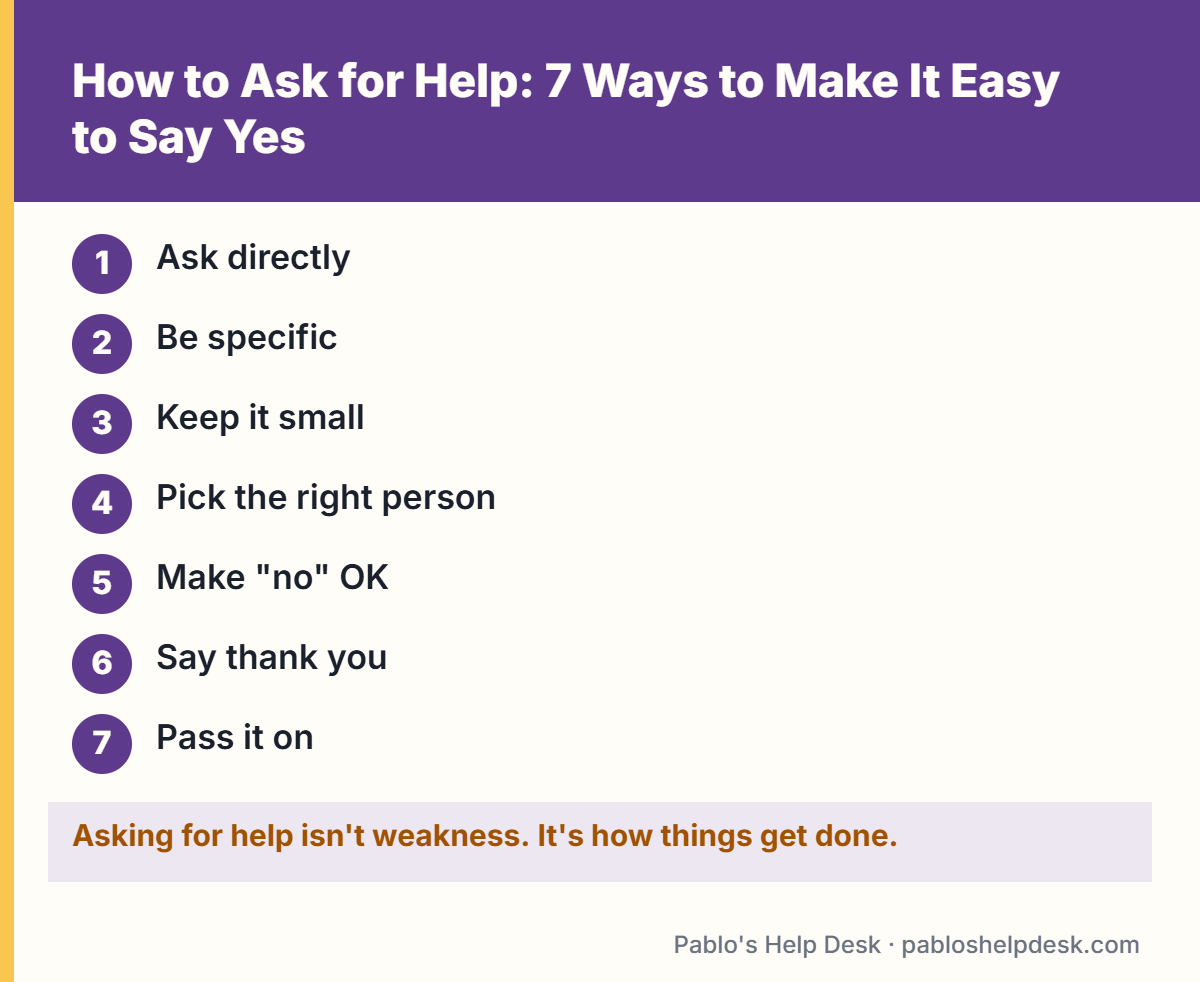
- Ask directly. Don’t hint and hope. In the Stanford study, askers thought hinting would work better, but the helpers said they were more likely to help when asked directly.
- Be specific. “Can you show me how to set up my new phone?” beats “I’m no good with this stuff.”
- Keep it small. One task. One time. If you need more later, you can ask again.
- Pick the right person. Ask the one who knows the thing. The neighbor who gardens. The grandkid who games. The friend who just did their taxes.
- Make “no” OK. Say, “If now’s not a good time, no problem.”
- Say thank you. Then tell them later how it went.
- Pass it on. Someday it’ll be your turn to help. Say yes when it comes.
When there’s nobody nearby to ask
Some of us live alone. Some of us have family far away.
There’s help for that, too. The Eldercare Locator is a free public service from the U.S. Administration for Community Living. You can call 1-800-677-1116 or text trained staff, chat online, or send an email. They connect older adults and families to local services, like meals delivered to your home and your local Area Agency on Aging.
Asking them is asking for help, too. It counts.
The bottom line
Strong people ask for help. They ask early. They ask plainly. And they say thank you.
So pick one thing you’ve been putting off because you didn’t want to ask. Then ask one person this week.
Asking for help isn’t weakness. It’s how things get done.
If you want a little more on this, read Your Experience Still Counts: Why People Ask You for Help. It’s the other side of the same coin. And Self-Confidence vs. Self-Esteem: Know the Difference.
Thanks,
Pablo
This article is for general education only. It is not medical or professional advice. If you’re struggling, talk to your doctor or someone you trust.
Free · 2 pages · Print it
Get The Scam-Proof Checklist
10 plain-English rules that stop most scams cold, plus what to do if one already got through. Keep it by the phone. I’ll also send you new posts when they come out.
No spam. We never sell or share your email. Unsubscribe any time with one click. Privacy