Acceptance Isn’t Giving Up: How to Tell the Difference
For a long time, this site had a little line under its name.
Working to balance change with acceptance.
I still like that line. Because that’s the work, isn’t it? Some things we can change. Some things we can’t. And a lot of life is figuring out which is which.
Here’s the trouble. From the outside, acceptance and giving up can look a lot alike. In both cases, you stop pushing on something.
But they are not the same thing. Not even close.
What giving up looks like
Giving up says, “Nothing I do matters.”
It stops trying on the thing that can’t be changed. Then it stops trying on everything else, too. The energy just drains out.
Giving up sits on the couch.
What acceptance looks like
Acceptance says, “This part I can’t change. So what can I do?”
It stops pushing on the locked door. Then it turns around and looks for the open one.
The American Psychological Association (APA) puts it plainly in its guide to building resilience: “Accept that change is a part of life.” The APA says that when you accept what you can’t change, it can help you focus on what you can change. It also says that after hard times, some goals may be out of reach. That’s real. Accepting it frees you up for what is still possible. (APA)
Mayo Clinic says something close to it. “You can’t change the past, but you can always look toward the future.” And then: “Don’t ignore your problems. Instead, figure out what you need to do, make a plan and take action.” (Mayo Clinic)
So acceptance isn’t the end of the road. It’s a turn in the road.
What the research says
Researchers have studied this very question. They look at two things. Letting go of goals you can’t reach. And putting your effort into new ones.
In one set of studies, they looked at college students, younger and older adults, and parents of children with cancer. People who could let go of goals they could no longer reach tended to feel better about their lives. So did people who could take up new goals. (PubMed)
Notice that it’s two steps, not one.
- Let go of what can’t be done.
- Pick up something that can.
Step one by itself can feel like giving up. Step two is what turns it into acceptance.
Now, let me state this plainly: this kind of study shows a link, not a promise. Letting go of one goal won’t fix everything. But the pattern is worth knowing. As we get older, some things really do change for good.
Three questions to tell the difference
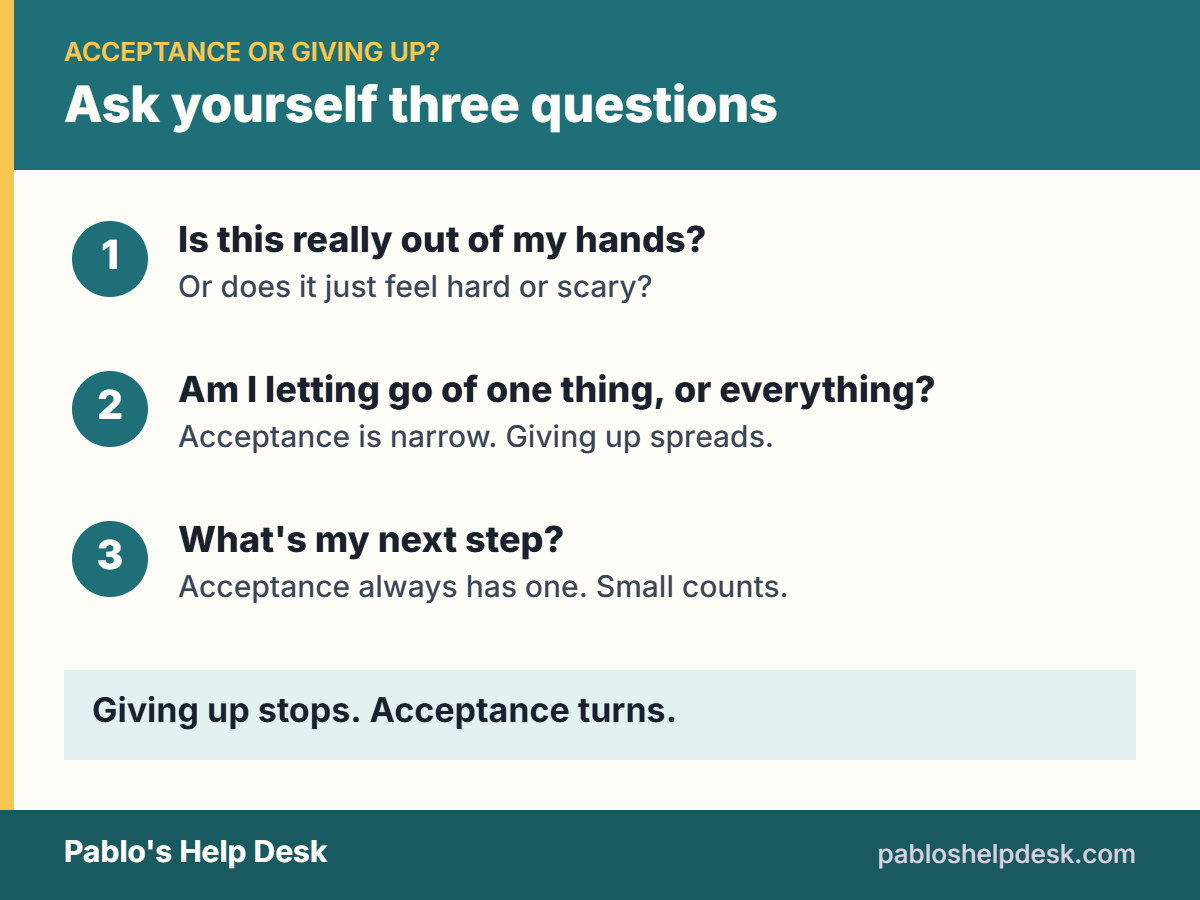
When you’re not sure if you’re accepting something or giving up on it, ask yourself these three questions.
1. Is this really out of my hands?
Be honest. Some things truly are. Some things only feel that way because they’re hard or scary. If there’s still a real step you can take, take it.
2. Am I letting go of one thing, or of everything?
Acceptance is narrow. It lets go of the one thing that can’t change. Giving up spreads. Are you quitting the things you can still do? That’s a warning sign.
3. What’s my next step?
This is the big one. Acceptance always has a next step. It might be small. Make a phone call. Take a walk. Try a new way of doing an old thing. If you can’t name any next step at all, talk it over with someone you trust.
A few ways to practice
- Write two lists. “Things I can’t change” on one side. “Things I can do” on the other. Keep the second list longer.
- Do one thing today. The APA suggests asking, “What’s one thing I know I can accomplish today that helps me move in the direction I want to go?” Small counts. (APA)
- Swap the goal, keep the reason. If an old goal isn’t possible anymore, ask why you wanted it. There may be a new way to get the same thing.
- Be kind to yourself about it. Letting go of something you wanted is hard. That’s not weakness. That’s being honest about where things stand.
- Don’t go it alone. If a change feels too heavy to carry, talk to your doctor or someone you trust. Asking for help is a next step, too.
The bottom line
Giving up stops. Acceptance turns.
We’re all going to run into things we can’t change. That’s part of getting older. That’s part of living.
Accept what you can’t change. Then put your energy where it can do some good.
That’s the balance. Change, and acceptance. We keep working on it together.
If you want a little more on this, read Hope as a Discipline: What Helen Keller Teaches Us About Resilience and Getting Back on Track: Eight Ways to Rebuild Your Motivation.
Thanks,
Pablo
This article is for general education only. It is not medical or mental health advice. Talk to your doctor or a qualified professional about your own situation.
Free · 2 pages · Print it
Get The Scam-Proof Checklist
10 plain-English rules that stop most scams cold, plus what to do if one already got through. Keep it by the phone. I’ll also send you new posts when they come out.
No spam. We never sell or share your email. Unsubscribe any time with one click. Privacy