Sensations in Meditation

Question:

During my meditation, my eyelids started tingling, then my eyebrows than I started feeling a point in my forehead like squeezing. Then my shoulders started to shake. Could you please tell me, what was that, and is it dangerous? My whole head was like stiff.

Read More

Leadership in mind

We’re so bombarded by our mobile devices that our ability to pay attention is declining—and extensive research on leadership shows a crisis of engagement in the workforce. Leaders are not satisfying their employees’ needs to find engagement in what they do. Hear about the three most important qualities a leader needs to help solve the crisis.

Read More

How to Be Productive, Not Busy

How to be Productive, Not Busy

In today’s world, it is so easy to be busy rather than being productive.

That’s because we have so many notifications, alerts, to-dos, things screaming for attention. Oftentimes, when we are not aware, we could simply spend an entire day just doing things, rushing from place to place, clearing item after item. But these may not be the most impactful things that move us towards our goals.

So how can we focus on the impactful and make the most of our days?

In this episode of The Personal Excellence Podcast, I share

  • 6 tips to be productive, not busy
  • Why you should not start your day with chat [1:25]
  • How to separate communication between inner circle loved ones and others [4:50]
  • Why I turn off alerts and notifications [8:21]
  • How to deal with incoming emails, alerts that you need to respond to [10:59]
  • Starting your day with a priority to-do list [12:44]
  • Why you shouldn’t beat yourself up when you go off task [14:49]
  • Using batching to group similar tasks [17:07]
  • How to create your 80/20 to-do list [20:32]
  • Using a “Will do” list to defer incoming tasks [20:32]
  • The importance of delegating [21:59]
  • Why delegating was my Achilles heel in the past [22:42]
  • 3 factors I used to determine when to delegate [25:05]
  • 5 questions to ask yourself in a weekly/bi-weekly audit [29:16]
  • Asking ourselves WHY, WHAT, and HOW as we live consciously [30:20]

Listen to this episode here:

If you’ve found The Personal Excellence Podcast useful, I’d really appreciate it if you can leave a nice rating and review on iTunes. Your review makes a difference and will help spread the message of conscious living to the world. Thank you!

How to be Productive, Not Busy [Transcript]

Celestine Chua: You’re listening to The Personal Excellence Podcast, the show that’s all about helping you be your best self and live your best life. I’m Celestine Chua, your host, and founder of PersonalExcellence.co. Let’s get started!

Hey everyone. That is Celes from PersonalExcellence.co. Welcome back to the podcast!

Today I want to talk about productivity — specifically how to be productive, not busy. I feel that in today’s world, it is so easy to be busy rather than to be productive. That’s because we have so many notifications, alerts, to-dos, things screaming for attention. Oftentimes, when we are not aware, when we are not conscious of it, we could simply spend an entire day just doing things, rushing from place to place, clearing item after item. But these things may not be the most impactful things that help us move towards our goals.

So today I want to share some simple tips, six tips in fact, on what we can do to focus on being productive rather than being busy.

1) Don’t start your day with chat

My first tip is don’t start your day with chat. It is very instinctual to want to open your chat application in the morning and see who messaged you. Thinking, What do I have in my chat inbox? What messages do I have? It feels exciting because you are getting messages from people, people you care about, or new people you just met. Also, it is sometimes like a little gift, like each message is a little gift and someone has a special message for you and you want to see what’s that. So I totally understand that.

But unless it is an off day where you are not working, for your work days, I recommend not starting your day with chat because it can easily derail your day into a series of chat exchanges where chat is your main focus, as opposed to what you need to get done. This is especially true if you are an entrepreneur, you control your day, you control your routine, or if you are a freelancer. It is very easy to have your entire day derailed because of chat or even because you are looking at your social media news feed. You know, the social media platforms today. I shared in a previous episode on FOMO, the fear of missing out, about how social media applications and platforms today are designed to get you to come back to the platform.

When you start your day with chat and this may be a chat application or a chat tool built into a social media platform, you have already entered their arena where there are all these design elements designed to get you to come back to the website. From the notification button color to the placement to the user interface, and so on. The best way is simply not going into chat at the beginning of the day. But instead focusing on the things you need to do.

Another reason is that at the beginning of the day, our energy is at its highest and you want to direct that to the highest purpose activities on your to-do list. As opposed to pumping that into chat because then you’ll be putting your best energy into chat messages and replies which may not be the best use of your energy.

There is an exception to this rule, which is if the person is a family member, an important loved one, like your partner or your kid. With these people, you should have a channel where they can easily access you. So this could be chat, this could be some other channel. That’s because there could be some urgent family matter or important issue where they need to notify you. Having this instant access lets you know if there anything that you need to tend to and so on.

This is where there is a conundrum. Because then you’ll be wondering, Oh okay, if I need to be easily accessible to these people, the problem is when I check messages from them, I will naturally see messages from others. My answer is to use two different chat applications. This is if you find that it’s worth doing that. Using two different applications: (1) One for your super important, inner circle loved ones. The people who need 24/7 instant access to you; and (2) The second for everyone else.

The good thing is there are so many applications today. Line. WeChat. Whatsapp. Facebook. Telegram. And so on. Simply designate one app to everyone else, I guess the default channel that everyone uses like WhatsApp and Facebook. And use a different channel that very few people use. Use that channel and allocate that to just your loved ones, like your parents or siblings or your spouse, your children. This way you have a separate channel that’s just for these people and you can use that without all these non-stop notifications, all these elements trying to pull you in. At the same time, you can still connect with the other people in your circle using the general application for everyone.

I do that and I find that super useful in helping me stay focused. Before that, I was just using one application for everyone when the one person I communicate with the most and I need to communicate with frequently would be my husband. I found that a lot of times when I was checking the chat application for his messages, I would naturally see the messages from other people. Some of these messages, in fact, most of the conversations were not essential. It’s like banter, casual banter, which is fine and good for socializing, but not to the extent where I need to see it all the time every day. The problem is when you log back onto these chat applications, you know that many of the social media tools today will show what time you were online and many of these tools don’t have a feature for you to turn it off — which is terrible. Then other people will see, “Oh you’re online, but you’re not replying to me. Why are you not replying to me?” And then that’s all this nonsensical stuff which is totally unnecessary.

So I find the best way is to simply use a different app for these inner circle people whom we need to communicate with on a very, very frequent basis throughout the day. And also with them, they understand that each of us has things to do. I have my things to do. You have your things to do. And our priority is to focus on these things. But at the same time, we check back this application throughout the day, just in case there are urgent matters, home matters, household issues, etc. that we need to see and deal with.

Another way that one of my ex-professors uses is having two different phone numbers. One number for close family members. Another for everyone else. That can work too if you are okay with using two different numbers or you have a dual SIM card phone. Otherwise, using the two chat applications,  that works pretty well.

2) Remove distractions

My second tip is to remove distractions. By that I mean the notifications, the alerts, all these different things that are so common and part and parcel of every application, software, website that we use or visit nowadays.

I find them very intrusive. I always turn off all these notifications and alerts. Whenever I install something new, if I have to install — So firstly, I rarely install new apps or software, only the essential ones. That’s very important, knowing the key things you need to have and saying no to everything else.

Then, with the apps that I do install, I will disable all the alerts, notifications, and so on. On your phone, there is an overriding feature in Android — I’m not sure in iPhone — where you can disable notifications. This is a phone-level setting, not a setting with the individual app. In the “Settings,” I think it’s there on most Android phones, there’s a feature in “Applications” where you can turn off notifications for each individual app. Doing so overrides the notifications for that app, if it doesn’t give you that option to turn off its notifications (which I find quite common in today’s applications).

So turning off these alerts. Email alerts as well. I don’t have email alerts. I only check emails at specific moments of the day when I’m taking a break from my core task. Because when I’m doing a task, especially a high-level task, just having this stream of incoming notifications, be in terms of SMSes or email alerts or any app notifications, I find them very disruptive and they often take my mind from a high-level mode to a very low-level reactive mode. When there are all these notifications going on, even if no active notifications right now, I don’t enter into high-level mode because I’m constantly sitting in wait for the next alert, the next message, the next notification. So I’m sitting there, in reactive mode, anticipating, Okay there could be a next alert, so I don’t want to enter into this high-level thinking mode where I’m thinking about ideas or writing an article and so on.

Some of you may be in positions where you need to be accessible all the time. For example, maybe you are an account manager at a PR agency and you need to be accessible to your clients. That is totally understandable. For these situations, I recommend designating fixed moments throughout the day where you check your messages, emails, return calls, and so on. This could be once every hour, at the start of the hour or once every 40 minutes. It could also be after you finish a task or a segment of a task. This way you introduce some structure into your days, as opposed to being in reactive mode 100 percent of the time.

You want to be clear on the Quadrant 2 priority tasks that you want to get done, while being responsive to the incoming alerts, the firefighting staff you have to handle as part of your job. In our job, it’s common to have a lot of Quadrant 1 tasks, which are the firefighting stuff, the urgent and important tasks. And there are the Quadrant 2 — the very important but never urgent tasks. We want to strike a balance between getting the Quadrant 1 tasks handled, and also having the time to work on the Quadrant 2 tasks that never become urgent but it is important to work on them to make significant headway towards our goals.

3) Have a priority to-do list

My third tip is to have a priority to-do list. Get clear on the 2-3 key things you would like to accomplish for the day for it to be rewarding.

As part of this priority to-do list, you can have other things that you need to get done too. For example, scheduling this doctor’s appointment or returning this critical email and so on. These are little tasks that may not be in the top 2-3 things you need to get done, but you need to get them done as part of moving things forward. But in this to-do list, you want to be clear of what are the 2-3 key things, the big rock items, that you want to spend a substantial or considerable amount of your time working on and make good progress in them.

When we don’t have a priority to-do list, it is really easy to spend our entire day working on 10 to 20 little things. But these 10 to 20 little things often don’t make a significant change or a significant dent in our Quadrant 2 goals in the long run. So we could be spending our entire day doing all these little things every day and constantly busy, thinking, I’m rushing and doing this and that, I’m multitasking, I’m doing all these different things. But that is not a good use of our time. If anything, when we are doing all these things, we are running in our rat wheels, as opposed to taking a good look at the tasks that require our time and energy, the tasks that we should be working on.

When trying to transit from this working on 10-to-20-different-things mode, to the work-on-2-to-3-big-items mode, we can often feel a lot of resistance. Because there’ll be all these things trying to pull us away from our priority tasks. All these things screaming for attention, firefighting stuff, seemingly super urgent critical stuff. I would recommend not seeing it as an absolute change that you need to make. Like, Oh, okay, I must just do these 2-3 big things and that’s all. I don’t want to do anything else. Oftentimes it is a transition that we do where, okay, we spend some time on the 2-3 big things. We know what they are. We spend some time on them. But there would still be the little things that come in.

Do what you can do. Do your best to hand those little things. Once you’re done, go back and focus on those 2-3 big items. See this priority to-do list as something to anchor you, to remind you of your priority to-dos. But don’t get pressurized or stressed by those things.

For example, if you don’t make significant progress on these things, or you don’t even get to spend any time on these things today, don’t beat yourself up, okay? Don’t feel bad about it. Because it’s really normal. It is super normal especially when you are at the intersection of a million to-dos and a million things demanding attention, to sometimes have days where you’re working on these million things as well. That’s fine. Just do what you can to get these things sorted out and then direct your focus back to your 2-3 priority to-dos.

That is the most important thing. Constantly making the effort to shift back to your priority to-dos, as opposed to taking it as an absolute standard that you have to follow. Because that can lead to a self-defeating mindset, a self-defeating situation where you feel bad, and you beat yourself up, and that isn’t what we’re going for here.

4) Batch similar tasks

My fourth tip is to batch similar tasks. Often times you will probably find a recurring pattern in the tasks that you do. And when you start seeing a similarity in certain tasks, it helps to batch them.

Batch them meaning, let’s say you need to return email number 1 and then, later on, you need to return email number 2, and number three, and number four, and so on. So as opposed to logging into your inbox every 5 minutes to return one email, I recommend batching all these tasks together. So you can spend 1-2 hours on a Quadrant 2 task, and then at a specific point in the day, log into your email and reply to all these emails together.

Another example is, say, you are a website designer. You are maintaining four different client websites. Say there are several changes that you need to make to website number three. And there are constantly new changes streaming in each day. Maybe it makes sense to batch all these little changes you need to make, and then make them at the end of the day or at a fixed moment of each day. As opposed to making no changes on an ongoing basis throughout the day. Because there is always a set-up cost involved for each task. Where you need to log into a certain interface, you need to key in certain details, you need to set your mind in that mode, and then you need to assess that situation and think about what you need to get done.

This setup cost happens each time you work on a task. When you have many little tasks for an overall project, and you keep repeating the same steps even if each time you are doing one small little task… Say you have five little tasks for this big project. This setup time quickly accumulates. Before you know it, you would have spent the entire day on this setup time and this “switching cost” where you’re constantly switching from task one to task two. Even if you are a superb multitasker, which I’m sure many of you guys are, there’s always this cost involved. Again like what I share in Tip #2 on removing distractions, you’re forever spending your time in this reactive mode, this low-level mode, where you are doing all these administrative switching things, as opposed to getting into the high-level mode where you are making significant changes.

So as much as possible, batching similar tasks together. This does require you to take a step back to evaluate and assess what are the tasks that keep taking up your time each day. Often times we are not aware that this is happening until we take a step back to write down the tasks that have been taking our time throughout the day, and start to see a similarity or trends in these tasks.

This is where having a “Will do” to-do list helps. In Live a Better Life in 30 Days Program, the task for Day 8 is to work on your 80-20 to-do list. For the to-do list,

  • 20% high-impact tasks. I recommend having a column where you write down your 20 percent high-impact tasks, i.e. the tasks that will make the biggest impact, that will be the best use of your time for the day. This would correspond to the priority to-do list in Tip #3.
  • 80% low-impact tasks. Then have another column which consists of your 80 percent low-impact tasks, and these will be the tasks that need to get done, the little tasks that are not the best use of your time but need to get done.
  • Will-do tasks. And then another column which would be the “Will do” to-do list where you write down the tasks that stream in throughout the day and you need to get them done. But you don’t need to do them right away. Oftentimes a lot of the things that we think what we need to do right away, we don’t really need to do them right away.

Putting them in the “Will do” column and then assessing them at the end of the day and tending to them, helps us see the similarity in these tasks and batch them so that we can deal with them more effectively.

5) Delegate

My fifth tip would be to delegate. Now I know that this tip wouldn’t be applicable to those of you who are not in a position to delegate. But for those of you who are, maybe you are an entrepreneur, or you are at a managerial position, or you’re working in a team where the other co-workers handling different tasks, then it is important to learn to delegate. Even if you are not in the position to delegate right now, there will likely be a time in the future when you move to a different position in your career or you move up the value chain in your career ladder, where you would need to learn to delegate.

I have to say that delegating has always been my Achilles heel because firstly, I like to be hands-on. I like to be in the thick of the things that I’m working on. I will say that I’m a creator. I get the satisfaction of creating stuff and you guys can see that. Like with my entire website, Personal Excellence, I’m very hands-on. The entire website is built by me and so on. When I delegate, I stop working on that particular stuff that I’m delegating. That removes one small piece of satisfaction because the creation process is where I get a lot of satisfaction.

The second reason is that I don’t like to trouble people. I don’t like to implicate others or burden people with my problems. I just like to handle things myself and internalize and deal with them as much as possible.

So for a long time, I just didn’t like to delegate. I would just do everything myself as much as I can to the point where I would feel like bursting. But I have found that delegating is an important skill. It is a crucial skill if you want to do much more than you are able to with your own bare hands. Because we can never accomplish as much if we are always relying on ourselves. We can always do more when we have an extra set of hands helping us. We can always do more when we have two different brains working on a problem.

This is something that I took very long to learn. Nowadays I’m learning to do that more. Delegating, identifying which are the parts of my business where I should delegate and let someone else handle and help me in them, while I work on the higher-level stuff that is the best use of my time.

With regards to delegating in my business, I have three factors that I use to evaluate whether I should consider outsourcing or hiring.

  1. Repetitive. Is this task repetitive? Is it highly recurring? If it is highly recurring, it has a high frequency, that means I should potentially look at hiring someone to handle this.
  2. Value of the task vs. my time. Is it the best use of my time? Or can my time be better spent elsewhere? When you are running a business and as your business matures and as your customer base grows, you start to be involved in many, many different tasks of many different functions. So you could start your business and many things are important. But there will be a point where there are just so many tasks and many things are important, but it’s just not possible for you to handle everything. And that will be certain tasks that are more important than others and that are a better use of your time.

    For example, in my business, there could be marketing, editing, audio editing, video editing, site maintenance, content creation. And all these things individually by themselves are important. But is every task the best use of my time? Or can my time be better spent elsewhere? And it is a very critical question because unless we consciously evaluate the value of our time and whether this time can be better spent on Task A or B or C, we will forever be in this mode where we feel that everything is important and everything deserves our time.

    But when we stack up all these tasks side by side, it becomes clear that there are certain tasks are a better use of our time than other tasks. And these tasks that the best use of our time, oftentimes they are the critical aspects of our business and our work. And us putting energy into them can create the biggest rewards.

  3. Pros vs. Costs of hiring. The last factor, whether the pros of hiring outweigh the costs. Because there will always be a cost involved when you’re looking at hiring or outsourcing. Now if you’re delegating to someone in your team, in the company that you’re working in, then the cost element wouldn’t really be applicable. But if you are a business owner or entrepreneur, then the cost element would be involved. Even if say if you are delegating something in your personal life — so you could be working in a company but you are looking at delegating aspects of your personal life, say household cleaning, grocery shopping, or potentially getting a helper, then the pros need to be weighed against the costs and whether it’s worthwhile.

When you’re dealing with something that is highly repetitive, is not the best use of your time, and the pros of hiring outweigh the costs, then you should look at kickstarting the hiring process. It can be pretty difficult to get good talent, good people to help you or good services to help you. In some cases, it may not be hiring someone as much as you are engaging a service to help you in that thing.

But once you find someone who can help you or a service that can help you, you will find the rewards tremendous. Because now you can take a load off your shoulders and dedicate your mind space, your time, your energy on the things that truly would be the best use of your time.

6) Do a regular audit

My sixth and last tip is to do a regular audit. Audit meaning you look back at how your week has been and you ask yourself:

  1. How has this week been?
  2. Am I satisfied with how I’ve spent this week?
  3. Have I spent this week on the most important things on my task list?
  4. Could I have spent this week in a better way?
  5. Moving forward what changes would I like to make, if any?

Asking yourself these questions can be very helpful because oftentimes we are just heads down in our work, our tasks, trying to complete item after item. We often don’t take this step back to get a macro focus on what we are doing, how we are doing things, whether that’s a better way for us to do something. Without this audit, we can forever be stuck in this micro mode, just rushing from place to place, finishing task off the task. Before we know it is already been weeks and weeks or even months, and we look back and we wonder, Where has all this time gone?

Doing this audit helps us take a step back and think about these three points:

  1. WHY. Why are we doing this? Is this the best use of all time?
  2. WHAT. The things that we are doing. Are these truly the best use of our energy? Are these the things that will be moving us towards our highest goals?
  3. HOW. The way that we are doing things, the approach that we’re using right now, is this the best approach? Can there be a better approach? Can there be a better way to do things?

So you can do an audit every week, every two weeks, or even every month. But the point here is to do an audit. Use the audit as a chance to evaluate how you have been spending your time, because it is so easy to be stuck in work mode, busy mode, and spend all the time that way without really thinking about whether this time has been spent effectively. An audit is this chance, this opportunity where we can take that step back to really think about how our days have gone, how weeks have been spent, and whether we can do things in a different way.

Closing Note

Productivity is when we are consciously spending our time. Consciously approaching our days and thinking about how we can make the most out of it.

Busy, in a way, can be considered a lazy way of living. In that, you’re not really thinking about the things that you’re doing as much as you are just doing them.

While it is very important to have a good work ethic, which is what being busy is about, you want to make sure that your time is being spent in the most impactful way. This is what productivity is about: Working hard, while at the same time making sure that your hard work is creating the highest impact. Making sure that your energy and your efforts are creating the biggest impact in the world.

So that’s it for today’s episode. Thank you so much for listening. I have an article that shares more tips on how to be productive versus busy that you can check out in the show notes. I’m going to link that in the show notes, along with links to some other resources related to today’s podcast.

If you have found today’s podcast helpful, I would super appreciate it if you can leave a review on iTunes. You can do that at personalexcellence.co/itunes. Every review goes a long way to helping the podcast to grow and towards spreading the message of conscious living further.

I want to take this chance to thank all of you guys who have posted such positive reviews and sending such wonderful feedback to me through the contact form. I read everything single one of your messages and I’m so grateful for your support. So thank you so much to you guys. You guys know who you are.

So that’s it. Until next time, remember: you are beautiful, you are perfect, you’re perfect the way you are. Talk to you guys in the next episode. Bye guys and have a great week ahead. 🙂

EndnoteThanks for listening to The Personal Excellence Podcast. If you have found today’s podcast helpful, I would really appreciate it if you can leave a review on iTunes at personalexcellence.co/itunes/. Every review goes a long way to letting others know about the show and spreading the message of conscious living to the world. For more tips and articles on how to live your best life, visit www.personalexcellence.co. Be sure to stay in the loop of my free content and updates by subscribing to my free newsletter at personalexcellence.co/newsletter/.

Related Resources:

The post How to Be Productive, Not Busy appeared first on Personal Excellence.

Read More

I’m Bisexual and I Have Been Resisting My Sexuality. What Should I Do?

Dealing with Bisexuality

(Image: Zachary Shea)

Firstly, I hope you will respect my wish for confidentiality and will therefore refer to me as ‘John.’

I have known that I have been bisexual (leaning towards men) for a while now. I have always wanted to keep it secret (because I don’t agree with bi/homosexuality), but it is becoming harder to do so. My parents don’t mind what or who I am, but I don’t want to let them or me down. Furthermore, a major issue is my social status. Both myself and my friends are seen as ‘cool’ and I worry they may discard me. We have gone to plenty of discos together, and I have been with a fair number of women in my time.

But in my heart and soul, I want to be with them. My straight best friends. Telling them might make them realize I like them and that isn’t a risk I’m willing to take. Another problem is my girlfriend. I don’t want to let her down. She is smart, funny and beautiful (a rare combo, I know).

My life looks perfect on the outside, but inside it’s a permanent battle. Please help me.

— John

Hi John, thank you so much for sharing this deeply personal problem. I see that there are a few layers to this problem, so let’s look at them one by one.

Your Social vs. Real Self

Let’s start with the central theme of your issue, which is,

  1. Who is John? Who is the real John?
  2. And does the real John correspond to the John that others know, the social side of you that you display to others?

I’m going to jump to the second question first, and the answer seems to be a “no” — no, the real John seems different from the John that others know. While most people have two sides — a real self and a social self where they show filtered aspects of themselves to others, especially to people they don’t know well, in your case this difference is so stark that it has made life a struggle.

That’s because firstly, the difference between your real self and your social self centers around a core part of who you are — your sexuality, which in turn linked to your relationships, what you can say, everything. While for other people, the difference between their real self and social self can be small things like being chatty in a social setting while being introverted on the inside, for you the difference is a fundamental part of who you are. Pretending to be chatty despite preferring to be quiet does not hugely affect one’s life other than that the few interactions with those friends. On the other hand, pretending to be straight when you are bisexual (and leaning towards men) affects you in more than just those few interactions. It’s a facade that you need to keep up with across all meetings and interactions. It affects your romantic relationships, what you can say to others, and who you can be.

Secondly, the reason we have a social self is to fit into social groups, especially when our real personality is very different from what is socially “accepted” or “welcomed.” That’s because individual social groups ultimately have their personality that may not fit with our real self. For example, I love talking about personal growth, how to live a meaningful life, and social issues that go beyond our individual selves. However, some of my friends have no interest in such topics and I don’t talk about such things when with them. I obviously my true, unfiltered self when with my husband and very close friends.

But for you, your social self is someone you show to everyone, including your loved ones. Your parents, your inner circle friends, and even your girlfriend, someone you are supposed to be the closest and most honest with.

While for most people, they are their 100% natural selves when with close friends and family, for you, you are your social self the whole time. Your social self has taken a life of its own and shaped your entire life around it. Instead of you being your real self with most people and showing your social self only in certain interactions, you are your social self the whole time and never your real self. There’s no “off” switch, so to speak. This is why life has become a permanent battle as you have no way to connect with the world as the real you.

Acceptance of Self

This brings me to my next point, which is something you said: “I have always wanted to keep it secret (because I don’t agree with bi/homosexuality).”

My question to you is, why? Why don’t you agree with bi/homosexuality?

While I don’t normally question people’s views on bi/homosexuality because everyone has the right to believe what they want, here I have to probe as your view on bi/homosexuality is intrinsic to your relationship with yourself. If you identify as a bisexual but you don’t agree with bisexuality, that’s a problem — a big, big problem.

Let’s look at various views on bisexuality (and homosexuality). For some people, they think of bisexuality as a choice, where people choose to be bisexual and they are simply deviating from “God’s intended design.” For some, they think of bisexuality as a result of a person’s biology, something they are born with and don’t get to choose. I believe most bisexuals/homosexuals can relate to this. Some may think of bisexuality as a state of mind, a result of people being experimental, and it’s something they should snap out of. And then there are religious and societal views, where some religions outright condemn bi/homosexuality and some conservative cultures deny its existence.

For me, I think humans are incredibly flexible — as much as we are biological beings, we have the ability to shape our lives in vastly different ways due to our highly developed minds. I believe that there are people who are born bisexual and it is part of their biology. I also believe that there are people who adopt a certain sexual orientation due to past childhood trauma and experiences, and it makes the most sense for them in this world. In the same vein, I believe there are people who are born with an open sexuality or bi/homosexual and become heterosexual to fit in (similar to what you are going through), just as there are people who are born heterosexual and hence stay heterosexual (since this is the default configuration of society).

All these don’t matter though, as it’s about your views on bi/homosexuality. I can understand if someone doesn’t agree with bi/homosexuality if he/she isn’t bi/homosexual — without walking a mile in others’ shoes, some people may not understand something that’s not in their day-to-day awareness set.

However, if you are bisexual and you don’t agree with bi/homosexuality, then why is that? Is it because of your religious beliefs? Is it because this is what you were taught growing up? Is it because this is against what society believes in? Is it because you don’t believe that this is biologically the right way for a human to be?

Whatever the reason, as long as you don’t agree with bi/homosexuality, you will forever be stuck in a self-battle. As Carl Jung said, “What you resist persists.” To achieve the state of self-acceptance, you need to uncover your resistance towards bi/homosexuality and work through it. Bisexuality is not something abnormal, just as homosexuality isn’t something abnormal. It is just different, something that most people don’t understand if they don’t have any bisexual/homosexual friends. Unless you accept yourself, all of yourself, it becomes an uphill battle trying to find happiness outside of you.

Who Are You?

This leads me back to the first question, which is, Who are you? Who is John?

Is John the cool guy often seen with his cool guy friends? Is John the guy with a beautiful, smart, and funny girlfriend? Is John the guy with a perfect life and a nice social status?

Or is John someone more than that? Someone who transcends these social definitions, who doesn’t need people’s perceptions to define who he is? 

Even though you are afraid to tell your friends and girlfriend about your sexuality, you have to ask yourself: What it is to you, and why does it matter? Because if your friends are with you because you are seen as straight, and they may discard you when they know your true sexuality, then are these friends you want to stay with? Perhaps not, or perhaps they should be seen as social buddies rather than close friends. Because don’t you want to focus on friends who care about you as you, rather than friends who judge you based your sexuality?

With regards to your girlfriend, I do think that you owe it to her to tell her the truth as she is committing herself to you by being in the relationship. You have to ask yourself which is the more important value: being Truthful, or being Agreeable (not wanting to let her down)? If both of you decide that you are not right for each other, then it’s better to break things off now rather than waste her time and your time. You didn’t mention your ages, but a woman has a biological prime for childbearing, so if she is in a relationship with no long-term future, that’s time taken away from her dating journey. Whether or not having kids is what she wants, it’s important for her to know so she can decide what to do and whether she should further invest in this relationship. For you, I believe you want to be with someone you truly love and want to be with, which may or may not be your girlfriend (since you are with her under a concealed sexuality).

With regards to your parents, the great thing is that they don’t mind what or who you are. This means that the battle you are really fighting here is with yourself, as I shared above. If your parents don’t mind what or who you are, then why are you so bothered about possibly letting them down? What is it that you are “letting them down” in — is it from not being “like other sons”? And in terms of what, your sexuality? Why would having a different sexuality be a let down in any way? If it’s because of social stigma, I believe (given what you said) that your parents’ love for you is stronger than what society or religion says. Whether or not there is negative stigma from others, this is something that your parents and you can work through together, as a family. Just because you are fearful of societal’s views doesn’t mean that you should hide your sexuality from them — especially if you have an open, honest relationship with your parents to begin with. It’s about telling them the truth and then working through this together.

Bringing Your True Self to the World

What does this mean? Does it mean that you should just “come out” to the entire world?

Well, it depends. It depends on where you live and whether the society around you is ready. In certain conservative cultures, people outright condemn bisexuality and homosexuality. For example, same-sex sexual activity is illegal in India and sex between men is criminalized in Singapore (though this law is not actively enforced). In Singapore, The Pink Dot (an LBGT-affirming event) has faced many challenges in recent years as they try to spread awareness of the community to the broader society. Depending on where you live, you may have to be careful in how and who you reveal your bisexuality to.

But no matter what people around you think, you have to (a) achieve self-acceptance and (b) give your true self a way to connect with others, even if starting in a small way. Such as only revealing it to certain close friends and family members first. Such as connecting with like-minds online, albeit under an anonymous handle, like in pro-LGBT forums, Facebook groups (this would require registering a different Facebook account to stay anonymous), and commenting in pro-LGBT YouTube channels (also under a different anonymous Google account). In a way John, you are already letting your real self get heard by sending in this Ask Celes question, so I thank you for that. 🙂

While society may not be fully ready for you yet — the aspect of you that is bisexual (because it is different from the “default” configuration that is heterosexuality) — that doesn’t mean that you should do the same to yourself. Society generally moves at the pace of lowest denominator, which means there’s often a need to accommodate for conservative views and less progressive behavior patterns. For example, environmental groups have been highlighting for ages the damaging effects of plastic use, yet governments, commercial groups, and the average person continue to condone, use, and discard non-biodegradable plastic bags and cutlery in the name of profit and convenience. Despite the emergence of green cars, most people still don’t use them because the default cars on sale are cheaper and easier to purchase. Even online, we are weighed down by a low quality of conversation because there are always the 0.01% trolls and spammers generating a lot of noise.

What does that mean? Does it mean that you should only wait until everyone is ready and accepting of bisexuality/homosexuality before you accept yourself? No, of course not. What if this happens in only 50 years? Are you going to wait for 50 years before you can accept yourself and embrace your bisexuality? That’s terrible and also incredibly damaging to your mental well-being and growth.

My advice is this: Don’t wait for others’ approval or acceptance for you to be who you are. Start to accept and love yourself, all of you, including your bisexuality. Figure out what’s blocking in your acceptance of your bisexuality, and address that. The problem isn’t with your family and their views (as you said they don’t care who or what you are), your straight guy friends and their possible rejection of your friendship, or your girlfriend, but how you see bi/homosexuality and as a corollary, yourself.

As you work on your self-acceptance, decide who you want to open up to about your bisexuality. Your girlfriend for sure, because you owe it to her to tell the truth. Your parents possibly, because they are your parents and you said that they don’t care about who or what you are. Selected friends whom you can trust. Your straight guy friends — if you are ready and you want them to know. Alternatively, you can choose not to tell them about your true sexuality and continue to hang out as social buddies. But you should most definitely find new buddies who non-judgmental about different sexualities, because good friends are people who care about you as you, not your physical or social attributes.

As you work on your self-acceptance, you will stop being troubled by others’ perception of bisexuality and of you, even though these may continue to be obstacles in how you can connect with the world. For example, you want to share your bisexuality only with trusted people and if it’s safe to do so, depending on the social environment you live in.

Obviously, the best case scenario is to live as your true self and have the society accept you 100% as who you are, but the reality is often not perfect. It isn’t for many people, even for heterosexuals. Many people today live with limitations caused by factors outside of their control, be it where they are born, their race, the opportunities they were given growing up, genetic health problems they had no say over, or in your case, having a sexual identity that’s not as widely understood or accepted as the default sexual identity. In the face of these imperfections, it’s about finding an equilibrium between living life as best as you can and managing the imperfections. Rather than hate the world for what it is, or hate our lives for what is not perfect, let’s try to make the best out of what we have and manage the other things that are not that great yet. Because we can’t control the cards we are dealt with, but we can choose how we deal with these cards.

I hope this post has been helpful in some way and you are able to pick the right way forward for yourself. Keep me posted on how it goes okay? 🙂

The post I’m Bisexual and I Have Been Resisting My Sexuality. What Should I Do? appeared first on Personal Excellence.

Read More

Tics, twitches, and Tourette’s

Adam Ladell was delighted to be runner-up in The Voice on Australian TV a few years ago. He’s a talented and confident singer—but offstage it’s a slightly different story. He caused a stir at school with his involuntary repetitive movements and loud, inappropriate vocal twitches which are part of his Tourette syndrome. Adam talks to us about working with Tourette’s and developing his performance skills.

Read More

Making Wisdom Your Most Important Goal

By Deepak Chopra, MD

It seems perverse that the easier life becomes, the worse our problems. Technology has created life-changing innovations like the Internet that are directly linked with terrorist attacks, giving like-minded fanatics instant global communication. Computers gave rise to social media, which has led to cruel bullying at school, fake news, conspiracy plots, and the anonymity to mount vicious personal attacks—all of these seem as endemic as hacking, another insoluble problem created by technology.

One could go on practically forever, and it wouldn’t be necessary to blame current technology either—the internal combustion engine is directly connected to climate change, and nuclear fission led to the horrors of atomic warfare. But my point isn’t to bash technology; we owe every advance in the modern world to it—except one.

Technology is based on higher education, and whatever its benefits, higher education has almost totally lost interest in wisdom. Wisdom isn’t the same as knowledge. You can collect facts that lead to the understanding of things, but wisdom is different. I’d define it as a shift in allegiance, away from objective knowledge toward self-awareness.

The Greek dictum “Know thyself” doesn’t make sense if the self you mean is the ego-personality, with its selfish demands, unending desires, and lack of happiness. Another self is meant, which isn’t a person’s ego but a state of consciousness. “Self” might not even be a helpful term, despite the age-old references to a higher self identified with enlightenment. It is more helpful to say that the pursuit of wisdom is about waking up.

Waking up is a metaphor for the conscious life, and the conscious life is what wisdom leads to. Every day we are driven by unconscious impulses and desires, and unexamined processes go on beneath the surface of the mind that lead to anxiety, depression, low self-esteem, self-destructive behavior, and every kind of pointless discord, from household tensions to war. The outbreak of World War I led to senseless slaughter, as did the excesses of Communism. These consequences were unforeseen, yet in retrospect it is obvious that World War I was a kind of eruption from the unconscious, of pride, anger, stubborn nationalism, and xenophobic tendencies that people were harboring as a matter of course.

European anti-Semitism wasn’t invented in Germany by a single fanatical Nazi; it was accepted in the most polite and civilized circles almost everywhere. In one way or another, allowing our unconscious to go unexamined has caused the greatest and longest suffering in human history. It was suffering and finding a way to end it that became the foundation of Buddhism, but any spiritual teaching that will show people how to wake up also aims to bring them out of suffering.

In that sense, wisdom has a definite purpose, but escaping the ills and woes of the unconscious life is secondary to the main purpose of waking up, which is to know who we really are. The answer can be formulated in a few words: humans are a species of consciousness whose special trait is self-awareness. Being self-aware, we have the capacity to access the very source of awareness.

At first sight this ability doesn’t necessarily sound positive. The vast majority of people have become expert at denial and were taught from childhood not to dwell on themselves, an activity deemed self-centered if not totally solipsistic. People are also expert at keeping secrets from themselves, at going along to get along, at valuing social conformity and fitting in. These habits unravel when self-awareness awakens. Not everyone wants to let them go, for obvious reasons.

But the worst aspect of being unconscious, or asleep to use the metaphor of waking up, is self-limitation. We all go around with core beliefs about how insignificant a single individual is, how risky it would be to step out of the norm, and how only the gifted few rise above the average. The wise in every generation have asserted the opposite, that the source of consciousness makes human potential infinite. We can think an infinite number of new thoughts and say things never before said. In fact, there is no arbitrary limit on any trait that makes us human: intelligence, creativity, insight, love, discovery, curiosity, invention, and spiritual experiences of every kind.

We are a species of consciousness whose great pitfall isn’t evil but “mind-forg’d manacles,” to borrow a phrase from the poet William Blake. We make up mental constructs, invent stories around them, and tell the next generation that these stories are true. One story says that women are inferior, a complex tale that gave rise to a thousand injustices and false beliefs. Us-versus-them thinking leads to stories about racism and nationalism that caused their own barbarous results.

Waking up allows us to escape all stories and to live free of self-limiting mental constructs. The real question is whether it can be done. Can you and I wake up? If so, how do we go about it? Are there awakened teachers who can provide examples of what it means to live the conscious life? This is exactly where wisdom enters the picture. Without living examples of awakened individuals, the whole enterprise would be trapped in a limbo of fantasy and wishful thinking. But when a society values wisdom, it turns out that the awakened exist among us and always have.

Anyone who wants to wake up is fortunate to be alive now, because despite our global problems, irrational behavior, and self-destructive denial, modern society is open to ready communication about every topic, including the exploration of higher consciousness. Where prior generations had little grasp of higher consciousness beyond the precepts of religion, millions of people today can walk their own path to self-awareness, choosing to include God, the soul, organized religion, and scriptures as they see fit, or to avoid them. Even “spirituality” is a term you can adopt or ignore—the real purpose of waking up is about consciousness.

We have always had the potential to be wise by using self-awareness to explore who we really are. A society driven by consumerism, celebrity worship, video games and social media gossip, and indifference to massive social problems feels like it could never find wisdom, or even the first impulse to wake up. But I’d argue that we are the most fortunate society to wake up in, simply because higher consciousness is open to anyone. I count this as the greatest opportunity facing us, to see that waking up is possible and to hasten toward it as quickly as we can.

Deepak Chopra MD, FACP, founder of The Chopra Foundation and co-founder of The Chopra Center for Wellbeing, is a world-renowned pioneer in integrative medicine and personal transformation, and is Board Certified in Internal Medicine, Endocrinology and Metabolism.  He is a Fellow of the American College of Physicians and a member of the American Association of Clinical Endocrinologists. Chopra is the author of more than 85 books translated into over 43 languages, including numerous New York Times bestsellers. His latest books are The Healing Self co-authored with Rudy Tanzi, Ph.D. and Quantum Healing (Revised and Updated): Exploring the Frontiers of Mind/Body Medicine. Chopra hosts a new podcast Infinite Potential available on iTunes or Spotifywww.deepakchopra.com

Read More

Why I Deleted My Twitter Account with 7,000 Followers

Why I Deleted My Twitter Account (with 7,000 followers)

Hi everyone! About two months ago (April 2018), I deleted my Twitter account @celestinechua. I thought I should write a post explaining this as some of you have been asking me about it.

My Issues with Social Media

First off you guys know my stance with regards to social media. While social media used to be a great place for authentic conversations, it has become a very “noisy” commercial ground now. When I use social media as a content publisher, I feel like I’m just one drop in a very large ocean, where my comments have no impact whatsoever. There are just way too many — think hundreds of millions of — content creators on social media these days, with many using bots, digital assistants, and agencies to tweak every aspect of their social media messaging, so that they can get the best engagement and ROI for their posts.

This is vastly different than years ago, say in 2011, when I was having many authentic interactions with readers on Facebook and social media has not become the monster that it is now.

These days though, my notifications on Facebook and Twitter are either spam, some commercialized plug, or some pointless alert. It has become very tiring to log into my social media accounts each day with a bright red alert showing XX notifications, only to sieve through and see that they are pointless updates. I have talked about these issues in these posts: Why I Deleted My Facebook PageChallenges that I’m Facing Today, and The Fear of Missing Out (I’ve since reinstated my Facebook page after deleting it in 2016, but I no longer actively maintain it).

Detroit Become Human: Hands in the Junkyard Scene

This is how I feel when I log onto social media and my inbox every day for the past few years (Image: Detroit Become HumantheRadBrad)

My Issues with Twitter

In the same vein, Twitter has become a frustrating experience for me in the past few years.

To begin with, most readers of PE do not follow me there. Many readers on PE don’t use Twitter, while those who do don’t connect with me using that channel. I think Twitter has a specific demographic and most PE readers are just not active Twitter users. Users who want to get my updates sign up for my mailing list (which is the official channel to get my updates btw — I post stuff that I don’t post here, including new courses and special messages). For anyone wants to send me a message, the contact form is the way to go.

Next, when I looked at my Twitter followers — about 7,000 of them — I realized that (a) this number has not been growing for the past two years, and (b) 99.9% of them are inactive or “dead.” “Dead” in that the users no longer use their accounts, or are following so many people that users like me who believe in tweeting less, not more, can no longer be heard anymore. Out of these 7,000, maybe only three people actively read and reply to my tweets (hi Charles, Ted, and Rick!). It became clear that my Twitter follower count has become a vacant number. While I was meticulously maintaining my Twitter account daily for the past few years and thinking that I was reaching 7,000 followers with every tweet, I was really shouting into a black hole.

Following this, I then looked at my Twitter messages. Over the years, I began to receive a high proportion of empty alerts, such as notifications of some company bot tweeting out my articles and tagging me, usually done to increase exposure of their account/business. Messages from content creators trying to network, expressing manufactured interest in what I wrote — but the reality is they are just trying to network to spread the word about their service. Nothing wrong with what they are doing, but when I check Twitter, I’m looking for authentic conversations with people who really read PE, not networking requests and solicitation. These are things that I’ve dealt with immensely for the past ten years, and I feel like I’m at a stage of my life (mid-30s) where I just want to move on and focus on creating content and live my life, not battle the same things that I spent my 20s dealing with.

Note that this issue is specific to me rather than most Twitter users. Running a large website has made me the target of an enormous amount of spam and solicitation requests. When I looked at my issues with Facebook, blog comments, contact form, and now Twitter, it’s the same thing — an enormous amount of spam, noise, and empty comments because of my blog’s visibility. While I used to get a ratio of 100% authentic messages to 0% noise in my messages, now it’s more like 0.01% authentic messages to 99.9% noise.

Frustration vs. Inspiration

After thinking about this, I realized the fundamental problem is that the social media and internet landscape has changed enormously since I started my website. Conversations online used to be authentic because people were using the internet in an authentic way then. These days, the internet has become massively commercialized, while abusers have a huge amount of power due to the democratization of technology and automation tools.

The answer, then, is to use social media in a way that enables me. I asked myself: If this platform is making me feel so frustrated when using it, should I continue using it then? The answer was clearly, a “no.”

To be honest, I felt a little surprised by my answer. Because having a Twitter account feels so basic, so essential today, something that every business owner must have. Every time you sign up for a new service, you will invariably be asked for your Twitter handle (and Facebook page ID). Not having a Twitter account is unheard of. It feels blasphemous. It feels like you are some backward, outdated business owner who is not in touch with his/her audience.

But is it true though? Because even when I was managing a Twitter account with “7,000 followers,” I didn’t feel like I was reaching anyone. Every time I tweeted something, I felt like I was throwing a coin into an abyss. I didn’t feel this way in the early years of Twitter — it’s only so in the recent years as social media morphed into some giant, monster entity. These days, I feel like everyone is shouting at the top of their lungs and commercial businesses have unlimited resources to micro-optimize every aspect of their presence, and social media is no longer the right place for me to connect with my audience: everyday people without a voice, people whom I want to speak out to and help.

In short, Facebook and Twitter were good ways for me to connect with my audience from the late 2000s to early 2010s, but not anymore as they have morphed into totally different beasts that favor quick engagement and short-form conversation. I have become tired of navigating these platforms’ ever-changing layouts and guidelines for outreach (particularly for businesses), and spending an exceeding amount of energy to maintain my accounts with very little return. The net conclusion of having a business account with these giants these days is that there are too many creators (many profit-focused over value-driven) with elaborate teams and assistants hacking the algorithms and getting their content seen by focusing on what the social media giants want (rather than what truly helps the user).

What I’m interested in is creating long-form, deep content on important life topics, and these are just not well-suited for their algorithms and landscape today.

“Death by a Thousand Cuts”

In retrospect, I should have closed my Twitter account much earlier. I feel like this is a case of “death by a thousand cuts,” something which I feel is very common in today’s social media world. When something is unpleasant, if the unpleasantness is on a very small level, you will usually tolerate it. What social media giants have done today is that they are delivering many little cuts slowly, over a long period of time. Tweaking the platform little by little, changing the rules every other day, altering the algorithm in a way that builds stickiness for them (but creates user fatigue), inserting little ads everywhere, and just making changes that maximize profit rather than create value.

Since these cuts are delivered little by little, most people don’t observe this. They continue to use the platform every day, addicted to it (an addiction that is carefully engineered by growth hacker teams). At the same time, the users start to experience other changes in their life: decreased productivity, mental fatigue, a general feeling of emptiness, but they have no idea that these are linked to their use of such platforms. So they stay on, getting sucked deeper and deeper.

I find this issue with Netflix as well (even though they have an active product which is video subscriptions) — I tried using it for the past month as part of a free trial from another service, and I find that it employs highly negative, dark design patterns meant to suck the user deeply into the platform. Not surprising since this is what many modern-day giants are doing.

When it comes to digital platforms today, figure out your needs and use them in a way that supports your needs, rather than the other way round where you change your life to fit their ever-changing rules and guidelines. I share more in 6 Tips to Deal with Digital Burnout.

Endnote

At the end of the day, I’ve spent the past few years trying to make sense of my relationship with social media and online tools. I don’t want to jinx this but I think I’m starting to reach a good place regarding this.

I have my Facebook page but I don’t actively maintain it anymore because of the reasons stated here. I no longer have Twitter and I’m happy to have gotten rid of it. As a Facebook personal account user, I use it in a way that supports my needs. I have my growing newsletter list where I can connect authentically with you guys, where I get authentic replies to what I send out (thank you to all of you who have been participating in my surveys and sending kind messages through the contact form!). There are still negative bad eggs every here and there, but I’ve come up with tools and ways to manage and minimize them to a near-zero instance.

In the meantime, I’ve been busy working on my next course (on how to discover your life purpose), based on your feedback to my email survey sent out a few months ago. I’ll be sharing updates via my email list when it’s ready, so stay tuned!

Check out:

The post Why I Deleted My Twitter Account with 7,000 Followers appeared first on Personal Excellence.

Read More

GE 295: How Founder Mike Roberts Started With Only $3K But Grew SpyFu To $7M ARR and 11K Customers (podcast)

Mike Roberts SpyFu Nacho Analytics

Hey everyone! In today’s episode, I share the mic with Mike Roberts, the founder of SpyFu and Nacho Analytics, software that is called the “Holy Grail of Competitive Intelligence”.
Tune in to hear how Mike built SpyFu with only $3,000, why historical data matters when it comes to digital marketing and how the company was able to make over $7 million in annual revenue.

Time-Stamped Show Notes:

  • [00:42] Before we jump into today’s interview, please rate, review, and subscribe to the Growth Everywhere Podcast!
  • [01:58] Mike founded SpyFu about 12 years ago in Scottsdale, Arizona.
  • [02:25] His office is nearby, so he commutes on his electric skateboard.
  • [02:55] His favorite metric is earning per employee.
  • [03:05] They make over $7 million in revenue annually.
  • [03:45] Mike started SpyFu with only $3,000 left in his bank account.
  • [04:01] Everything mattered and every mistake was personal, in his experience.
  • [04:23] Entrepreneurship is a journey and you’re constantly learning.
  • [05:25] SpyFu is $39/month for unlimited use.
  • [05:55] It allows you to fully research your competitors.
  • [06:39] SpyFu generally has more historical data, whereas SEMRush will give you 18 months of data.
  • [07:00] History matters: people make mistakes early on and it’s important to see everything that they have done and if they worked.
  • [07:41] With SpyFu, there are no limits, unlike every other one of their competitors.
  • [09:00] He doesn’t want to cut his prices, but acknowledges that you can make more money per customer if you have more customers.
  • [10:46] SpyFu has around 11,000 paying customers.
  • [10:56] A lot of their customers use the free option.
  • [12:07] Their launch brought in $20,000 MRR.
  • [13:18] Nacho is the “Holy Grail of competitive intelligence”.
  • [14:40] The entire internet is built on anonymous user tracking.
  • [15:05] So, Mike’s team wondered what would happen if they collected data, but didn’t use that to display ads.
  • [15:21] They take all the data and push that into Google Analytics.
  • [15:37] Then you can look at that info as if it were your own.
  • [15:57] They are not sponsored by Google, but are legitimate.
  • [17:12] This sort of data has always existed, but it’s only been accessible to billion dollar companies.
  • [17:30] $99 gets you information on 5 websites.
  • [19:51] If Mike had gotten capital for SpyFu, they wouldn’t have $7 million in revenue, they would have made $40 million. However, their attention would be diluted and he wouldn’t have been able to launch Nacho.
  • [20:20] Raising capital sometimes costs control of the company.
  • [21:10] VC money can get in the way when you have a failed entity, but you won’t quit because of pride and debt.
  • [22:00] Mike has more failures than he can count and actually has a podcast where he talks about them.
  • [22:50] SpyFu has a lot of servers and environments.
  • [23:30] He set things up so that certain environments don’t get scanned and indexed by Google.
  • [24:15] There was a time that they meant for the site to get indexed, but it accidentally did not.
  • [24:38] Robotto is a great resource for monitoring text robots.
  • [25:37] Mike has 10 electric skateboards and hover board-type items.
  • [26:00] He is looking forward to getting an electric bicycle.
  • [27:20] Mike’s favorite tool is VWO, as it has helped him make millions.
  • [30:25] Mike originally thought he had to set aside a certain percent of his revenue.
  • [30:55] He later realized that there are better ways to do revenue sharing.
  • [32:12] One book Mike recommends is How to Win Friends and Influence People.

Resources from the interview:

Leave Some Feedback:

  • What should I talk about next? Who should I interview? Please let me know on Twitter or in the comments below.
  • Did you enjoy this episode? If so, leave a short review here
  • Subscribe to Growth Everywhere on iTunes
  • Get the non-iTunes RSS Feed

Connect With Eric Siu:

The post GE 295: How Founder Mike Roberts Started With Only $3K But Grew SpyFu To $7M ARR and 11K Customers (podcast) appeared first on Business & Personal Growth Tips.

Read More

How I Handled a Toxic Boss (It Might Not Be What You’re Expecting)

You’re reading How I Handled a Toxic Boss (It Might Not Be What You’re Expecting), originally posted on Pick the Brain | Motivation and Self Improvement. If you’re enjoying this, please visit our site for more inspirational articles.

Ah, the thrill of securing a new job. It’s exciting! There’s so much hope that goes into looking for a new role and the sense of professional validation that comes from making it through the application and interview process can be a little intoxicating. They’ve met you and they want you. Yay!

But what do you do when a few weeks into your highly anticipated new position you realise it isn’t the shiny opportunity you had hoped for? What if it turns out the culture is hostile and there’s one very obvious culprit.

The Toxic Boss

This was a very real scenario I found myself in a few years back. I’d been working hard trying to climb that progression ladder in my old role but kept getting knocked back, without any proactive feedback to help me improve for next time. So I began to look elsewhere. Within a few months, an opportunity landed in my lap that sounded perfect. A global organisation, great salary and perks, and the step up in job title I had been coveting. I applied, was interviewed and offered the job.

As the first day at my new job approached I eagerly awaited the sound of my alarm on Monday morning. During my first week, I noticed the rest of the team were subdued but assumed it was because my role was new and they weren’t used to reporting someone. At the end of the week, I took them all out for a drink after work to get to know them a bit better. I was surprised when they began to tell me they were relieved I was there and confused by their cryptic assertions they hoped ‘things would get better now’.

The following week everything began to get clearer. My boss, the one who had been overseeing the team, and who interviewed me for the role began to reveal another side that completely blindsided me.

The Signs of a Toxic Boss

In research conducted by Gallup, 60% of people advised that their boss makes them miserable at work. It’s not uncommon to come up against personalities we clash with in the workplace. Navigating these clashes is a sign of good emotional intelligence, and definitely, something to work on as an area to cultivate peace at work.

However, there is a big difference between a personality clash and someone who is toxic. Especially when this person is in a position of power. Some of the signs of a toxic boss include:

  • Micromanaging 
  • Lack of compassion or social skills  
  • No interest in staff wellbeing or development 
  • Takes personal credit for all the teams good work  
  • Blames their mistakes or errors on the team 
  • Belittles, ridicules or acts abusively towards you or a colleague 
  • Dismissive of ideas or team input 
  • Gossiping, bitching and backstabbing in the office

When it came to my experience, my boss displayed all of these behaviours. One day they would be charming, kind and interested in my work and personal life. The next day they were abusive, volatile and all too happy to tell me how incompetent I was. They were also smart. They left no paper trail of the way they treated staff. All emails and voicemails reflected the charming persona they worked hard to present to clients and other senior management.

What to do when dealing with a toxic boss

Toxic bosses tend to fall into one of three camps: narcissistic, dictator or inadequate. Knowing how to handle a toxic boss depends which one of these camps they fall into. Inadequate bosses may be the easier of the three to handle and find ways of getting along with because their reasoning for being toxic is evident – they’re usually fearful you could do a better job than them.

It’s much harder to overcome the challenges of a toxic boss when they fall into the narcissistic or dictator camps because these are usually ingrained behaviours that stem from their own experiences and perceptions of the world. These behaviours can be very difficult to change.

There’s a wealth of articles out there providing proactive advice on how to deal with a toxic boss. Many of these provide practical tips like setting verbal boundaries and how to report the behaviour to HR.

What did I do? I resigned.

Two months into my new role I knew I had to make a decision. The emotional toll of dealing with this person was bleeding into all areas of my life and I knew I didn’t want to spend another lunch break hiding in the ladies toilets, crying over my sandwiches.

While that might sound a bit defeatist but my number one priority was my emotional safety. One friend told me I should have stuck it out, made formal complaints, protected the rest of the team. The members on my team had been working in their roles ranging from one to eight (!) years working under the toxic boss. I decided their capacity to cope or put up with this individual didn’t need to be mine. I discussed my resignation with the rest of the team before having a meeting with a member of HR, where I made it clear why I was leaving. This included requesting to work my notice from home, with no further contact with the boss, which they agreed to.

It took me a month to find another job but the relief of being out from under my toxic boss vastly outweighed the stress of job hunting. My next job reaffirmed I’d made the right decision, with an incredibly supportive Manager and Director who really helped me to progress and develop as a professional.

There’s the saying “you don’t live to work, you work to live”. One of the biggest career lessons I’ve learnt is that work doesn’t have to be painful. Putting my emotional health first led me to better things. Above everything else, if you’re in a similar situation, that might be worth considering.


You’ve read How I Handled a Toxic Boss (It Might Not Be What You’re Expecting), originally posted on Pick the Brain | Motivation and Self Improvement. If you’ve enjoyed this, please visit our site for more inspirational articles.

Read More

The Shiny Object Syndrome: How to Stay Focused and Stop Getting Distracted

The Shiny Object Syndrome: Stay Focused and Stop Getting Distracted

Have you heard of the Shiny Object Syndrome? It is the tendency for someone to chase something new — be it a new business idea, tool, or goal — rather than stay focused on what they’re doing.

It is similar to a child who is attracted to anything that’s shiny and new. I have a nephew who is 18 months old, and he is constantly attracted to anything that moves or emits sound. As a child approaches a new object that he’s never seen, he’s intrigued at first, but quickly loses interest as the item loses its appeal. He’s then attracted to the next new shiny thing, only to lose interest and seek the next new shiny object!

You know that you have experienced the shiny object syndrome if you belong to the following:

  • You have a list of business ideas but nothing gets executed.
  • You constantly start new goals but never see them through to the end.
  • You jump from one internet course to another, drawn by the wild claims of each course.
  • You frequently jump from one goal to the next rather than sticking with what you’re doing to the end.
  • You keep registering new domain names, even launching new websites, but you never work on building those sites.
  • You have a collection of plugins and tools, but you don’t actually use them.

The Issue with the Shiny Object Syndrome

At the heart of it, the issue with the shiny object syndrome is distraction. Being constantly drawn to new ideas and tools, and abandoning important tasks in the process.

When you’re constantly distracted, a few issues happen:

  1. You never get things done. That’s because you’re always on to something new, rather than completing your current plans.
  2. You spend too much time on new ideas and fancy tools, of which 95% are noise, rather than building the fundamentals.
  3. You become a jack of all trades, master of none. That’s because you don’t spend enough time to become good at something. There is a difference between a Beginner vs. Intermediate vs. Veteran vs. Expert, and you spend too much time being a Beginner since you’re switching focus and learning things from scratch all the time. This is different from the talent stack, which means being good enough in a variety of skills, hence giving you an edge over others.
  4. Because you never get good enough at something, you never reap the market leader rewards. The market leader effect is the phenomenon where the winner takes all. Most people will only ever know the top leaders in each industry, and hence market leaders often enjoy a huge lead in market share over everyone else. When you’re constantly chasing new things, you spend too much time learning the basics of each tool, each skill, rather than building on your skills. This causes you to miss out on market leader gains.
Market Sales Chart (Market Leader Effect)

When you are the best in your field, you enjoy significant gains — whether monetary gains, brand name recognition, or opportunities. This is the market leader effect. (Image: Personal Excellence)

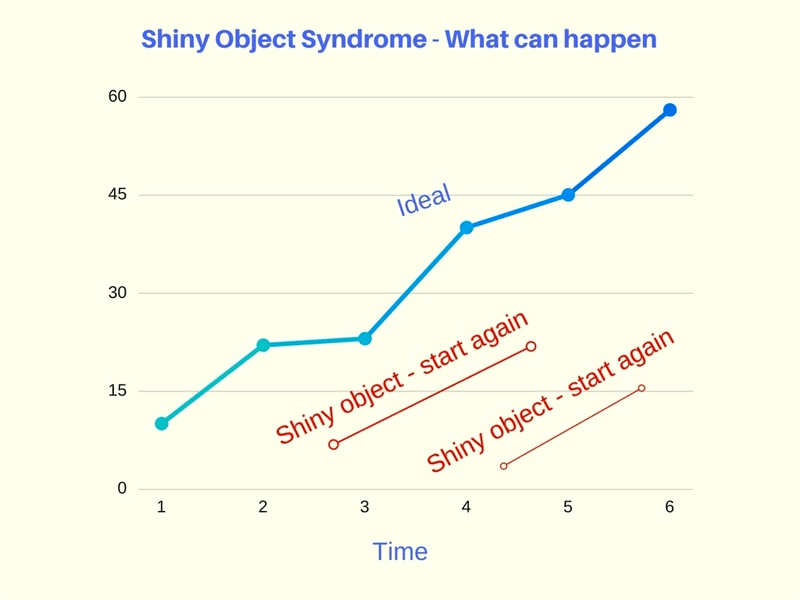
The Shiny Object Syndrome

But when you are constantly attracted to shiny objects, you never have the chance to become great at something. You’re always climbing the learning curve for each new thing you chase. (Image: Jan Sullivan)

How to Avoid the Shiny Object Syndrome: 7 Tips

So how can you stay focused and avoid the shiny object syndrome?

  1. Understand that new does not mean better. To be clear, addressing the shiny object syndrome is not about ignoring every new thing. In today’s world, it is important to keep in touch with the latest trends and updates. However, when all you do is follow every new tool and idea, you waste your time chasing trends rather than getting things done. Understand that new doesn’t mean better. Just because a company just launched something new doesn’t automatically mean that it’s better.
  2. Learn to see past the hype. There are constantly new, shiny objects in the online world. New startups, new products, new services. On social media, seeing raving reviews creates a mob mentality where you feel the need to jump in and follow what others are doing.

    But see past the hype. While people may brag about how great a product/service is, what’s good for others may not be good for you. Even though a company can promise the world on what their product can do, many startups, ideas come with birthing pains and issues. Rather than jump headfirst into something, question how it fits in with your priorities.

  3. Assess its fit with your work (and life). Before jumping into a new idea or tool, assess its fit with your work and life. Don’t follow what others are doing just because it’s the hottest thing now — it’s not sustainable. Ask yourself,
    1. Is this what I really need?
    2. Will it add value to my work and life?
    3. What are the pros vs. the cons of doing this?

    Only do something if it’s what you need and it adds genuine value to your work and life. Just because others are doing something doesn’t mean you have to.

  4. Improve your signal-to-noise ratio. The best way to manage distraction is not through discipline, but by managing the sources of distraction. When you are part of groups and newsletters that keep recommending new products, new offerings, it disrupts your focus and train of thought. You have to deal with the mental load of looking up each recommendation, assessing if it’s good for you, and making a decision about it. This is known as cognitive load, something that I mentioned in my How to Say No podcast.

    Instead of sieving out noise which takes up precious mental energy, remove low-quality information sources. Evaluate your social media news feeds, Facebook group memberships, email subscriptions, and RSS feed subscriptions. What is your noise-to-signal ratio for each channel? Noise refers to information that’s irrelevant to you, while signal refers to information that’s useful and relevant. A high noise-to-signal ratio means the channel has a high proportion of unhelpful, irrelevant suggestions (noise) vs. helpful suggestions (signal). Unsubscribe from groups and newsletters with a high noise-to-signal ratio. Get your information from sources with a high signal-to-noise ratio instead.

  5. Understand the concept of switching costs. Even though there are new tools released all the time, I only look into a new tool when (a) it has something that my current tools can’t provide, and/or (b) there are very strong reviews from multiple sources. Otherwise, I simply take a cursory glance at what’s available and return to my work priorities.

    One reason is that when you shop even though you don’t need anything, you’re invariably going to end up buying something. The second reason is switching costs, which are invisible costs incurred as a result of switching to something new. Switching costs can be monetary. They can be the time taken to learn a brand new system. They can also be the mental cost of changing your focus. When you keep switching to new ideas, new projects, and new tools, you are just incurring switching costs all day long and getting nothing done. Always factor such costs in when you are enticed by a new idea or tool.

  6. Adopt a “wait and see” approach. When you’re unsure, it helps to adopt a “wait and see” approach. With rapid technological changes today, many tools tend to become obsolete after a couple of years. For example, many WordPress plugins are no longer supported or have died out. Products that claim to be the best often get replaced by better products one to two years later.

    My personal approach when I feel 50/50 about something is to wait and see. If it’s a new tool, I take the chance to look at the company’s background, preview the tool, and assess if I really need it. For new online tools, there are often integration issues and unknown bugs, and it can be costly to be an early adopter if you already have a live business with customers. Unless this is something that I need to use now and I have no other alternative, I find that “waiting and seeing” a much more prudent approach.

  7. Differentiate between shiny objects and real opportunities. Last but not least, learn to differentiate between shiny objects and real opportunities. Shiny objects are things that look good and exciting, but are really distractions at the end of the day. There are many new products these days that look promising but don’t add value to your work and life. By the time you are done with it, you realize you have no need for that tool — after which you get distracted by another shiny object.

    Keep a watch out for real opportunities — and be ruthless in saying no to shiny objects. Real opportunities make a real impact in your work. For example, tools that dramatically improve your workflow. Tools that help you grow your business. Tools that help you better engage with customers. Tools that help you deliver better products and services.

Have you been distracted by shiny objects? It’s time to get your focus back on. Get clear on your big rock priorities, invest your 10,000 hours, and pursue ideas that make a real change. Let’s get a move on and work on our real priorities! 🙂

Read:

The post The Shiny Object Syndrome: How to Stay Focused and Stop Getting Distracted appeared first on Personal Excellence.

Read More