
Are You Planting the Seeds for Your Future?

Last week, I was researching a software tool for my business. After reading raving reviews, I decided to try it out. So I posted an inquiry in their forums.

Imagine my surprise when the CEO, Deep, responded to me personally with “Celes, you probably don’t remember but you coached me during some of my tough times. You and Tony Robbins helped me tremendously. You helped me do the limitless. 🙂 ”

Surprised, I quickly scanned my memory of the clients I worked with and realized it’s a coaching client whom I worked with in 2009! The details started flooding back. Deep signed up for my coaching back in 2009, which was 8 years ago. At that time he was a manager in a top bank but felt empty with his work and life. He was also feeling negative and low in confidence. During our sessions, we worked on finding his life direction, creating his career vision, and building his business plan, among other things.

After our sessions ended, Deep left his job and freed himself from his baggage. He traveled for a year, evolved to be a different person, and then started to build a product, which led him to create his software company today. With over 15 million client orders processed, it is helping thousands of business owners today with their businesses and the rewards of his labor are paying off!

Planting Seeds

When I looked back at our coaching logs, it’s remarkable to see Deep’s vision manifested into reality:

  • His life vision: “To generate enormous wealth used to help the human community.”
  • His business vision: “To make awesome tools, information products, and online marketplaces to help small business owners across the world. To be a preferred choice for all our clients, customers and partners.”

That’s exactly what he is doing now.

It got me thinking about the concept of planting seeds. How a seemingly small action can blossom and lead to some unimaginable, amazing outcome later.

For Deep, when he decided to act on his emptiness in life, he didn’t have a grandiose plan to start a world-class business. He just wanted clarity on what to do next. He had planted his first seed — to act on his unhappiness. His second seed was when he took the leap of faith to sign up for my coaching. After all, he didn’t know me personally, and the only thing he knew about me was through my articles.

During one of our sessions, I told him: “Don’t restrict yourself with your situation in life. Don’t worry about whether something is possible, realistic or logical. Just imagine this as your anything-goes menu where you can order anything you want from the universe.”

This really struck Deep deep (no pun intended). Following this direction, he opened his heart, wrote his vision and was extremely inspired by what he wrote. This was the third planted seed. Subsequently, we discussed other things during our calls, including his goals, values, and plans. These planted seeds would germinate and grow into his software company today, with him being the CEO of a team of 12 employees across the United States and India.

It is the same for other goals in life. Every goal, no matter how big, starts off as a seed:

  • Dating — You want to meet the love of your life. It starts by clearing your limiting beliefs surrounding love. Then opening your heart to others. Then meeting new people. Then building relationships. Then assessing the right guy/girl, if the connection is for you. These are some of the things I teach in Soulmate Journey, my course on finding love, and some of my participants have been updating me on their new-found relationships and upcoming nuptials.
  • Friendship — Having best friends you can rely on doesn’t happen overnight. It starts by being there for others first. Giving without expecting to receive. Being responsive. Making the effort to maintain your friendships. 
  • Health — Having good health doesn’t come from exercising and eating healthily for one single day. It’s something that you build over time. Choosing healthy over unhealthy food each day. Choosing to be active. Many seeds planted over a long period, every day.
  • Family — Having positive family relationships takes time, especially if your family relationships aren’t perfect to begin with. Caring for them. Doing little acts of kindness. I had a client who made the decision to work on her estranged relationship with her mom. One year after our coaching, their relationship is now in a much more positive place, where they talk with love and understand each other more.
  • Career — Getting an amazing job doesn’t happen overnight. You have to first plan your career. Build your skills and talent stack. Then network and build relationships with industry peers, recruiters, and headhunters.
  • Business — Same for a successful business. It starts with a vision. Then taking an endless series of steps to build your empire. Making endless iterations, adapting every second. Being open to failure and criticism, because these will always be there no matter what you do.

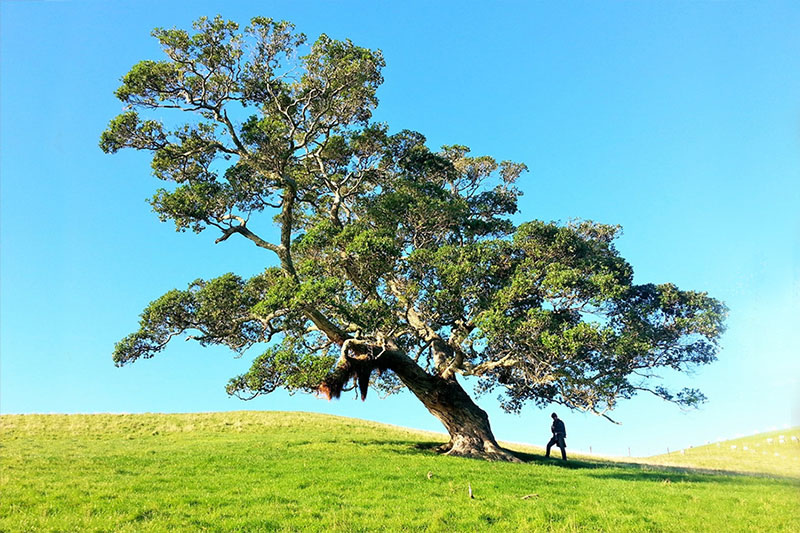
For each seed, you nurture it by giving water, warmth and sunlight. As you do that, it grows into a seedling. Then a sapling. Then a tree.
Big tree

(Image: Gilly Stewart)

The tree here refers to what you want to achieve — run a successful business, have a great career, have a great relationship, have great friends, have great health, be financially abundant, be a prominent figure in your field, have your TV/talk show, move overseas, travel around the world, or some other goal.

The seeds here refer to your first steps to make your goal happen.

Many people often look at the trees, wondering when they are going to get that. Nice, big, gorgeous trees that they want in their garden.

But that’s missing the point. The critical point is not the manifestation of the trees, but the planting of the seeds. Because when you are not planting seeds, how can the trees grow in your backyard? How can you expect to get results, when you have not put in the effort to get things moving?

Corn seed, planted on soil

Corn seeds, ready to be planted into the soil (Image: Mohammed Anwarul)

Planting Seeds in Your Life

This brings me to these questions:

  1. What goals have you been meaning to pursue, but are putting off? In Love? Health? Carer? Business? Family? Friendships? Pick two areas.
  2. What is the first seed you can plant to get it going?
  3. How about the next 3 seeds? What can you do to keep this momentum going?

Say you want to switch to a career in Machine Learning. However, your past experience and skills are not in this area. A possible seed you can plant is to take up a course in Machine Learning. I have a friend who is doing a two-year Masters course in Machine Learning for this very reason — to switch to this field after he graduates. 

If you have an aptitude for programming, you can self-learn with free materials online and tools like TensorFlow. You can develop open-source tools using machine learning, get user feedback and market results (e.g. X number of downloads, featured on XYZ magazine), and highlight these achievements in your resume as validation of your skills in this area. This is exactly what my husband did in the past year, though in a different field, and he’s now able to pivot and switch his career to this new field.

Or say you want to get married at some point. You are 35, single, and constantly tied up with work. Maybe a good first step is to draw some boundaries with work. Stop working all the time and create a cutoff. Set aside a few hours each week to meet new people. Examine if you have inner blocks to love, which is very common for long-standing singles, and engage a coach to help you address these blocks. Staying immersed in work, without opening yourself to others, will not help you get into your dream relationship.

Not all the seeds that we plant will blossom. Sometimes there are seeds that just don’t germinate. For example, when you reach out to a friend to build a connection, but it’s not reciprocated. When you want to build a relationship with someone, but he/she is not interested. When you start a project and put in the due effort, but it doesn’t turn out the way you want. When you try to help someone, but get a negative or lukewarm response. When you open your heart and trust someone, but he/she bites you in the head.

But that doesn’t matter. Not all actions will lead to results. But some will. The goal is to plant as many seeds as possible in pursuing your goal. To plant the right seeds by getting advice from the right people and sources, because these shape your day-to-day thinking and long-term direction. To create so many avenues and possibilities for success, that success is imminent. To never stop taking action.

So… what seeds do you need to start planting? Can you get started right away today? Because the sooner you plant your seeds, the sooner you water them and care for them, the faster they will germinate, grow, and blossom into the beautiful trees you are looking for. 🙂 And how your future will be, 10, 15 years down the road will be shaped by the seeds that you plant today.

Be sure to check out: 

The post Are You Planting the Seeds for Your Future? appeared first on Personal Excellence.

Read More

How A Grounded Pilot Used Meditation to Fly Again

Carl Eisen was at the height of his career in the fall of 2007. An Airbus A300 captain in his mid-forties, he was confident and assured, with more than 10,000 hours of experience in the cockpit. His profession required calm, unflappable, singular focus, and Eisen was proud of his ability to perform complicated maneuvers under extreme stress.

Then he bought his wife a new horse trailer.

“I was towing it with my truck to have electric brakes installed,” he remembers, “and as I was driving down the road, I thought, it has no brakes, maybe I’m going a little fast—” and as if on cue another vehicle pulled out in front of him, cutting him off. Eisen managed to get his truck and trailer under control and safely off the road, but as he sat there in the immediate aftermath of a near wreck, adrenaline pumping, he had a terrible realization. “I didn’t really feel any different than I did any of my other waking hours.” Eisen had been living in a constant state of heightened alert, unable to turn it off.

“Pilots are expected to be superhuman, to suppress feelings of anxiety.”

He made an appointment with his doctor, hoping he had “a heart condition or brain tumor,” he says, knowing that a prescription of antidepressants and therapy would jeopardize the job he loved. “Pilots are expected to be superhuman, to suppress feelings of anxiety.”

A pilot who is diagnosed with depression or anxiety and doesn’t disclose it to their airline is at risk of prosecution from the Federal Aviation Administration. A pilot who’s diagnosed and does disclose it faces immediate grounding.

Eisen was grounded for a year. He took antidepressants and explored cognitive therapy, and when he still felt anxious after nine months, he found his way to insight meditation. “I understood immediately that that’s what had been missing.” He meditated for twenty minutes a day and after a month his “anxiety level was almost to zero.”

Staying Cool When Instruments Freeze

Eisen soon had ample opportunities to practice his new mindfulness techniques on the job, and one of the most dramatic came on a hot summer afternoon in 2014, when he piloted his Airbus A330 through a line of thunderstorms as he departed Dallas for Newark. “Almost immediately, the needles on two of my airspeed indicators started fluctuating, then slowly dropped to zero.” Eisen, like all Airbus pilots, is well-trained for this. There’s a procedure pilots are required to commit to memory. “The first item on that checklist is Disregard All Airspeed Indications, because you don’t know which ones are correct.”

Eisen followed the procedure and took the engine power to 84 percent. “Then, to my surprise, the other two remaining airspeed indicators showed that we were slowing down. But were we actually slowing down or are they icing up too?” Mindful of the checklist that says Disregard All Airspeed Indications, Eisen waited and watched, but the situation didn’t stabilize as the procedure indicated it would, and his intuition told him the plane was indeed slowing down. He bucked the procedure and bumped the engine power up to 87 percent. “At that point I became a test pilot, abandoning a mandatory recovery procedure. I had no way of knowing exactly HOW fast we were going. If I put in too much power I risk overspeeding, losing control and/or breaking the plane apart in mid-air. But If the two remaining airspeed indicators are correct, I really AM slowing down to the point of a stall, which means the plane stops flying and starts falling out of the sky.” With autopilot off and turbulence tossing the plane in all directions, Eisen tuned in to the feeling of the plane. “I could feel the air flow burbling over the wing. That’s a sure sign—we’re on the verge of stalling!”

So Eisen free-styled—and called on his mindfulness training. “Rather than get wrapped up in figuring out the details, I remembered one simple fact about the 160 tons of aluminum I was piloting: If you cut the power to zero and pitch the nose down 2 degrees, you can hand-fly without any airspeed indicators at all and stay in the normal speed range making the jet one very expensive glider.”

Eisen knew from experience that would allow him to get control of the plane. Sure enough, the iced-up systems started working again in the warmer air, and Eisen and his co-pilot were able to emergency-land without further problems.

A subsequent investigation revealed that it would have taken 90 percent engine power to stabilize the aircraft. “If I had fixated and followed the procedure to the letter, we would have stalled and lost control.” When the unexpected happens, and the prescribed procedure fails, Eisen says, “you need to be present for what IS and not stuck in stories about how things SHOULD be. Non-reactivity and non-fixation (open and inclusive awareness) really help me exercise discernment. Meanwhile, improved concentration and focus free up working memory so I can think more clearly, in a less distracted way.”

Coming Out of the Meditation Closet

Despite the transformational effect of his meditation practice in his own life, personal and professional, Eisen kept it to himself. And he might have continued as a “closet meditator” if Andreas Lubitz had not crashed a Germanwings airplane into the Alps in March 2015.

“I thought if I can’t talk about this openly, we are not going to make any progress for pilots’ mental health. If I have to become the poster child, I will.”

But Eisen discovered no one wanted to talk about it. “The letters I wrote about my own experience” —letters he sent to his airline and union— “they wouldn’t even respond to me.”

So he continued his own studies with Diana Winston, Director of Mindfulness Education at UCLA Semel Institute’s Mindful Awareness Research Center (MARC), and became certified as a mindfulness teacher. He started mindfulaviator.com, an online resource that demystifies meditation and makes it accessible to airline pilots. He connected with Matt McNeil, a commercial pilot and mental health professional who started an organization called Lift Affect to offer mental health services to pilots. And he noted that although pilots and other crew were using mindfulness apps on their phones, and were receptive to his message, the real resistance came from airlines, the unions, and the Federal Aviation Administration. “My experience with trying to introduce mindfulness to the airline industry is the sound of doors slamming all the way down the hallway.”

The skills and abilities that make pilots able to fly a 300,000-pound aircraft through inclement weather with ease can also be their downfall.

Eisen says those doors need to open. A recent study indicates that 13.5 percent of the 130,000 pilots surveyed meet the threshold for depression. “That study should have been a wake-up call, the Germanwings flight should have been a wake-up call. The approach the airlines are taking is very old fashioned.”

Meanwhile, Eisen says, the grassroots effort made by him and a few others is taking off, and not a moment too soon.

“When we deal with pilots, when they finally do come forward, they wait until their ass is on fire. They wait until they’re on the roadside bleeding out before they come for help. I was one of those guys, too.”

Eisen says the effects of mindfulness meditation are particularly acute for pilots, who tend to be goal-oriented. “Attachment to outcome is one thing pilots are into, we create certainty in our minds. It’s essential if you’re going to become a pilot, but you don’t know how to disentangle yourself from that in the rest of your life.” The skills and abilities that make pilots able to fly a 300,000-pound aircraft through inclement weather with ease can also be their downfall.

“The first time you check out an airplane it’s massive and intimidating, but like anything else, you become accustomed to it. But there’s a level at which we’re fooling ourselves. We should be in awe all the time. After all, one mistake and it can kill you and everyone on board,” Eisen points out. “But with mindfulness practice, I find that the experience of fear regarding a future task is optional. Some people use fear to motivate themselves, to give themselves an edge or to remain hypervigilant. I used to do this myself. Now I choose curiosity and wonder. I’m in awe of the machine and grateful for the people who make it all work so reliably and safely. Gratitude and awe, without fear, give me lots of motivation and comes with a more open and inclusive awareness.”

Eisen hopes talking openly about mental health will someday be as common among pilots as any other topic. “With the drug and alcohol program, they introduce it at training. But we do not have conversations about mental health in training. We just need to have the conversation for real, out in the open.”

The post How A Grounded Pilot Used Meditation to Fly Again appeared first on Mindful.

Read More

How to Program Yourself for an Amazing Relationship

Everybody wants a meaningful and lasting relationship. So, why does there seem to be such a scarcity of great relationships these days? Is there some way that we could be better prepared before we take a big relationship plunge?

While every relationship has its own unique complexities, I believe that what we bring into a relationship emotionally is crucial to the success of that relationship. Too many people make a commitment to another person without being emotionally aligned with the reality of that commitment. They are still thinking like an individual instead of a couple.

When one becomes two it’s time for an upgrade

When we decide to settle down in a relationship, we need to change the way we think.  We need a different kind of internal program if we want to enjoy all the benefits of a relationship that can go the distance. When we are single, it’s easy to be centered on ourselves because we live in a simpler, more singular world.  Function on that singular level is not very complicated.

To be part of a lasting and supportive relationship, we need to expand our thinking because life gets a bit more complicated and requires a program with greater capacity. That means it’s time for an upgrade. To succeed in a relationship, we need to reprogram the way we think about life. If we do it right then life gets better, more meaningful and rewarding.

Out with the old, in with the new

Anytime we raise the bar of expectations in any area of our lives, we need to upgrade our internal programming.  Those who choose to stubbornly stick to their old way of thinking can’t experience meaningful growth.

If we want to accomplish something extraordinary, like a truly successful relationship, the place to start is internally.  Our old way of thinking got us where we are, and that was what it was designed to do.  But now we are ready to move on, to grow and expand our world and reach out for more.

Know what you want

When a computer programmer decides to create a new program he always has a reason, an objective.  Programs are designed for very specific purposes.  If the programmer doesn’t understand what he is trying to accomplish, how can he design the right program? Likewise, before we can change our thinking, we need to have a clear understanding of what we intend to accomplish, and why.

Let’s go back to our single person who wants to build a relationship.  For the sake of discussion, let’s just say he’s a single guy who has enjoyed living on his own for the past five years. Now he’s met someone really special and as the relationship grows he wants to take it to the next level.

The relationship shift

Now his internal focus has shifted to include another person and his mental reference point has changed from me to we. At this point his life needs to be played by a completely different set of rules because he has a whole new point of reference.

Including another person in your life means changing the way you think about everything.  It’s your life times two and then some, which means it’s at least twice as complicated.  We won’t even talk about what happens when you bring children to the mix. So why do it?  Why purposely complicate your life? Because you know that it has the potential to be at least twice as rewarding and enjoyable. You know it and you want it.

A real relationship needs a serious commitment

Here’s a chapter from my own life. I didn’t get married until I was in my thirties, and the reason for that is – I only wanted to do it once and I wanted to make sure that I did it right.  My dad had drilled it into my head as a kid, “don’t make promises you can’t keep.”  I knew that marriage would be one of the most serious promises I would ever make, and I wanted to be sure that I could keep my word.

So I waited.  I waited until I met somebody I knew I could not live without.  Obviously, I wanted it to work.  Realizing that there are certain things that can quietly undermine a marriage, I wanted to make sure that these things were handled before I made a major commitment to our relationship.

Leave the baggage behind

One of the subtleties that will unravel the fabric of a relationship is when someone carries a fantasy about a past flame. I’d seen it happen to other marriages, and I wasn’t about to let it happen to mine.  So I did a little self-examination to see if I was harboring any fantasies of this sort.  I made sure that each memory of past relationships included complete closure.

For a single person, perhaps such fantasies aren’t considered harmful.  But they can spell disaster for a marriage because every time there’s a disagreement you can escape into the fantasy of “what if.”  This may seem like a small change and obviously there were others that needed to be made as well.  But 27 years later, here I am, still married to the same, wonderful woman.

Channel your emotional power

So, why was I motivated to do this self-examination and to root out any little problems that I found?  Because my emotions were fully engaged and I was highly motivated to make whatever changes were necessary.  I knew that I wanted to build a  relationship that could go the distance, and I wasn’t about to let anything stand in my way.

In this crazy world, a truly meaningful relationship really is an extraordinary thing.  If that’s the kind of relationship that you want, then you need to be willing to upgrade the thinking that drives your behavior. You need to program yourself for a relationship that will bring genuine joy and meaning to your life.

How well is your internal relationship program serving you?
What do you think is the most important quality in a relationship?
Share your thoughts on facebook or google+

If you enjoyed this article consider email updates!

Ladies, want to know how to rewire your man’s brain so he will pay more attention to you and treat you better? You’ll want to read this article.

The post How to Program Yourself for an Amazing Relationship appeared first on Advanced Life Skills.

Read More

Do Yoda Proud: Meditation 101

  Meditation refers to a state where your body and mind are consciously relaxed and focused.  Practitioners of this art report increased awareness, focus, and concentration, as well as a more positive outlook in life. Meditation is most commonly associated with monks, mystics and other spiritual disciplines.  However, you don’t have to be a monk…

Read More

How to Build an Edge: Develop Your Talent Stack

Talent Stack

Talent stack is a concept coined by Scott Adams, creator of the Dilbert comic. It’s the idea that you can combine normal skills until you have the right kind to be extraordinary.

An example is Scott himself. He’s not the best artist — there are better artists than him. He’s not much of a business expert — there are more savvy experts. He has never taken a college-level writing class. Yet, he created Dilbert, a famous comic strip that appears in 65 countries.[1] Scott is said to have a net worth of $75 million, majority of which comes from Dilbert.[2]

As he says, “When you add in my ordinary business skills, my strong work ethic, my risk tolerance, and my reasonably good sense of humor, I’m fairly unique. And in this case that uniqueness has commercial value.”

Understanding how a talent stack works is important. Normally, people think that success comes from developing talent in one skill. This works well in some fields. In medicine, the natural progression is to pick a specialty. In sports, you train to become best in your field, like Tiger Woods (golf) and Michael Jordan (basketball). In acting, you develop the best acting chops, like Robert De Niro and Morgan Freeman.

But besides becoming world-class in one skill, talent can come from having a unique stack of skills that no one else has. You can utilize different skills to create value in a way no one else can, thus becoming one-of-a-kind in your own league.

More Examples of Talent Stack

Lisa Elfridge is a celebrity make-up artist on YouTube. She was already known prior to starting her website and YouTube channel. But after she started her channel focusing on beauty and makeup tips, her authority and success rose to a whole new level.[3]

Reason? She is one of her kind in her field.

  • Celebrity makeup artists work with their clients for photo shoots, appearances. They don’t publish their work online. Most of their self-marketing happens offline, through networking, connections, etc.
  • On the other hand, online makeup gurus generally show how they do their own makeup. But they are not professionally trained. They cannot give professional advice on what is the best makeup for different skin tones, or for skin that is not like theirs.

Lisa has a unique talent stack to navigate the ultra-competitive beauty space:

  1. Makeup skills. She has professional makeup skills.
  2. Industry knowledge. She has real experience working with celebrities.
  3. Presentation skills. She communicates her makeup tips in an easy-to-understand way. White backdrop, no frills or production gimmicks. No music. Just her and her beauty tips.
  4. Video creation skills. She knows how to create professional-looking videos, or at the least she hires people with the right skills.

People in the celebrity makeup world have the first two skills. Online makeup gurus have the latter two skills. But Lisa is able to harness all four skills, hence becoming extraordinary in her field. That’s her talent stack.

Example: Blogging

When I started my blog, I was not much of a writer — I have never taken a professional writing class. I have average web design skills. I have good marketing and business strategy skills. I have very strong analytical skills. And I have a strong passion for growth.

Put these together and I was able to create a coaching business that thrives despite stiff competition. My blend of skills is strong enough to stand out in the market:

  1. Marketing and business strategy. Most web business owners do not have professional marketing knowledge. What was common sense to me, in marketing my business, was alien to everyone else. After entering the field, I realized no one really knew what they were doing in terms of business strategy and management. Many bloggers were just randomly blogging but no one was thinking about their blog as a strategic platform for their business, not until the 2010s when the commercial potential for blogging became obvious.
  2. Design and coding. Many web business owners do not have web design or coding knowledge. In the end, they get stuck with technical issues as running a web business has become super complicated today. You can hire a designer but you get stuck in the to-and-fro and trying to convey your ideas to them. Even when paying high fees for good designers, there’s still a gap between intention and execution. And that’s not even talking about ongoing maintenance which is part of any website today.
  3. Coaching. My coaching has a unique edge because I can analyze and break down intricate problems, with a focus on solving issues by tackling their root cause. On the other hand, most coaches provide surface solutions and some form of emotional support, but their clients continue to deal with the same problems becauss the root issue is never addressed.
  4. Writing. I am an average writer, but at the very least my writing is passable and good enough for blog articles. I’m also constantly working on my writing skills.
  5. Analytical skills. For everything else, my ability to learn and analyze things helps me fill the gap.

Since starting my blog, I have built new skills to further stand out from the competition: public speaking, podcasting, video editing, and networking skills. With a diverse mix of skills, I’m able to stay ahead despite constant market changes.

How a Talent Stack Works

A talent stack works in this way:

  • You leverage on the skills that you have to create an edge. Marketing, networking, technical, design, etc.
  • Even if you don’t have a skill, you can learn it to set yourself apart from others.
  • You mix seemingly normal skills together and become extraordinary in your own right.

Example: Recruitment

Let’s say you are a software engineer. You are great in your field. You design and develop software with ease. However, you are stuck in a job that pays you almost the same amount every year.

Many software engineers are technically competent but lack the savviness to market themselves. They are simply not taught how to market themselves in engineering and computing classes. A possible talent stack here can be:

  • Technical. You already have this skill if you’re a software developer.
  • Networking. You form positive relationships with people across the organization. You have high visibility among the management. You form relationships with recruiters, headhunters, and peers in different industries to expand your job options. You know how to use Linkedin to connect with industry peers and get potential job offers.
  • Presentation. You can present yourself well, and your ideas eloquently.
  • Marketing. You know how to market yourself and sell your strengths. Your resume is filled with achievements but not responsibilities. You know how to present your skills and job history in the best way.

You don’t need to be the best in networking/presentation/marketing. Just knowing some networking, presentation, and marketing skills puts you at a sweet spot, ahead of others. Because everyone else (in your field) lacks these skills.

One of my recent clients is a technical developer. In the past year, he learned different technical skills (that are emerging in the market now) to widen his skills set. Doing so increased his appeal as a job candidate. At the same time, we worked on his self-marketing skills — giving his resume an overhaul, focusing on achievements rather than responsibilities, learning to position his skills and capabilities. He also began networking — with recruiters, headhunters, industry peers — to get himself out there.

In the end, he got a job offer that paid him 60% more than his previous job.

If he didn’t upgrade himself, chances of such an attractive job switch are virtually zero. He would be locked in his current company, subjected to the offer presented by his company. In fact this was what happened in his previous jobs. But because of his skill sets, he can navigate the industry easily and get the best offer. He’s not the best marketer. He’s not the best networker. But having decent skills in these are enough to put him ahead.

The goal of a talent stack is to stack different skills to create a sweet spot. A sweet point that dramatically raises your value in a competitive field. This applies whether you are a blogger, salaried employee, business owner, baker, software developer, coach, or something else.

3 Questions to You

My questions to you:

  1. What industry are you in? Blogging? Health and fitness? IT? Coaching? Online business? YouTube? Others?
  2. In your industry, what skills do people compete on?
  3. Given that everyone has these skills in #2, what new skills can you learn to 10X your market value?

Another Example: Music

For example, electronic music tends to be very loud music that is used for raves, nightclubs, and festivals. Kitarō is different. He uses electronic and other instruments to create instrumental, East Asian music that is soothing and pleasing to the ear. In the American music industry, his music is a refreshing change.

He is not the best synthesizer player. He’s not the best flute player or drummer. But his ability to integrate western style of music with eastern elements makes him one of the most prominent musical acts of New-Age music, with more than 100 million copies of his 50 albums sold worldwide.[4] Kitarō’s talent stack lies in his synthesizer skills, his general knowledge in music (self-taught), his familiarity with the Eastern culture (he was born into a family of Shinto-Buddhist farmers), and his connection with nature (he lives in the mountains to get inspiration for his music).[5][6][7]

Wrapping Up

What new skills can you learn? If you have absolutely no idea what to learn, some true-north skills that are great for stacking are:

  • Public speaking
  • Marketing
  • Coding (Because the world today is so digitized)
  • Social media marketing
  • Business management
  • Whatever you are passionate about

Again, you don’t need to be the best in every skill. Simply learning a new skill opens up so many options. For some, learning and combining different skills may be the answer to discover your passion and talent — rather than something that you discover by sitting around and waiting for life to happen.

Read:

The post How to Build an Edge: Develop Your Talent Stack appeared first on Personal Excellence.

Read More